

Highlights
In this blog, you will learn why AI-generated code, despite its speed, often introduces ambiguity, risks, and technical debt. It explains how Spec-Driven Development (SDD) solves these issues through clear, machine-readable specifications that guide architecture, code generation, and testing. You’ll explore SDD’s core workflow, maturity levels, real-world use cases, team transformation, adoption criteria, and actionable steps to get started with this engineering approach.
It’s fair to say that we are currently living in a strange paradox of the software engineering world. Why? Well, on one end, AI coding agents are seamlessly generating functions, API handlers, UI components, test suites, etc., in seconds (tasks that once took hours or days for developers). However, on the other hand, these AI agents may sometimes hallucinate, misinterpret logic, overlook edge cases, and produce vague output that was never asked for.
I understand that businesses wish to ship faster, scale, and modernize faster than ever. But flawed AI-generated code creates technical debt at lightning speed, introduces hidden risks, breaks compliance rules, and slows teams down. Finally, organizations end up spending more time fine-tuning, refactoring, or rewriting that they save from leveraging AI tools in the first place.
To address these roadblocks, spec-driven development (SDD) emerges as the perfect answer. That is, rather than relying solely on raw prompts or allowing AI tools to interpret inputs, SDD centers structured specifications – comprised of clear, validated, and machine-readable intents – within the development lifecycle.
To clarify the concept, I’ll now provide an introduction to spec-driven development.
What is Spec-Driven Development and Why Does it Matter Now?
Spec-Driven Development (SDD) is an engineering method that relies on executable specifications as the only source of truth regarding system behavior, architecture, and implementation requirements.
Unlike regular documentation, which explains in natural language what the system should do, SDD specifications are formal, machine-readable artifacts that describe system behavior to such a high level of detail that code generation, validation, and testing from the specification itself can be automated.
To answer the second part, here are the major factors that call for SDD’s intervention now:
- AI Code Generation: AI-generated code has advanced to the point where the speed of development now depends on knowing what code to write, rather than just typing it out. With AI agents able to create entire microservices, the main limitations are specifications.
- System Complexity: The complexity of modern systems, led by microservices, event-driven architectures, and distributed computing, has made it almost impossible to transfer implicit knowledge between team members. That is, architectural details can no longer be relied upon to exist only in developers’ memories or in traditional documents.
- Dynamic Requirements: The stability of traditional requirements has diminished over the years due to rapid market changes and agile methodologies. Specifications must now act as living documents that adapt alongside system requirements, rather than static artifacts (those created at the beginning of a project).
So, spec-driven development (SDD) addresses these challenges while transforming development practices to leverage AI capabilities, maintain architectural integrity, and enhance development velocity.
Wondering how SDD works? Let me break it down for you in the next section.
What Does the Core Workflow of Spec-Driven Development Entail?
At the core of SDD lies a clear workflow based on the principle of intent and not interpretation. Here’s the overview:
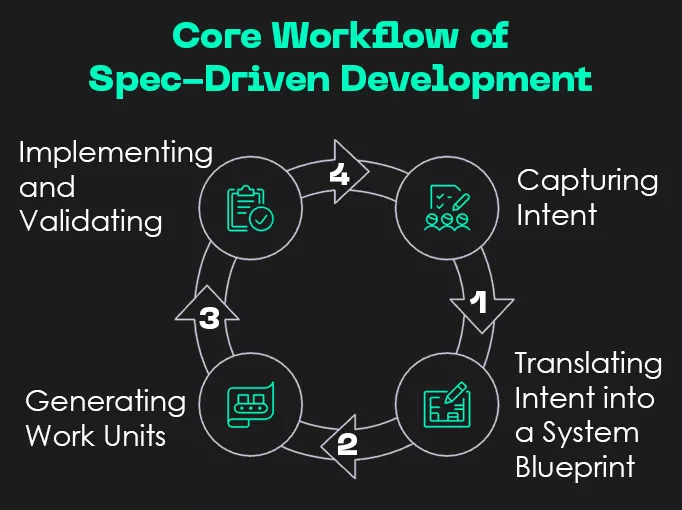
Fig: Core Workflow of Spec-Driven Development
1. Capturing Intent: This step involves understanding what needs to be built and the reasons behind it. It includes identifying business goals, user requirements, functional expectations, and domain-specific rules, all captured in a structured, machine-readable manner.
2. Translating Intent into a System Blueprint: During this step, abstract intent is converted into a concrete specification, covering features like high-level architecture, domain models, and APIs. This blueprint provides clarity and serves as the foundation layer for all subsequent tasks.
3. Generating Work Units: Next, the blueprint gets divided into executable units such as tickets, tasks, and API endpoints. These units then streamline the development process and ensure alignment across teams. This helps AI agents generate code linked to them.
4. Implementing and Validating: This is the final step where AI agents create code based on the given specifications. Developers review and validate the code (human in the loop) through automated and manual testing. This ensures that it matches the intended specifications. Moreover, any discrepancies can be immediately rectified.
Such a workflow minimizes ambiguity, reduces rework, and keeps AI outputs accurate, focused on real business needs.
Well, spec-driven development isn’t a one-time leap; it’s a progression through three maturity levels. Keep reading to learn about them.
What Are the Three Key Maturity Levels in Spec-Driven Development?
Here are the three key maturity levels in spec-driven development:
1. Spec-Aware Development: In this case, teams rely on structured specifications as their main resource during development. Although they might still code manually, specification is the main guiding principle. In this case, AI tools may be used for small, spec-informed tasks. This level helps to reduce misunderstandings and change communication without altering the workflow.
For example, a team building a payments API may manually refer to an OpenAPI spec to ensure every endpoint follows the agreed contract.
2. Spec-Led Development: In this case, the specification not only shows the roadmap but also is the main source of control for development. AI agents or code generators read the spec and come up with code, tests, and scaffolding that are well-grounded. Meaning, developers get to play the roles of reviewers, validators, and integrators instead of being the primary code authors. This speeds up delivery time while reducing ambiguity.
For example, developers may upload an OpenAPI spec, and an AI agent may auto-generate controllers, models, and test cases, which the team can review and refine.
3. Spec-as-Source Development: This can be labeled as the greatest form of SDD. The specification here is the single source of truth for the whole development lifecycle. Code, tests, documentation, and workflows are all derived from the specification and developed in alignment with it. That is, when the specification changes, the entire downstream ecosystem is updated automatically or semi-automatically.
For example, when a product manager updates the OpenAPI spec, the system automatically regenerates code, tests, mocks, and documentation across all services.

Explore how our unified expertise helps ISVs and enterprises achieve faster ROI and sustainable digital growth – everything powered by AI.
Keep reading to learn about three major concepts connected to SDD.
In Which Real-World Scenarios Does SDD Excel?
SDD aligns perfectly with the demands of modern engineering across three major scenarios. They are:
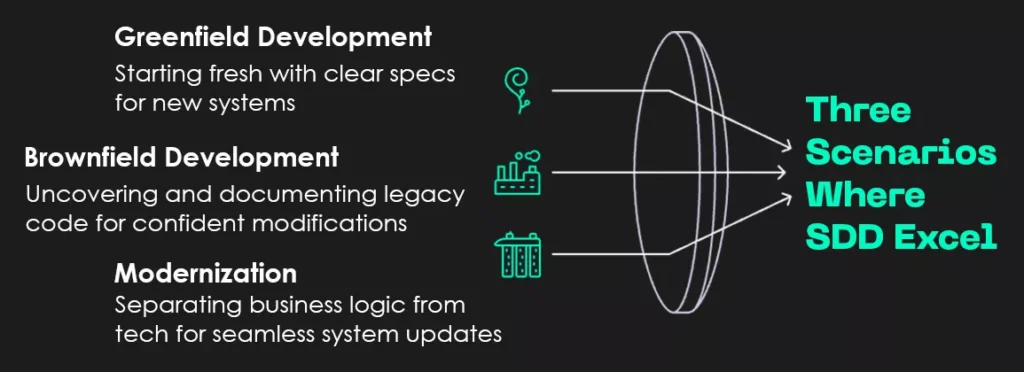
Fig: Real-World Scenarios in which SDD Excels
1. Greenfield Development: This kind of development is great for SDD. The reason? Well, you get to start clean with no legacy code holding you back. You can decide what the system should do upfront and turn that instruction into a clear spec. That spec will keep everything aligned and remove guesswork. Here, AI can help generate the first version of the system quickly.
Example: A small SaaS team can use SDD to build their onboarding module from scratch with accurate specs guiding every step.
2. Brownfield Development: This usually hides years of undocumented decisions within the codebase. SDD helps bring all that knowledge to the surface level by turning behavior into a spec. Once everything gets documented clearly, teams can modify the system with confidence.
Example: An internal tools team can retrieve specifications from the legacy HR portal, allowing them to seamlessly integrate new workflows.
3. Modernization: This becomes easier when you separate business behavior from the tech present underneath. That is, SDD lets you rewrite or re-architect systems by validating everything against the same spec. This keeps business rules intact while providing teams the leeway to adopt modern stacks.
Example: An operations team can use specs to gradually rebuild their reporting system in a newer stack while keeping outputs identical.
Note: With the surge of spec-driven development, it is evident that the role of developers has shifted from code writers to system architects. Let’s understand this shift further.
How Does Spec-Driven Development Transform Engineering Teams?
Traditionally, software teams followed a hierarchy where architects define the system, developers interpret it, and then another set of developers implement features. SDD softens these joints by placing specifications at the center of the development process.
This means: when the spec becomes the primary artifact, every developer is expected to think like an architect. Writing or refining specifications requires the same level of systems thinking that was once limited to senior technical roles.
This shift changes how developers spend their time. Now they focus less on writing repetitive code and more on understanding edge cases, defining interactions, and validating system behavior. So, code reviews have evolved into spec reviews.
This means that organizations must adapt operationally. Starting with performance evaluations, it should prioritize architectural clarity and specification quality over volume of code. Plus, teams need training to build specification literacy so developers can confidently read, write, and critique specs.
This also calls for a cultural shift. Meaning, teams need to give spec reviews the same importance as code reviews, recognizing that issues in the initial intent can have a bigger impact than problems in the actual code. By encouraging developers to enhance specifications before starting coding, organizations can achieve faster delivery, better communication, and stronger systems. And companies that embrace this approach will often see easier onboarding, fewer knowledge gaps, and improved long-term agility in their engineering efforts.
Quick question: Do you think SDD is relevant for everyone? The right answer is no. SDD isn’t suitable for all organizations or projects. Understanding its value helps avoid premature adoption or missed opportunities.
Let me help break this down next!
Who Should Adopt Spec-Driven Development?
To answer this question, I’ve divided the need for SDD adoption into two categories:
A. Organizations That Should Adopt SDD:
- Fast-scaling startups that need consistency and speed without compromising quality.
- SDD reduces misalignment across teams, locations, and product units for businesses with complex systems.
- Specs help capture legacy behavior before rewriting begins for companies facing modernization changes.
- Organizations relying heavily on AI coding agents.
- Teams facing difficulties with rapidly growing technical debt
B. Individual Contributors Who Should Adopt SDD:
- Developers transitioning into architect-like roles
- Product managers writing structured requirements
- QA engineers validating behavior against standardized intent
- DevOps teams automating workflows tied to specs
Does any of the above resonate with you? If so, look no further! I’ve outlined the steps to help you embark on your journey into spec-driven development.
How Can You Get Started with Spec-Driven Development?
Here are steps that you can follow to get started with spec-driven development:
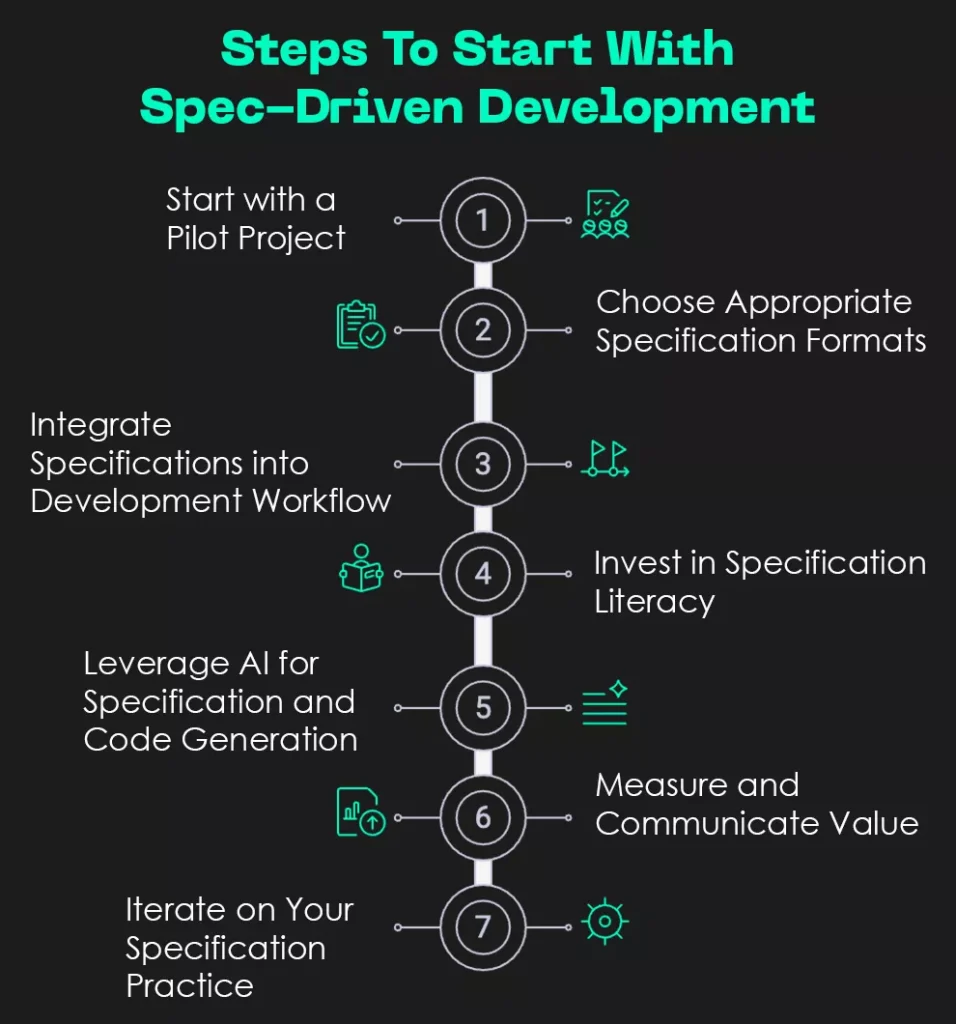
Fig: Steps To Start With Spec-Driven Development
- Start with a Pilot Project: Find a small, low-risk project and start with a 3-5 member team that can complete it in a few weeks. The project should be significant enough to demonstrate the value of the specs, but not be a vital part of the mission. New microservices or focused feature upgrades are the best. Don’t use a project with a tight deadline for your first attempt.
- Choose Appropriate Specification Formats: Choose formats that suit your system. A formal spec language is a powerful tool, but it takes some time to learn. Most teams can start easily with OpenAPI and structured markdown.
- Integrate Specifications into Development Workflow: Make it a mandatory step to spec review before the code is written. CI checks should be added so that the code remains in line with the spec. Docs and diagrams can be auto-generated from specs as well.
- Invest in Specification Literacy: Most developers are not very good at specs, thus, short workshops and collaborative sessions should be organized. Beginners can be partnered with experienced authors. Templates, examples, and light style guides can be shared to keep the work consistent.
- Leverage AI for Specification and Code Generation: AI can be used to create the first drafts of specs which can be then finalized manually. AI can generate scaffolding, boilerplate, and initial tests from the approved specs. However, human review should always be there to ensure correctness and architectural alignment.
- Measure and Communicate Value: Improvements such as fewer defects, quicker onboarding, and more accessible code reviews can be tracked. Team feedback and confidence levels should also be checked. Leadership can be informed of the results so that they can help with wider SDD adoption.
- Iterate on Your Specification Practice: The first specs may not be perfect; however, the learning and refining process should be acknowledged. A brief retrospective focused on the positive and negative aspects should be held right after the pilot. Templates and procedures should be updated, and as your team gets more comfortable, the level of specification can be increased gradually.
If you’re aiming for a seamless spec-driven development journey, here are the essential tools you should become familiar with:
- Speckit: This is an open-source CLI toolkit from GitHub that helps spec-driven development (SDD) by automatically creating structured workspaces, specs, plans, and tasks for AI coding agents. It allows the different phases like greenfield prototyping and brownfield enhancements to be continued through slash commands in IDEs.
- Tessl: This is a CLI-based framework in private beta, is the one that firmly connects code generation to editable specs as the main artifact, while generated files are marked as non-editable. It prepares workspaces for coding assistants and delves into spec-as-source SDD for exact AI-human collaboration.
- Kiro: This is an efficient, agentic IDE conceptually based on Code OSS that focuses on specs and hooks for prototype-to-production workflows. It is supported by MCP tools, steering rules, and VS Code extensions to achieve seamless AI-assisted coding.
That’s it; you’re well-equipped to start the SDD marathon!
Final Thoughts
Spec-Driven Development (SDD) faces several common misunderstandings. A frequent misconception is that SDD is merely “waterfall with extra steps.” Critics often overlook that specifications are living documents that adapt as requirements change, rather than fixed texts created at the start. Another mistaken belief is that writing specifications adds unnecessary workload.
However, organizations that implement SDD find the investment beneficial, experiencing less rework and quicker onboarding for new team members. Why am I claiming this?
The answer: Businesses that rely solely on AI-generated code without structured specs accumulate hallucinated logic, inconsistent patterns, and unpredictable failures. But those that adopt SDD will shift from code ownership – where engineers fight to keep implementations aligned to intent ownership – where specifications drive the entire lifecycle.
So, in a world where AI can generate code faster than ever, the organizations that invest in clarity, structure, and intent will define the next era of engineering.
Bonus: If you want to explore more AI-driven tips, roadmaps, and best practices for integrating AI into your projects, contact us at Nitor Infotech, an Ascendion company.