

Highlights
One of the most significant shifts in product engineering is the collaboration between humans and AI agents that now spans practically every stage. This blog describes the ways in which AI augment human capabilities, how the engineering lifecycle gets redefined, and the importance of four collaboration dimensions in creating contemporary products. Besides that, it discusses the roadblocks that are frequently faced by product engineering teams, the changes necessary for getting used to them, and the business benefits that organizations can achieve through a human-AI collaboration.
Let’s say you’re building one of the greatest products with a team of 20 technical experts powered by artificial intelligence (AI) at its core. Your team develops a robust architecture, ensuring scalability, while AI provides insights to guide the product launch phase. However, as you plan for the real-world production environment, you might encounter gaps that AI overlooked or drew inaccurate datasets at the initial level. This calls for the concept of “human in the loop” to make the human-AI collaboration a reality in today’s product engineering landscape.
Meaning, creativity is a process that is intuitive, empathetic, and based on the specific experience of the domain, and it is the human being who can envisage and solve problems that are beyond pure logic. On the other hand, AI is equipped with an ever-lasting and fast pattern-recognizing capability. This enables it to convert data and logic into viable solutions. So, these are not competing forces but rather, they complement each other.
The product engineering lifecycle has undergone a significant transformation, moving beyond legacy approaches. This change is driven not only by AI’s family members, like generative AI and agentic AI, but also by a renewed focus on human input.
So, to keep up with the industrial standards and win big, I recommend you read this blog to improve your ROI by solving critical problems and creating products that meet dynamic market shifts, while syncing the collaboration between humans and AI.
Let’s get started!
Why does Human-AI Collaboration Matter for Next-Gen Product Engineering?
The product engineering scenario of this modern world isn’t only about one team deploying a feature and pushing it to the production phase. As user expectations have evolved, organizations are now dealing with a lot of ecosystems of microservices, APIs, cloud infrastructure, different UIs, data pipelines, and more, while keeping a note of compliance and security.
Yes, automation did help to a certain point in time by addressing challenges from repetitive tasks. However, since the volume of data kept growing, AI solutions had to pitch as the hero solution. On top of that, it has been observed that human judgment matters the most when context, nuance, ethics, and strategy are at stake.
Previously, the talk was largely around “Let AI do the work”. Now, this concept has shifted to AI being a partner and not a substitute for humans.
As AI extends its agentic arm, it is now able to initiate suggestions, take actions under supervision, learn over time, and adapt to context. Such AI agents are trained by human experts in the backend. They are the ones who ensure they connect the appropriate datasets and nodes, enabling the agents to effectively meet expectations and deliver the desired outcomes.
So, from a training point of view, to continuously improve the AI models to build better products, everything relies on the human-AI collaboration. Organizations that invest in this transformation will experience enhanced agility and responsiveness, leading to better innovation and faster deployments.
Here are three key statistics highlighting the impact of the collaboration between AI and humans:
- A recent report states that organizations anticipate a 65% increase in human engagement in high-value tasks through effective human-AI collaboration.
- Another McKinsey report projects that AI will create 170 million new jobs worldwide by 2030.
- Another source states that 70% of organizations think that AI agents will necessitate changes in operations, thus making leaders reconsider roles and legacy workflows. Companies discover that the best use of AI is when people are part of the process. This successful collaboration between humans and AI is expected to lead to a 65% increase in engagement with value-driven tasks, a 53% rise in creativity, and a 49% enhancement in employee satisfaction.
Seems like a now-or-never kind of situation, right?
Well, if you wish to engineer products with AI while keeping humans in the loop, read the next section.
How Has the Product Engineering Approach Transformed with Human-AI Collaboration?
Today’s product engineering lifecycle has evolved beyond a mere technical sequence of tasks. It has now become a unique mindset that combines the strengths of AI and human capabilities, all while prioritizing the needs of end users.
At present, to be successful, being successful demands not just A/B testing for a while but taking total ownership of formulation, impact, and results. In other words, for business leaders, this way of thinking does not simply open the door to efficiency, but it also offers a true strategic advantage: teams align user, market, and technology goals at every stage, they adapt quickly, and they can learn from both their wins and failures.
Here’s how the human-AI collaboration powers the product engineering lifecycle:
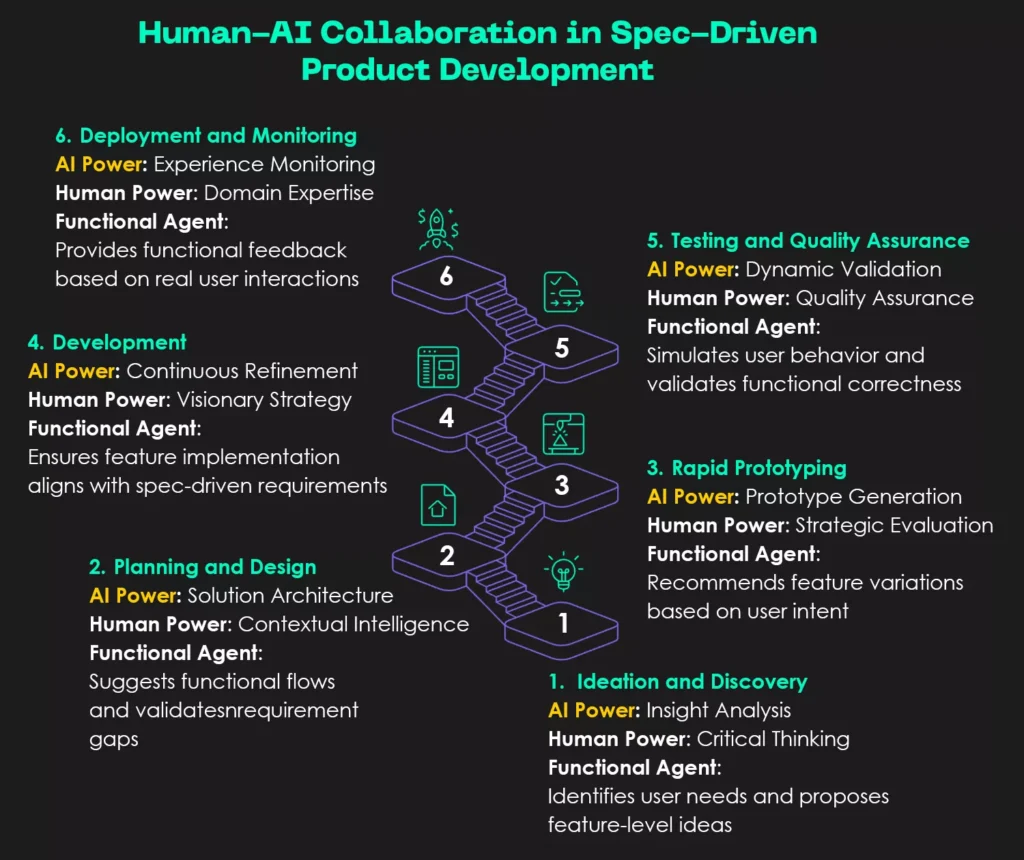
Fig: Human-AI Collaboration in Spec-Driven Product Development
1. Ideation and Discovery
- AI Power: AI and its allies (Gen AI and AI agents) help analyze insights, detect emerging issues, and disclose critical needs that often go unsolved. This helps product engineers to gain well-researched insights.
- Human Power: Product thinkers continue to use critical thinking and questioning capabilities to make sure that the insights can be turned into innovations that are not just feasible but also relevant to the market.
2. Planning and Design
- AI Power: Advanced cognitive systems detail solution architectures, evaluate the trade-offs, and provide user interface suggestions that can be adjusted by the degree and spread over the entire design.
- Human Power: This involves product architects and designers to bring contextual intelligence, evaluating business goals, user psychology, and all aesthetic nuances to turn insights into experiences that resonate. They validate trade-offs with domain expertise and align the design with the product’s strategic intent.
3. Rapid Prototyping
- AI Power: Gen AI can help produce diverse prototype versions and content, while agentic AI’s autonomous capability can manage iterative testing, feedback documenting, and prototype optimization.
- Human Power: Product engineers and stakeholders need to intervene here to evaluate the prototype from all perspectives, such as the user relevance, brand fit, and most importantly, strategic alignment. This provides them with the opportunity to provide nuanced feedback and direction to the LLM model/agent to make accurate iterations.
4. Development
- AI Power: Advanced AI assistants can support continuous product feature refinements, workflow enhancements, and integrations. This can accelerate value delivery through data-driven optimization practices.
- Human Power: Product engineers act as visionaries in this phase. Their job here is to embed strategies, ethical frameworks, and user-centric innovation. They ensure a product evolves not just technically but as a sustainable solution that can disrupt legacy standards.
5. Testing and Quality Assurance
- AI Power: AI can help create test scenarios (simulations) that can manage execution dynamically, change the strategies in real-time, and facilitate the validation process to be efficient. This helps to detect risks at an early stage and strengthen the quality of products.
- Human Power: It is the product engineers who clear up the ambiguities, set the quality at the highest level, and make sure that the product builds trust. AI experts are responsible for training the model to make it a testing tool. They are also responsible for incorporating all the shifts received from testing the product to make it a successful one.
6. Deployment and Monitoring
- AI Power: Advanced AI tools/agents can be used for product release management and monitoring user experience. This gives users the benefit of fewer service interruptions and early detection of scaling issues.
- Human Power: Through core domain expertise and a high-level product engineering mindset, product leaders determine the right areas and moments to make tweaks, intervene, or turn decisively. This generates real value not only for the users but also for businesses.
Note: While we consider the stages of product engineering, it’s essential to recognize how agentic AI transforms the process across three key dimensions, with an important human role in each:
- Engineering Agents: These agents handle system-level tasks like architecture validation and code generation, accelerating implementation by identifying patterns that humans might miss. Product engineers then contextualize these findings to align with strategic goals.
- Product (Functional) Agents: By understanding user needs and providing functional suggestions, these agents facilitate feature development. On the other hand, product managers interpret these insights to ensure relevance to market demands.
- Customer-Centric Agents: Focusing on user behavior and feedback, these agents inform product decisions, while human stakeholders analyze insights to refine offerings and meet customer expectations.
Extra read: How AI Agents Are Redefining Product Engineering as We Know It
Easier said than done – I mean, in theory, all the above phases may seem like a cakewalk, but an effective level of human-AI collaboration depends on following the right dimensions.
Keep reading to learn about it!
What Are the Four Dimensions of Effective Human-AI Collaboration?
The human-AI collaboration is not a one-shot wonder, nor does it happen overnight. It must be orchestrated with the right approach and mindset.
Here are the four major dimensions of effective huma-AI collaboration that product leaders must focus on:

Fig: Dimensions of Effective Human-AI Collaboration
Dimension 1: Trust Calibration
In complex situations, blindly trusting AI may lead to errors. On the other hand, complete distrust may limit the potential of AI. So, a balance is required to build great products, and it should be driven by the trust developed between engineers and AI.
That is, trust calibration involves building transparent, interpretable AI outputs and setting expectations for AI as a partner, not an oracle.
Dimension 2: Skill Transformation
Seamlessly collaborating with AI requires various skills such as data literacy, prompt engineering, interpreting outputs generated by AI, and more. So, product builders must shift from task execution to concentrating on fine-tuning and ethically leading AI models to achieve the desired results.
In simple terms, to win big, organizations must make their people “AI-literate”.
Dimension 3: Decision Rights Framework
Unambiguous governance methodologies can lead to seamless collaboration with AI. Knowing the exact situations in which AI only works as a suggestion specialist and when to act independently is crucial.
In simpler terms, a decision rights framework provides the tools for the movement of accountability and moral standards by thoroughly showing the separation of work between people and AI.
Dimension 4: Feedback Loops and Learning Systems
One of the most important dimensions for human-AI collaboration is continuous feedback and learning. That is, AI should be able to learn from humans, and humans should be able to draw conclusions from AI systems.
So, feedback loops are mechanisms that not only enhance the performance of AI systems but also improve the skills of the team working with AI.
The above-mentioned dimensions collectively create a model that highlights the interaction between trust, skill development, decision-making, and the utilization of feedback loops.

Don’t get left behind in the tech marathon! Harness our AI capabilities to steer your product engineering journey seamlessly.
Next, you’ll learn about the estimated timeline and roadmap that you can implement to build robust products, keeping AI as the central mechanism and humans as the navigators.
How Can You Implement Human-AI Collaboration to Build Robust Products?
Here is the roadmap that you can follow to implement human-AI collaboration to build robust products:

Fig: Building Successful Products with Human-AI Collaboration
Phase 1: Identifying High-impact Collaborative Zones (2-3 weeks)
- The first step is to outline the product engineering lifecycle and figure out the areas where a human-AI partnership would drive measurable value.
- Once done, run stakeholder workshops to create an inventory of pain points, opportunities, and desired results.
Phase 2: Building Collaborative Infrastructure (4-6 weeks)
- Your next job is to install AI platforms or AI partners that offer real-time co-authoring access. Make sure that the platform or partner that you associate with is equipped with generative AI and agentic AI capabilities.
- Apart from that, introduce collaborative tools like cloud-based environments, data lakes, and governance modules.
- During this phase, aim for reskilling camps where teams can get training to develop AI literacy while focusing on ethical standards.
Phase 3: Aiming for Scalability and Optimization (6-12 weeks)
- Test the use of collaborative workflows in agile sprints, thus continually evaluating performance and trust calibration.
- Make customer input methods via dashboards, continuous integration pipelines, and automated incident reporting more uniform.
- Finally, frequently revisit and update the rights to make decisions. This is what makes organizations fit according to the changing industry and regulatory standards.
Now that you are aware of the nuances and roadmap, I’ll highlight some of the grey areas that you need to consider when it comes to human-AI collaboration.
Discover the Benefits of PEAI for Yourself!
Nitor Infotech’s experts can assist you in crafting market-leading products that offer next-gen user experience.
What Are the Key Challenges and Considerations of Human-AI Collaboration?
The collaborative approach is a boon and carries a lot of potential. However, product leaders or engineers should not rush it.
Here are some of the key challenges and considerations that you need to be aware of:
- Bias and Explainability: Let’s be honest – AI algorithms can be biased (in the same way as their training data). So, human oversight is indispensable for checking the results, making “humans in the loop” responsible in sensitive spheres.
- Skill Gaps and Change Management: If you don’t clearly define human versus AI roles, product engineering teams may either over-trust AI (leading to errors) or under-use it (losing potential). Moreover, human skill gaps can dampen the effect of collaboration.
- Data Privacy and Governance: Secure management of data and assurance that the system complies with regulations (for example, GDPR or CCPA) is a never-ending challenge. This requires constant updates of the governance framework.
- Trust Calibration and Over-Reliance: Excessive trust in AI models may lead to less attention being paid to human insights. Therefore, team members need to find the appropriate balance to maintain quality and safety.
Time to wrap it up!
The Road Ahead: Engineering the Future Together
The fact is inevitable: human-AI collaboration in product engineering leads to increased creativity, quicker market cycles, and the generation of innovation. With AI becoming less of a tool and more of a partner, organizations now have the opportunity to rethink beyond legacy frameworks.
Getting closer to the future means using more collaborative intelligence. To do this, engineering leaders must create an environment of trust and encourage the habit of continuous learning so that both humans and AI can flourish together (more like brothers of today and tomorrow).
The transition to this new epoch signifies product engineering as the skill of organizing effective collaboration between inventive humans and clever algorithms that not only solve societal problems but also ensure the well-being of the planet for future generations.
I believe this partnership can not only address major societal challenges but also promote the well-being of our planet for future generations.
Ready to create a bigger impact by building the next-gen products? Contact us at Nitor Infotech, an Ascendion company. Our dedicated AI experts will help you harness the power of artificial intelligence to the fullest to provide meaningful value to your customers.