

What separates market-leading products from those that disappear?
The answer often lies in product engineering. It is the strategic discipline that transforms brilliant ideas into solutions customers want and use. Product engineering is an approach that entails every step of making a product. This is right from scratch – the initial concept to market deployment and ongoing optimization.
While many companies focus solely on features or flashy technology, successful organizations understand that product engineering is the systematic approach that bridges the gap between vision and reality. It’s what ensures every design decision, every line of code, and every user interaction contributes to meaningful business outcomes.
Think about it: you’ve got a killer idea, maybe even some solid code, but somewhere between “this is genius!” and “why isn’t anyone using this?” something goes wrong. That’s where product engineering swoops in.
I’m going to walk you through everything you need to know about product engineering—and trust me, it’s way more interesting than it sounds. We’ll start with the basics (what exactly is this thing?), then explore all the moving parts that make it work.
You’ll meet the key players on a product engineering team (spoiler: it’s not just developers), discover the tried-and-true practices that separate the pros from the amateurs, and see why companies that nail this stuff consistently outperform their competition.
Let’s look at how we define it.
What is Product Engineering?
Product engineering is a vast area that brings together design thinking, engineering concepts, and project management to create practical, scalable, and user-friendly products. It is unlike traditional software development, which often focuses solely on coding and deployment. Product engineering spans the entire lifecycle of a product—from ideation to retirement.
Now that we’ve covered the basics, let’s break this down into bite-sized pieces.
What Are the Key Components of Product Engineering?
1. Ideation and Prototyping: This stage entails coming up with creative thoughts and building prototypes to verify them.
What it includes:
- Market research and user persona development
- Brainstorming sessions and concept refinement
- Creating wireframes, mockups, and interactive prototypes
- User testing and feedback collection
- Validating concepts through the creation of MVPs (Minimum Viable Products)
Airbnb’s founders started by creating a simple website prototype to test their “rent your space” concept. During a design conference, they rented air mattresses in their residence to test the concept. This ultimately proved the market demand before building the full platform.
2. Development and Deployment: This phase is about building and launching products while ensuring scalability and efficiency.
What it includes:
- Agile development methodologies and sprint planning
- Frontend and backend development with scalable architecture
- API design and third-party integrations
- Continuous integration/continuous deployment (CI/CD) pipelines
- Performance optimization and security implementation
- Release management and rollout strategies
Netflix’s engineering team uses microservices architecture and automated deployment systems to push thousands of code changes daily while maintaining uptime.
3. Maintenance and Scalability: This ongoing phase ensures products evolve with user needs and market changes while maintaining optimal performance.
What it includes:
- Performance monitoring and analytics tracking
- Bug fixes and security updates
- Feature enhancements based on user feedback
- Infrastructure scaling and optimization
- Technical debt management
- A/B testing for continuous improvement
Instagram’s engineering team continuously optimizes their image processing algorithms and server infrastructure to handle billions of photo uploads daily. When they noticed users were spending more time on video content, they pivoted resources to enhance video features and improve streaming performance. This action demonstrated how maintenance involves strategic evolution, not just bug fixes.
Cool, but what’s the point of all this? Glad you asked! The aim of product engineering is to deliver products that address user needs, align with market trends, and provide long-term value.
Examples
- Developing mobile applications for healthcare that streamline patient management
- Using AI-driven tools for automation testing in software development to improve productivity and precision
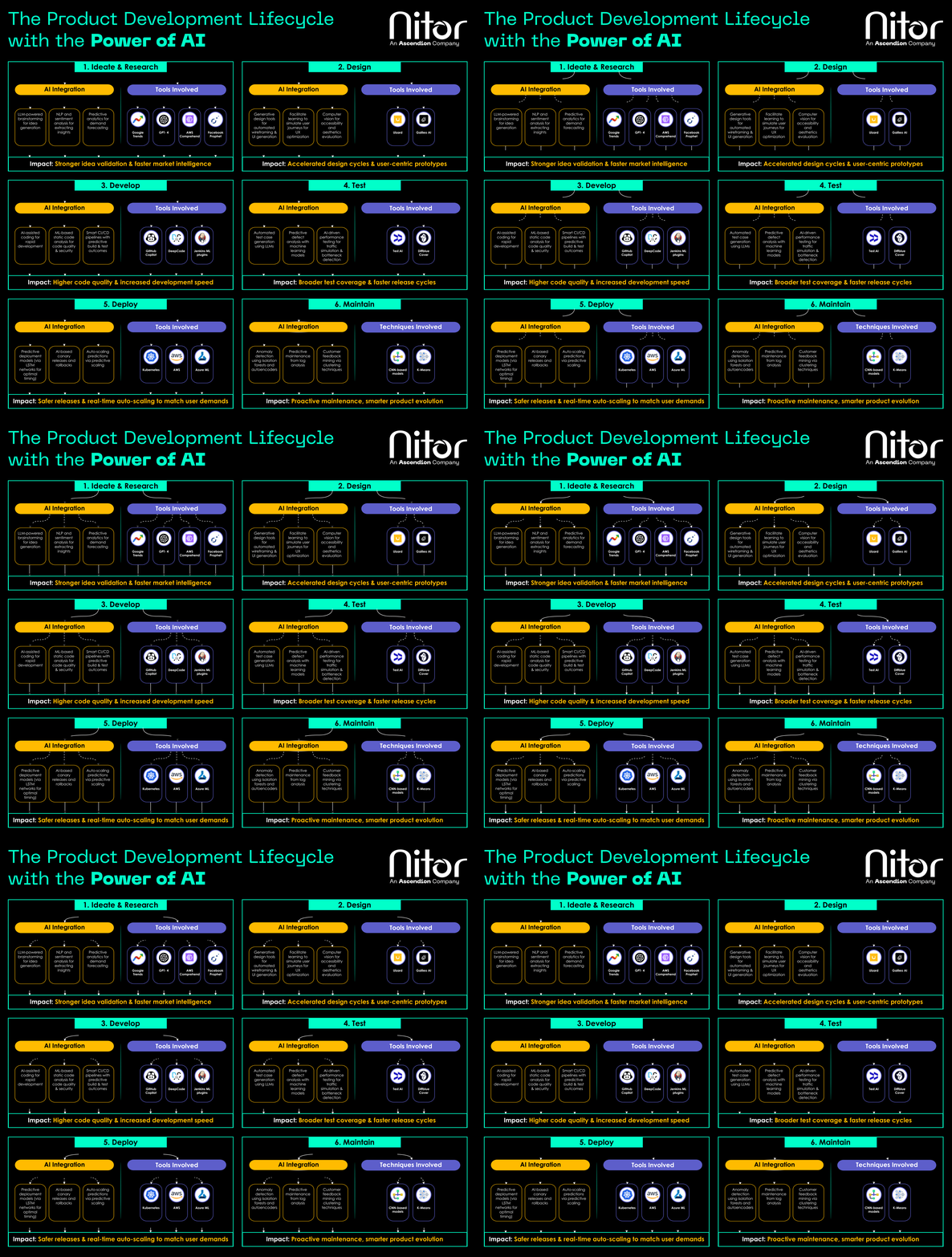
Master the product development life cycle in minutes!

Learn about the 6 key phases that turn great ideas into market-winning products.
Knowing the ‘why’ is great, but how does this work in practice?
What Does the Product Engineering Lifecycle Look Like?
The product engineering lifecycle is a structured framework designed to guide teams through the stages of product development, ensuring successful outcomes.
Having an excellent idea is not enough to build a successful product. It’s about executing that idea through a structured process that maximizes your chances of market success. Here’s how the product engineering lifecycle works:
The 6 Phases of Product Engineering:

Fig: The 6 Phases of Product Engineering
1. Strategy & Innovation
Though not all ideas are worthy of being turned into products, everything begins with an idea. This stage mainly focuses on strategic thinking and validation. Your concept gets put under the microscope by market researchers and subject matter experts. They ask the tough questions: “Is there real demand? What are the risks? Can we actually build this?”
Key activities include:
- Market research and competitive analysis
- Concept validation with potential users
- Risk assessment and feasibility studies
- Business case development
Smart companies often bring in product innovation specialists to help with ideation, research, and strategic planning. It’s better to kill a bad idea early than to waste months building something nobody wants.
- Tools: OpenAI for ideation, Confluence for documentation
2. Requirement Analysis & Product Design
Once you’ve got a validated concept, it’s time to get specific. This is where product managers, designers, and technical architects roll up their sleeves to figure out what you’re building.
The key here is prioritization—separating your “must-haves” from your “nice-to-haves.” This phase typically involves:
- Functional requirement documentation
- User interface and experience design
- Technical architecture planning
- Feature prioritization (the MoSCoW method, which categorizes elements into the following four buckets: ‘Must have’, ‘Should have’, ‘Could have’, and ‘Won’t have’ or ‘Will Not Have this time’)
- Product roadmap creation
- Use case definition and user story mapping
Think of this as your product’s blueprint phase. Getting this properly is crucial for everything else that comes after.
- Tools: AI-powered design platforms, usability testing tools
3. Product Development
Now comes the building part. Your development team takes all those carefully crafted designs and requirements and turns them into working software. This isn’t just about coding. It requires solid project management and proven development methodologies. What’s more, it calls for constant communication between developers, product managers, and designers.
Development activities include:
- Sprint planning and agile development
- Frontend and backend coding
- API development and third-party integrations
- Code reviews and version control
- Continuous integration setup
- Tools: Automation testing platforms, AI tools for performance optimization
4. Quality Assurance & Testing
Before your product sees the light of day, it needs to prove it works—and works well. To make sure your product satisfies design requirements and provides an excellent user experience, QA teams subject it to extensive testing.
Testing phases typically cover:
- Functional testing and unit tests
- User acceptance testing (UAT)
- Performance and load testing
- Security vulnerability assessments
- Cross-platform compatibility testing
- Automated testing implementation
The goal is catching problems before your users do. This is because nothing kills a product launch like a buggy first impression.
5. Product Deployment
Launch day!
Deployment, however, is more than simply turning a switch. It involves release management, monitoring user feedback, and being ready to iterate quickly based on real-world usage.
Deployment activities include:
- Production environment setup
- Release management and rollout strategy
- User onboarding and training materials
- Performance monitoring setup
- Customer support system implementation
- Feedback collection mechanisms
For many products, this phase also includes customer onboarding, training, and any necessary customizations. The best teams embrace continuous integration and delivery practices. This allows them to push improvements and fixes rapidly.
6. Support & Maintenance
You still have work to do, even after your product is live. Continuous upkeep and support guarantee that your product remains useful and competitive. This is where you gather insights for future iterations and keep your users happy.
Ongoing activities include:
- Bug fixes and security patches
- Performance monitoring and optimization
- Customer support and troubleshooting
- Feature enhancements based on user feedback
- System backups and disaster recovery
- Analytics tracking and reporting
Think of this as the “keeping the lights on” phase—except done right; it’s also where you gather insights for your next big product evolution.
Each phase builds on the previous one, creating a framework that turns ideas into market-ready products that solve real problems for real people. Speaking of people, let’s meet the key players you absolutely can’t do without.
What Are the Key Roles in a Product Engineering Team?
A successful product engineering team is composed of diverse roles. Each of these contributes unique expertise to the development process.
Essential Team Members
1. Product Manager
- Outlines the product plan and guarantees that it is in line with business goals.
- Acts as the bridge between stakeholders and the engineering team.
2. Software Engineers
- Develop and implement code using modern software engineering practices.
- Focus on building scalable and efficient solutions.
3. QA Engineers
- Perform a variety of tests, including performance, regression, and functional tests.
- Ensure the product meets quality standards before deployment.
4. User Researchers
- Gather insights into user behavior and preferences to improve product usability.
5. Automation Engineers
- To improve efficiency, use automation testing platforms and AI-powered solutions.
6. Scrum Masters
- Facilitate agile development practices and ensure seamless team collaboration.
Great teams are awesome, but even great teams need a playbook to win consistently, wouldn’t you agree?
What Are Some Best Practices for Effective Product Engineering?
To achieve optimal results, product engineering teams should adhere to proven best practices.
1. Build and Release in Small Steps:
- Don’t try to build the perfect product all at once. Instead, break your features into smaller pieces and release them step by step.
- Release small updates regularly instead of waiting months for big launches.
- Get real user feedback quickly so you can make changes fast.
- Start with the hardest and most important features first.
- If something’s going to fail, you want to know early when you can still fix it.
- Each small release teaches you something new about your users and market.
2. Track the Right Numbers:
- Not all data matters equally. Instead of measuring everything, focus on the numbers that help your business grow.
- Ignore vanity metrics that don’t imply much, such as page views.
- Focus on important metrics like:
1. How many customers return to utilize your product
2. How fast your system runs
3. How fast your group can create new features
4. How happy your customers are
5. How much it costs to run your product
3. Get Everyone Together to Solve Problems:
- Some of the best ideas come when different people work together in the same room.
- Run design workshops where everyone can share ideas.
- Bring together designers, developers, and product managers.
- Include real customers in these sessions when possible.
- Break down walls between different teams.
- When everyone helps create the solution, everyone wants it to succeed.
4. Work with Other Departments:
- Your product team shouldn’t work alone. Talk regularly with sales, marketing, customer support, and other teams.
- The sales team knows what features customers are asking for.
- Customer support knows what problems users face every day.
- Marketing understands how people find and use your product.
- These teams talk to customers all the time and have valuable insights.
- Regular check-ins help you build features people really need.
5. Keep Your Code Clean and Consistent:
- Good code isn’t just about making developers happy—it’s about building a product that lasts.
- Set clear rules for how code should look and work.
- Use tools that automatically check if the code follows your rules.
- Make code reviews a normal part of building features.
- When code follows the same patterns, new team members can help more quickly.
- Less bugs and simpler fixes are the results of clean code.
- You won’t waste time trying to understand messy code later.
Following best practices sounds nice in theory, but what’s actually in it for you?
What Are the Benefits of a Strong Product Engineering Strategy?
A well-defined product engineering strategy offers numerous advantages that drive business success.
Advantages
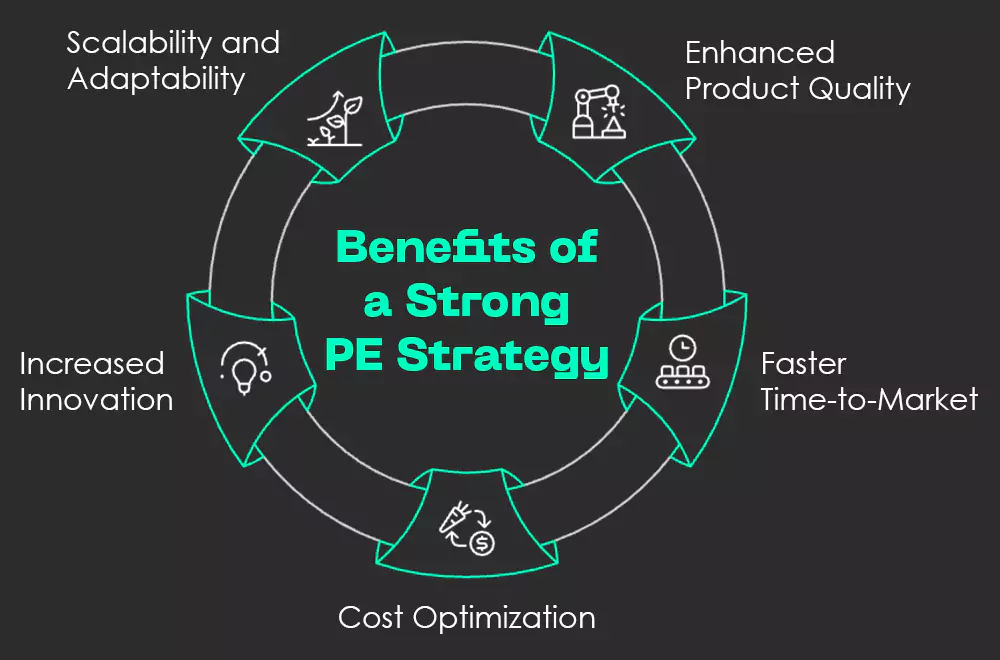
Fig: Benefits of a Strong PE Strategy
1. Enhanced Product Quality
- Improved user experience and functionality ensure higher customer satisfaction.
- Streamlined processes reduce delays and accelerate delivery.
3. Cost Optimization
- Efficient resource utilization minimizes expenses while maximizing output.
4. Increased Innovation
- Encourages creative problem-solving to maintain a competitive edge.
5. Scalability and Adaptability
- Products can change and adapt to meet evolving market demands and user needs.
Those benefits sound pretty good on paper, but let’s see how this plays out in the real world.
Industry Applications & Use Cases
Product engineering is used in many different fields, which helps companies come up with new ideas and do well.
Key Industries
1. Healthcare
- Mobile apps for telemedicine and patient management.
- Performance testing for critical health systems ensures reliability.
2. Finance
- Secure platforms for online banking and trading.
- Security testing safeguards sensitive data.
3. Retail
- E-commerce platforms and inventory management systems.
When engineering products for global markets, regulatory compliance becomes as critical as your code quality. At Nitor Infotech, we’ve built our operations around meeting international standards from day one. We maintain GDPR compliance for European data protection requirements, with comprehensive privacy policies that properly handle EU residents’ personal information.
Our security framework includes SSAE-18 auditing standards and BSI ISO/IEC 27001 information security management certification, ensuring data protection across all client engagements. Additionally, our HIPAA compliance enables collaboration with healthcare organizations.
This proactive compliance approach allows us to deliver product engineering solutions across diverse industries and geographies while maintaining the highest standards of data security and regulatory adherence.
Pretty impressive stuff, right? The bottom line is that product engineering might sound like corporate jargon, but it’s really your secret weapon for not building stuff that flops spectacularly.
We’ve all seen those products that make us go “Who thought this was a good idea?” Well, those teams probably skipped half the stuff we just talked about.
The reality is, turning a brilliant shower thought into something people actually pay for isn’t magic. It’s just good product engineering. Remember: the companies crushing it aren’t just throwing features at the wall to see what sticks. They’re being strategic about it, and now you know how to do it too.
Nitor Infotech specializes in providing end-to-end product engineering services tailored to your business needs. We are all in when it comes to accelerated development, enhanced product quality, and long-term scalability.
Successful digital initiatives need both technical excellence and strategic execution. Our engineering expertise transforms ambitious visions into reliable, scalable products.
Contact us now to learn how we can enhance your product engineering strategy.