

While many industries/businesses are leveraging artificial intelligence for better data analytics, enhanced marketing, and improved customer service, product engineering is quietly undergoing a revolution of its own, led by AI agents. The talk is no longer going through a rigorous traditional product engineering approach, meaning no manual code, linear lifecycles, and siloed teams. AI-powered agents are modern-day engineers that can envision, build, and maintain for you. According to a recent statistic, the market growth rate for AI agents from 2025 to 2034 is projected to achieve a compound annual growth rate (CAGR) of 45.82%.
This indicates that these autonomous assistants are more than mere passive tools; they are poised to become top collaborators in managing complex tasks, optimizing decisions, and continuously adapting throughout the product engineering lifecycle.
In this blog, you’ll discover how AI agents are transforming the fundamental aspects of product engineering. We’ll delve into the evolving role of engineers, highlighting advancements in speed and scalability. As you read on, you’ll gain insights into the mechanisms that enable these AI agents to drive exceptional products. Finally, I’ll guide you through the potential challenges to be mindful of and the promising future that awaits.
Enjoy this read and feel free to ask any questions at the end!
How are AI agents redefining the product engineering landscape?
AI agents are not just general-purpose assistants; they are sophisticated, goal-driven, context-aware, and autonomous units. Imagine a scenario where an AI agent seamlessly integrates into the product engineering lifecycle: it autonomously analyzes data, identifies inefficiencies, and suggests optimizations. It does this while adapting to the specific needs of your project.
Yes, this is the reality now!
Here’s how these agents create impact across all the stages of product engineering:
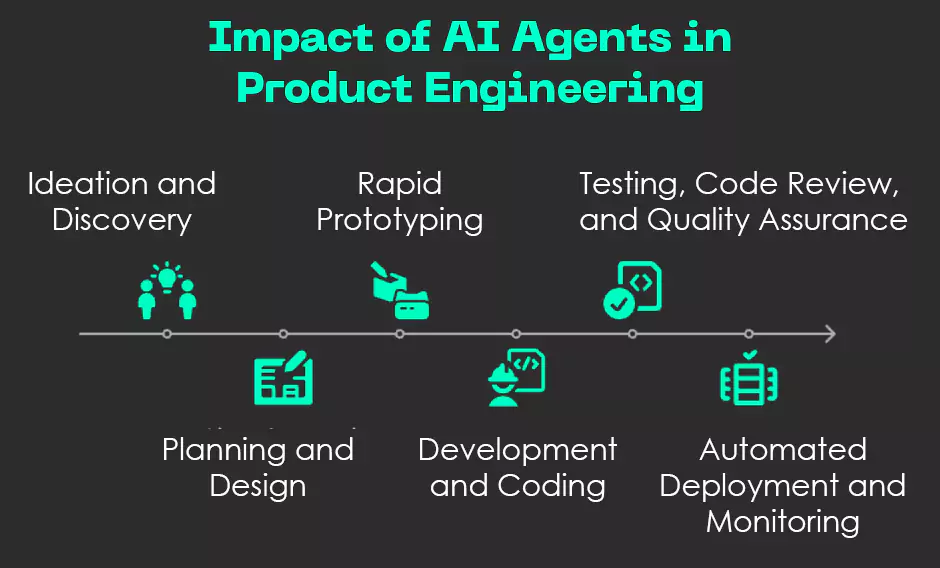
Fig: Impact of AI Agents in Product Engineering
1. Ideation and Discovery:The best product ideas often hide in plain sight within mountains of data. AI agents excel at being digital detectives, sifting through customer reviews, social media conversations, market trends, and competitor activities to uncover insights that human teams might miss. What makes this particularly powerful is speed and scale.
That is, while a traditional research team might take weeks to analyze market data, AI agents process thousands of data points overnight. They connect dots across different sources to reveal emerging user needs and market gaps that would otherwise remain invisible.
2. Planning and Design: These agents act as strategic copilots. That is, they help with analyzing user data, past performance metrics, and business goals to suggest experience blueprints that align with real-world needs. This falls under the planning phase.
Then comes the design phase. Here, AI agents speed up iterations dramatically. They can generate multiple UI variations adhering to brand guidelines, simulate real user interactions, and run continuous A/B tests—turning “let’s see if this works” into “we know this works” in record time.
What sets them apart is their predictive power. AI doesn’t just design beautiful interfaces; it forecasts user behavior, highlights confusion points, and provides data-backed insights. The result? Smarter planning, intuitive design, and fewer costly reworks down the line.
3. Rapid Prototyping: Gone are the days of manual wireframing and slow validation cycles. With AI agents, prototyping becomes a real-time process. Meaning, designers can just describe a concept by writing a simple/complex prompt, and the agent builds interactive prototypes on the fly, aligned to UX best practices, accessibility standards, and brand identity.
Moreover, these prototypes can be instantly tested with AI-simulated users or integrated with feedback loops from real sessions. This shortens the concept-to-validation cycle dramatically. Thus, enabling teams to experiment, learn, and iterate without hassle.
4. Development and Coding: Developers spend countless hours writing repetitive code and debugging issues, but agents built with AI are changing this dynamic entirely. They auto-generate boilerplate code that follows a team’s conventions, suggest performance optimizations, and catch security vulnerabilities before they become expensive problems.
The exciting part is, these agents learn from the existing codebase over time, understanding specific patterns and architectural decisions. They make increasingly relevant suggestions that free developers to focus on solving complex problems rather than routine tasks.
5. Testing, Code Review, and Quality Assurance: Quality assurance has traditionally been the bottleneck that slows releases, but AI agents are turning it into a competitive advantage. They execute comprehensive regression tests automatically, learn from past failures to predict where new issues are most likely to occur, and prioritize test cases based on actual user impact rather than gut feelings.
Furthermore, such agents can significantly assist in code review, identifying potential bugs, adherence to coding standards, and security flaws, thereby enhancing overall code quality and maintainability before deployment.
6. Automated Deployment and Monitoring: According to recent reports, automation in deployment processes can lead to over a 40% boost in productivity. With AI agents in the mix, you can rest assured—everything from orchestrating deployment workflows to monitoring server response times and user engagement is handled seamlessly. Plus, when issues arise, these agents don’t just raise alerts. They proactively resolve common problems by leveraging patterns learned from past incidents.
This creates what every engineering team dreams of: a self-healing system that gets smarter with every deployment. It is a system that allows teams to ship with confidence knowing they have intelligent guardians watching over their products 24/7.
Note: While AI agents are transforming product engineering, they’re not replacing human creativity, intuition, and judgment. They’re amplifying these unique human qualities by handling routine tasks and providing data-driven insights, creating space for teams to focus on what matters most.
The stages with agents appear solid, but are you curious about how these agents actually function to enhance product engineering? If so, the next section will satisfy your curiosity and explain the underlying mechanisms.
How Do AI Agents Work to Power Product Engineering?
At the core of AI agents lies a mix of intent recognition, memory, planning, and adaptive execution. Here’s how these components come together to power modern engineering workflows:
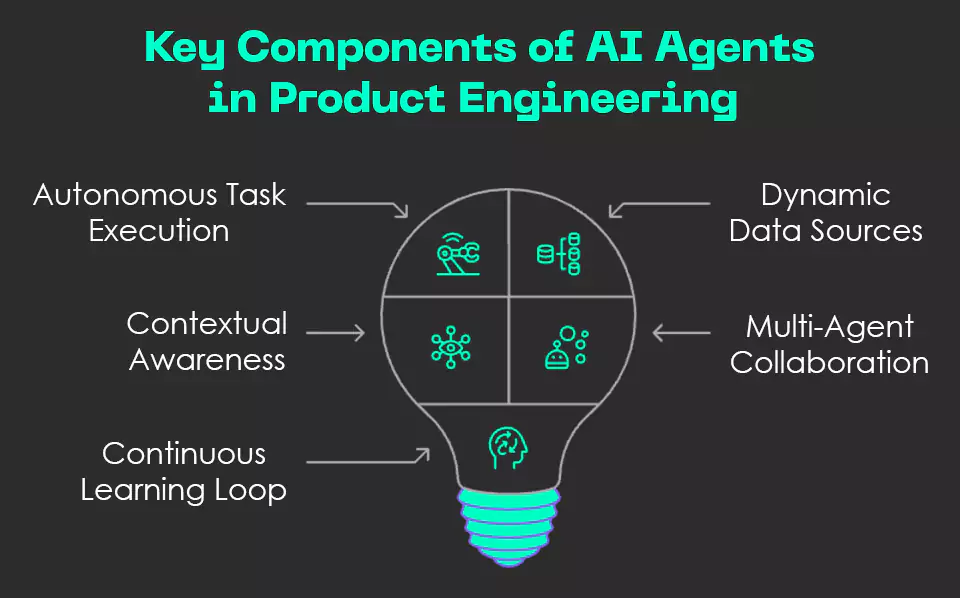
Fig: Key Components of AI Agents in Product Engineering
- Autonomous Task Execution: Imagine you telling an AI agent, “optimize app speed,” and it breaks down this high-level goal into actionable subtasks like analyzing performance metrics, identifying bottlenecks, and prioritizing improvements based on impact.The agent uses planning algorithms to determine optimal action sequences, considering dependencies between different strategies. It might start with smaller tasks like image compression while analyzing complex architectural changes, monitoring each intervention’s effects to ensure improvements don’t create new problems.
- Dynamic Data Sources: AI agents integrate data from a wide range of sources—including code repositories, log files, user behavior analytics, and third-party APIs—enabling them to make decisions based on both real-time and historical information across multiple platforms.By continuously aggregating and analyzing this diverse data, agents provide deeper, context-rich insights that improve accuracy and responsiveness in product engineering workflows.
- Contextual Awareness: Modern agents can understand and adapt to unique product environments through embedded memory and context retention systems.
They can build a comprehensive understanding of any codebase architecture, user behavior patterns, and team preferences, automatically adjusting strategies according to various circumstances.For example, if there’s a traffic spike or if the business priorities shift, agents will remember what worked before and predict how changes might affect different system components. - Multi-Agent Collaboration: Today, engineers have started to deploy specialized agent swarms that coordinate like a highly skilled team. One performance agent for optimizing speed, one security agent for monitoring vulnerabilities, one UX agent for analyzing user interactions, and so on.These agents can communicate actively, delegate priorities to themselves, and coordinate efforts to avoid conflicts while ensuring that optimizations neither compromise security nor user experience.
- Continuous Learning Loop: They create feedback cycles that make them increasingly valuable over time. Every interaction and decision outcome becomes a part of their growing knowledge base.They learn to recognize early warning signs, identify subtle correlations between code changes and system behavior, and develop sophisticated mental models of product ecosystems. This enables more nuanced recommendations and helps anticipate challenges before they turn into critical issues.
With such a magic wand, businesses are increasingly seeking engineers who can think outside the box and harness the capabilities of these AI agents to create better products quickly.

Take a close look at how we deliver impactful outcomes through Product EngineeringAI.
So, next, we’ll explore how the role of engineers has evolved in this dynamic landscape.
In What Ways Is the Engineer’s Role Evolving with the Rise of AI Agents?
With AI agents handling repetitive, logic-driven tasks, the engineer’s role is moving from being an executor to an orchestrator.
Here’s a list that highlights the narratives of today’s engineering roles:
- From Coding to Coaching: Engineers have now become “trainers”. That is, they “train” agents by defining goal parameters, curating datasets, and guiding task boundaries instead of writing every line of code.
- From Debugging to Designing Systems: The engineering focus has evolved from fixing individual issues to architecting entire ecosystems that maximize AI agent effectiveness. Engineers now design modular, agent-compatible systems where different AI components can seamlessly integrate, communicate, and collaborate.
- From Silos to System Thinking: Today’s engineers have started to develop a holistic understanding that spans multiple domains. Starting from AI ethics and data governance to user experience design and cross-functional business implications. That is, they now need to focus on the bigger picture i.e., the organizational impact.
Onwards to know about the business impact of agents in product engineering.
What Is the Business Impact of AI Agents in Product Engineering?
AI agents not only enhance speed but also transform business outcomes. This assertion is backed by the following reasons:
1. Agile, Autonomous Product Delivery
Agents facilitate shorter sprint cycles, dynamic prioritization, and real-time experimentation. This aligns well with Agile and DevOps methodologies, enabling faster MVPs and continuous delivery.
2. Higher ROI on Engineering Investments
By reducing manual overhead and improving efficiency, businesses realize higher output with leaner teams. When an AI agent is deployed, productivity significantly increases, allowing teams to concentrate on building strategies and training models to achieve their goals, ultimately resulting in a higher ROI.
3. Enhanced Decision-Making
Such agents can digest and interpret large datasets to provide actionable recommendations. These can further help product managers and engineers to align roadmaps with evolving user needs and finally build better products.
These are just a few examples of its capabilities. Next, I’ll present some real-world use cases to illustrate my point further.
Which Real World Use Cases Prove the Value of AI Agents in Product Engineering?
When discussing real-world use cases, it’s clear that nearly all industries are beginning to harness the power of agentic AI. Here are some of the most notable and recent examples that highlight the impact of AI agents on product engineering:
1. Boosting Developer Velocity with Generative Coding Agents
A renowned cloud services provider conducted a productivity study and found that integrating AI code-generation agents into developers’ IDEs helped them complete tasks faster, with a 27% higher task success rate. These agents were deployed to suggest code, fix vulnerabilities, and streamline workflows, reducing cognitive load while amplifying output.
2. Accelerating Task Completion in Development Pipelines
A developer tool widely adopted by engineering teams across Fortune 500 firms showcased that developers using its AI pair-programming assistant completed tasks faster than usual. Additionally, real-world testing revealed 34% faster code development, 38% faster test writing, and a remarkable 96% user satisfaction rate.
3. Streamlining Operations with Lifecycle Assistants
At a major software firm, AI-powered agents are now driving decisions across the entire product lifecycle—from forecasting supply chain demand to tailoring customer experiences. Reports claim that these agents have contributed to a 30% boost in operational efficiency, particularly in areas involving complex data interpretation and decision-making.
4. Strengthening Risk Detection with Intelligent Transaction Agents
Coming to the financial services sector, a prominent bank deployed AI agents to monitor and analyze real-time payment and fraud patterns. This resulted in a measurable 15–20% reduction in rejected transactions, along with enhanced efficiency in detecting suspicious behavior and routing alerts, without overloading human analysts.
This kind of widespread, measurable impact across industries highlights how AI agents are becoming the new backbone of product engineering.
Moving ahead, let me talk about the popular AI agents that you can explore for product engineering.
What Are Some of the Top AI Agents for Product Engineering?
Here are five standout AI agents, without the sales pitch:
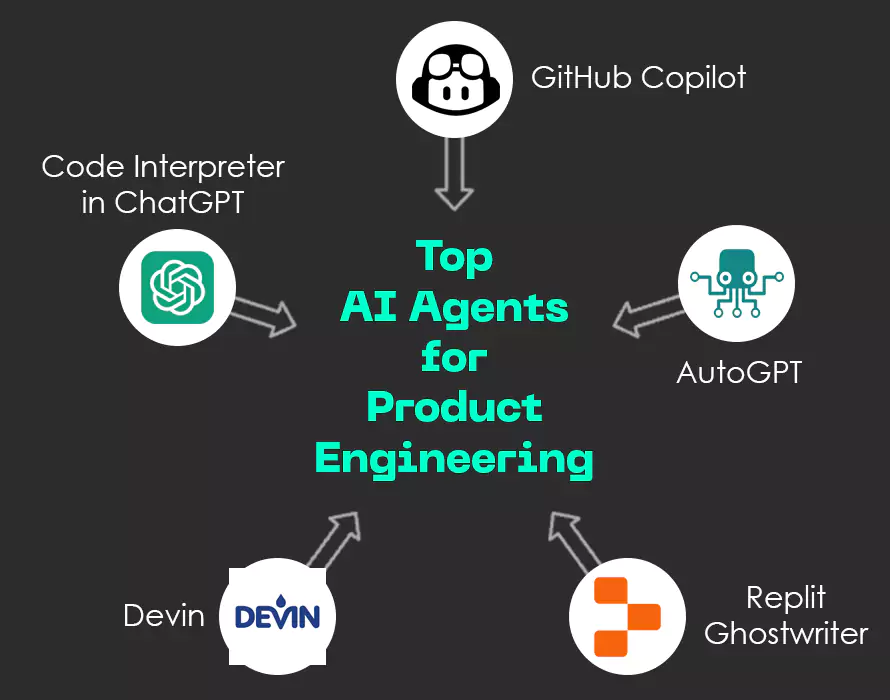
Fig: Top AI Agents for Product Engineering
- GitHub Copilot: Helps developers by suggesting code, functions, and tests in real time.
- AutoGPT: Enables complex goal execution by breaking tasks into subgoals and chaining them autonomously.
- Replit Ghostwriter: Tailored for collaborative coding environments and optimized for quick prototyping.
- Devin: One of the first agents capable of independently managing software engineering workflows.
- Code Interpreter in ChatGPT: Great for data transformations, analytics, and writing functional code from scratch.
Each of these offers different specializations. So, feel free to choose based on your product’s lifecycle needs.
How Do You Choose the Right AI Agent and Engineer Products That Actually Work?
If you’re wondering starting with any kind of agentic tool/framework will solve your problem, well, that’s not the case. When adopting any kind of agents, you must always start with a purpose.
Here’s what you should do:
- Define the Objective: Clarify what task or lifecycle stage the agent must impact (for example, test automation or code generation).
- Evaluate Compatibility: Ensure seamless integration with your existing toolchain (for example, GitHub, Jenkins, Jira, etc.).
- Assess Learning Capability: Prioritize agents that adapt and learn from team interactions.
- Focus on Transparency: Choose agents that allow human override and provide traceable reasoning.
- Pilot, Then Scale: Run sandbox experiments before integrating into your production pipeline.
FYI: You still need a well-architected environment, strong governance, and a feedback-rich engineering culture to make these assistants work perfectly.
Even the smartest agents have their blind spots. Up next, explore the key challenges you need to be ready for when working with AI agents.
What Challenges and Ethical Dilemmas Should You Prepare For?
No innovation is free of friction, and the same goes for these agents. Here are some of the hurdles that teams might face:
- Data Privacy & IP Protection: Agents may inadvertently leak sensitive code or customer data during training or prompt execution.
- Model Bias & Hallucination: AI agents trained on biased or outdated data may deliver flawed suggestions, especially in edge cases.
- Over-dependence: Over-reliance on agents can erode human skill development, leading to engineering deskilling.
- Job Redefinition Anxiety: The rise of autonomous agents introduces cultural challenges, including fear of job loss or lack of clarity in role ownership.
So, organizations must uphold strong ethical frameworks, conduct regular audits, and maintain transparency to keep agentic systems human-centered and trustworthy.
Next up: a glimpse into what’s ahead!
Where Are AI Agents Taking Product Engineering Next?
The horizon for AI agents in product engineering is expansive, promising to reshape not just how we build products, but fundamentally transform the relationship between human creativity and machine intelligence in ways we’re only beginning to understand.
Here are some of the trends that we can look forward to:
- Proactive Engineering: Moving ahead, agents won’t just respond to complete tasks; they’ll predict and initiate enhancements to build on top of existing mechanisms.
- Zero-Touch Product Delivery: With the rise of cognitive automation, we’ll move toward hands-free product releases with minimal human intervention.
- Agent-User Co-Creation: We’re about to enter an era where end-users will collaborate with agents and experts to custom-build their microproducts, allowing them to experience a hyper-personalized product era.
Therefore, AI agents are set to become the core operating unit of modern product engineering, all while evolving the roles of engineers and product owners. As with any technological leap, success lies not just in adoption, but in adaptation—rethinking our workflows, skillsets, and ethics for this new frontier.
So, is your team ready to collaborate with intelligent agents? Because the future isn’t just automated—it’s agentic. At Nitor Infotech, an Ascendion company, we’re leading the way to ensure your journey with AI agents is seamless, impactful, and designed to help you build exceptional products.
Write to us with your thoughts, and our team of experts will get back to you!