

The days of traditional AI seem slightly old-fashioned. Fast forward from those to today – we’re talking about Agentic AI systems that don’t just crunch numbers – they create strategies.
The business world is witnessing something extraordinary. AI has evolved from being a helpful tool to becoming a strategic partner. This isn’t about chatbots answering customer queries or algorithms sorting data. We’re entering an era where AI can think, plan, and strategize alongside human leaders.
Traditional product strategy is drawn from human intuition, market research, and guesses. Teams would spend weeks analyzing data, debating features, and making strategic bets. But here’s the thing – markets move faster than ever. Customer requirements shift overnight. Competitors emerge from unexpected corners.
The old playbook isn’t enough anymore. Companies need partners who can process information at superhuman speed while maintaining strategic vision. Enter agentic AI – artificial intelligence that doesn’t just follow orders but actively participates in shaping your product’s future.
What makes this different from having a smart assistant? It’s the difference between having someone who executes your plans and having someone who helps create them. Agentic AI doesn’t wait for instructions. It observes, analyzes, and proposes. It’s like having a co-founder who never sleeps and processes data from a thousand sources simultaneously.
This shift changes everything about how we build products. It’s time to explore what it means to have AI as your strategic partner. That is the focus of today’s blog. This is going to be a series wherein we delve into the ins and outs of the role of Agentic AI in the product strategy revamp.
Understanding Agentic AI: Beyond Automation to Strategic Partnership
Let’s start with the basics. What exactly is agentic AI?
Think of traditional AI as a very smart intern. You give it tasks; it completes them efficiently. Ask it to analyze sales data, and it produces charts. Request customer insights, and it delivers reports. But it never suggests what you should do next.
Agentic AI is different. It’s more like a seasoned business partner who studies your market, understands your goals, and comes to meetings with recommendations. It doesn’t just process information – it interprets it and suggests actions.
Three key characteristics define agentic AI.
- First, autonomous decision-making. The system can make choices without constant human input. It weighs options, considers constraints, and selects the best path forward.
- Second, goal-oriented behavior. Unlike traditional AI that responds to prompts, agentic AI works toward specific objectives. Tell it you want to increase user engagement by 20%, and it will continuously work toward that goal, adjusting strategies as needed.
- Third, contextual learning. The system learns from every interaction, market change, and user behavior pattern. It builds a deeper understanding of your business environment over time.
Here’s where it gets interesting. Traditional AI systems wait for commands. You ask, “What are our top-performing features?” They answer. Agentic AI flips this dynamic. It might proactively say, “I’ve noticed a 15% drop in feature adoption among new users. Here are four strategies we ought to ponder.”
This shift from reactive to proactive changes the entire strategic landscape. Instead of humans generating all the ideas and AI providing analysis, both humans and AI contribute to strategy formation.
The system processes market data, user feedback, and competitive intelligence simultaneously. While your team sleeps, it’s analyzing user behavior patterns, monitoring competitor moves, and identifying emerging market trends. By the time you brew your morning tea or coffee, it has insights ready for your strategic discussions.
What does this mindset entail? This question finds an answer in the following section. Keep reading! Before that:

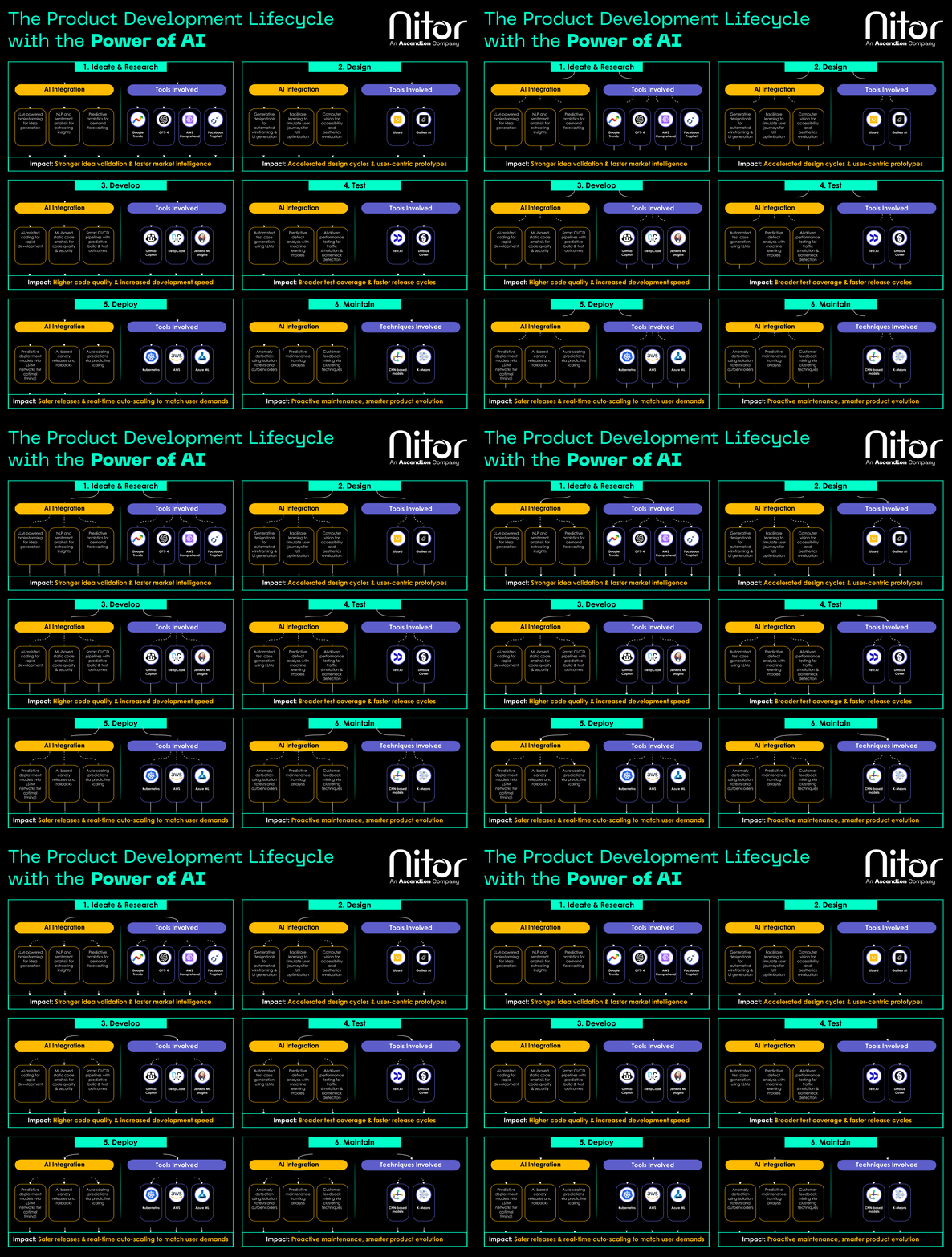
Take a couple of minutes to look at our picturesque representation of the product development lifecycle with the power of AI.
The Co-founder Mindset: How AI Thinks About Product Strategy
Humans and AI approach strategy differently. Understanding these differences is crucial for an effective partnership.
Human strategic thinking is intuitive and creative. We connect seemingly unrelated ideas. We factor in emotions, brand values, and long-term vision. Last but not least, we make gut decisions based on experience and instinct.
AI strategic thinking is systematic and comprehensive. It processes vast amounts of data without fatigue. It identifies patterns that escape human notice. It maintains objectivity even when emotions run high.
Consider market analysis. A human product manager might spend days researching competitors, reading industry reports, and gathering customer feedback. They’ll form opinions based on this information, filtered through their experience and biases.
Agentic AI processes the same information in minutes. But it also analyzes social media sentiment, monitors patent filings, tracks hiring patterns, and correlates economic indicators. It identifies connections across thousands of data points that no human could track.
The magic happens when these approaches are fused. Human creativity sparks innovative ideas. AI analysis validates and refines them. Human intuition identifies opportunities. AI quantifies the potential impact.
AI excels at pattern recognition. It spots subtle trends before they become obvious. It notices when user behavior shifts in ways that suggest changing needs. It identifies market gaps that competitors haven’t filled.
AI also maintains consistency. It doesn’t have bad days or become involved in workplace dynamics. It applies the same analytical rigor to every decision, whether it’s choosing between two features or planning a major product pivot.
But AI needs clear direction. Setting proper goals and boundaries is essential. You wouldn’t give a human unlimited authority without clear objectives, would you? The same applies to AI. Define success metrics, establish decision-making boundaries, and maintain regular strategic alignment.
The complementary nature of this partnership creates something powerful. Human creativity generates possibilities. AI analysis identifies the best opportunities. Human judgment makes final decisions. AI ensures consistent execution.
How does agentic AI bring about changes in product development? Read on to find out.
Transforming Product Development: From Idea to Market
Agentic AI revolutionizes every stage of product development. Let’s walk through the transformation.
- In the ideation phase, AI monitors market signals continuously. It tracks emerging technologies, shifts in user behavior, and gaps in competitor offerings. When it identifies opportunities, it doesn’t just flag them; it develops preliminary concepts and estimates market potential.
- Market research becomes dynamic rather than static. Traditional research provides snapshots of market conditions. AI provides continuous monitoring. It tracks how user needs evolve, how competitors respond, and how market conditions shift. This real-time intelligence enables more agile strategic decisions.
- Feature prioritization gets smarter. Instead of relying on subjective ranking systems, AI analyzes user behavior data, support tickets, and usage patterns. It predicts which features will drive the most engagement, retention, and revenue. The system updates priorities as new data becomes available.
- Consider A/B testing. Traditional approaches test predetermined variations. AI generates test ideas based on user behavior patterns. It identifies which user segments might respond differently to various approaches. It even suggests test parameters and success metrics.
- Product roadmaps become more adaptive. Static roadmaps break when market conditions change. AI-powered roadmaps adjust automatically. When user behavior shifts or new competitors emerge, the system evaluates the impact and suggests roadmap modifications.
- The launch process is getting more sophisticated. AI analyzes optimal timing based on market conditions, competitor activities, and user readiness indicators. It monitors launch performance in real-time and suggests adjustments to marketing messages or feature positioning.
- Post-launch optimization never stops. AI continuously analyzes user interactions, identifies friction points, and suggests improvements. It correlates user feedback with behavior data to understand the true sentiment behind feature requests.
But here’s the critical balance: data-driven decisions must align with human intuition and brand vision. AI provides insights and recommendations. Humans make choices that reflect company values and long-term strategy. The partnership ensures decisions are both analytically sound and strategically aligned.
Now, how can human–AI strategic partnerships be built?
Building the Human-AI Strategic Partnership
Creating an effective human-AI partnership requires intentional effort. It’s not as simple as installing software and expecting magic.
- Trust forms the foundation of any partnership. With AI, trust comes through transparency. The system must explain its reasoning, show its data sources, and make its decision-making process clear. Black-box recommendations undermine confidence and limit adoption.
- Communication protocols matter. Set in motion standard strategic reviews wherein AI comes up with recommendations. Create feedback loops where humans can guide AI learning and decision-making. Define escalation procedures for significant strategic decisions.
- Team training is essential. Product managers need to learn how to work with AI insights rather than replacing their judgment with AI recommendations. The goal is augmentation, not replacement.
- Cultural change is often the biggest challenge. Many organizations have deeply ingrained decision-making processes. Introducing AI as a strategic partner disrupts established hierarchies and workflows. Some team members might feel threatened or skeptical.
- Address concerns directly. Explain that AI makes human capabilities better – it is not out to replace them. Show concrete examples of improved outcomes. Begin with low-risk applications and steadily add AI involvement as confidence blossoms.
- Common resistance points include fear of job displacement, concern about AI accuracy, and discomfort with algorithmic decision-making. Address each concern with facts, training, and gradual implementation.
- Best practices for AI setup include clear objective definition, comprehensive data integration, regular model updates, and continuous performance monitoring. The system is only as good as the data it receives and the goals it pursues.
- Human product managers evolve in this new environment. Instead of spending time on data collection and basic analysis, they focus on strategic interpretation and creative problem-solving. They become not just AI trainers, but also strategy synthesizers and decision facilitators.
- The role becomes more strategic and less operational. Product managers create a route for AI learning, analyze insights within the company’s context, and devise strategic decisions. This is not all – They even make sure AI recommendations tell the same story as the brand values and long-term vision do.
Let’s now turn our focus to certain challenges and ethical considerations.
Navigating Challenges and Ethical Considerations
No partnership is without challenges. Human-AI strategic collaboration brings unique considerations.
- Over-reliance on AI creates dangerous blind spots. AI systems work within their training parameters. They might miss factors outside their data scope or fail to account for unprecedented situations. Maintaining human oversight prevents tunnel vision.
- Bias in AI recommendations poses significant risks. If training data contains historical biases, AI might perpetuate them in strategic recommendations. Consistent bias audits, as well as assorted data sources can lessen this risk.
- Transparency becomes crucial for ethical AI use. Stakeholders need to understand when and how AI influences strategic decisions. This transparency brings trust and accountability into the picture.
- Company values must guide AI behavior. Technical optimization might suggest strategies that conflict with ethical standards or brand values. Human oversight ensures AI recommendations align with organizational principles.
The importance of human judgment cannot be overstated. AI generates insight after powerful insight, but humans get to make final decisions. This division of responsibility ensures accountability and maintains strategic alignment with the company’s vision.
Speaking of ‘vision’, let’s contemplate the future.
The Future of Agentic-AI-Human Strategic Collaboration
We stand at the beginning of a new era in product strategy. Agentic AI offers nonpareil capabilities for well-thought-out planning. Companies that embrace this partnership gain significant competitive advantages.
Early adopters are already seeing results such as:
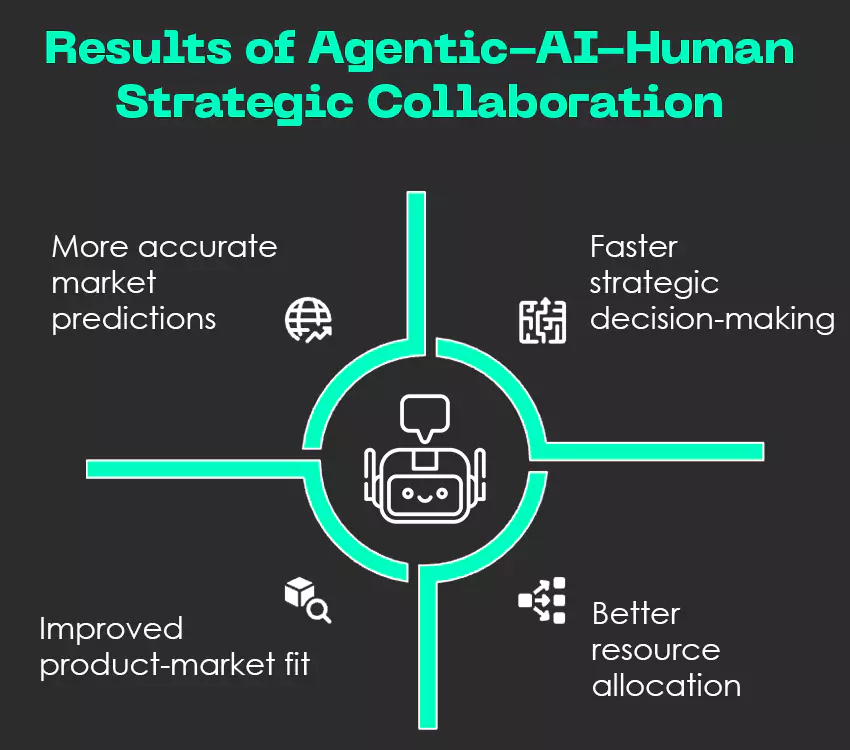
Fig: Results of Agentic-AI-Human Strategic Collaboration
These advantages compound over time, creating substantial market positioning benefits.
The future points toward fully integrated human-AI strategic teams. AI will handle data processing, pattern recognition, and initial strategy formulation. Humans will provide creative vision, ethical guidance, and final decision authority. Together, they’ll achieve strategic outcomes neither could reach alone.
This transformation won’t happen overnight. It requires careful planning, cultural adaptation, and continuous learning. But the potential rewards justify the effort.
The question isn’t whether AI will become a strategic partner in product development. It’s whether your company will be among the early adopters who shape this new landscape or the followers who struggle to catch up.
The dawn of human-AI partnerships is here. The future of product strategy will be written by companies brave enough to embrace this partnership.
Are you ready to rethink everything you know about building products?
You might want to choose quickly, because your AI-augmented competitors are already making their moves.
Contact us at Nitor Infotech to learn more about digital transformation and the wave of Agentic AI that we have been exploring. Also, watch this space to read the rest of the blogs that we will be publishing in this series!