

Highlights
Code review is essential for software quality, yet traditional approaches are often slow and susceptible to human error. This read delves into how AI-driven code reviews are revolutionizing the quality and security assurance for development teams. With features like contextual analysis, intelligent bug detection, and performance optimization, AI facilitates quicker, smarter, and more consistent reviews. Learn how AI enhances human reviewers, increases developer productivity, and improves code reliability. You’ll also explore the top AI tools, their advantages, challenges, and the future of AI in software quality assurance.
What do you think is one of the most critical activities when building a great software product? Well, it’s about meticulously reviewing every line of code to ensure nothing slips through the cracks. Code reviews represent a fundamental quality assurance practice in software development, playing a vital role in maintaining code standards and preventing bugs from reaching production systems. While their importance is widely recognized, traditional review processes consume considerable development resources and can involve repetitive tasks. Here, AI (artificial intelligence) presents an opportunity to optimize these workflows, reducing manual effort while improving the consistency and comprehensiveness of code evaluation.
AI-powered code review is the next leap in how development teams approach quality assurance, identifying more bugs, enforcing standards consistently, and freeing up developers to focus on what they do best.
In this blog, you’ll explore everything about AI-powered code reviews — from how they work and their key advantages to what you need to know before adopting them, how they boost developer productivity, and more.
So, lean back, get all the insights, and reshape your development workflow!
What is AI-Powered Code Review?
AI-powered code review is an automated process that uses machine learning and natural language processing to analyze code, identify issues, and provide intelligent feedback. These systems are trained on massive datasets of code from successful projects, learning to recognize patterns, best practices, and common pitfalls across different programming languages and frameworks.
Unlike traditional static analysis tools that follow rigid rules, AI code review understands context and can detect subtle issues that might slip past human reviewers—especially during busy development cycles.
Onwards to know about how it operates.
How does AI Code Review Work?
Here’s what happens when AI reviews your code:
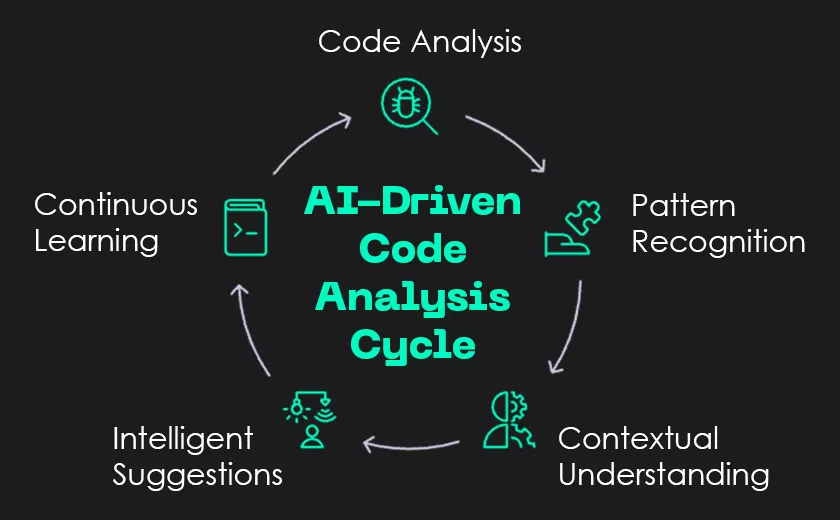
Fig: AI-Driven Code Analysis Cycle
- Code Analysis: The AI system scans your code, breaks it down and analyzes it at multiple levels—from individual lines to overall architecture patterns.
- Pattern Recognition: Next, it compares your code against its vast knowledge base of patterns, identifying potential issues by recognizing anti-patterns and security vulnerabilities.
- Contextual Understanding: Unlike simple rule-based tools, AI understands the relationships between different parts of your code, tracking data flow and function dependencies.
- Intelligent Suggestions: For each issue found, the AI provides specific suggestions for improvement, often with explanations of why the change matters.
- Continuous Learning: As the AI processes more code and receives feedback from developers, it continuously improves its accuracy and relevance.
Next, let’s unfold the advantages and drawbacks of AI-powered code review.
Where Do AI Code Reviews Shine and Where Do They Fall Short?
It’s important to set realistic expectations about AI code review capabilities. While these tools are genuinely helpful, they’re not as comprehensive as some marketing materials suggest.
What They’re Good At:
- Basic Pattern Recognition: AI tools excel at detecting common patterns like SQL injection vulnerabilities, buffer overflows, and obvious security anti-patterns. They can spot these because they’ve seen millions of examples in their training data.
- Style and Formatting Issues: Most AI review tools are quite good at enforcing consistent coding standards. They can identify naming convention violations and suggest formatting improvements.
- Simple Bug Detection: They can catch obvious issues like unused variables, unreachable code, or basic logic errors that traditional linters might miss.
What They Struggle With:
- Complex Context Understanding: Present AI code review tools often demonstrate limitations in comprehending intricate codebase contexts. They frequently miss nuanced issues that require a deep understanding of system architecture, business logic, or domain-specific requirements. These systems may struggle with multi-file dependencies, complex data flows, or subtle semantic relationships within the code.
- Business Logic: AI tools can’t understand your specific business requirements or domain logic. They might suggest technically correct code that’s completely wrong for your use case.
- Security Beyond Patterns: AI can detect known vulnerability patterns but struggles with novel security issues or complex attack vectors that require a deep understanding of your application architecture.
So, AI code review tools are most effective when you think of them as sophisticated linters rather than replacement reviewers. The key is using them as part of a layered approach: let AI handle the routine checks, then have human reviewers focus on the logic, architecture, and business requirements that AI can’t understand.
Keep reading to learn how AI code reviews empower developers to work smarter and deliver stronger, more resilient products.
How Does AI Code Review Transform Developer Productivity?
Here are the key advantages that AI-powered code reviews offer to developers to boost their productivity:
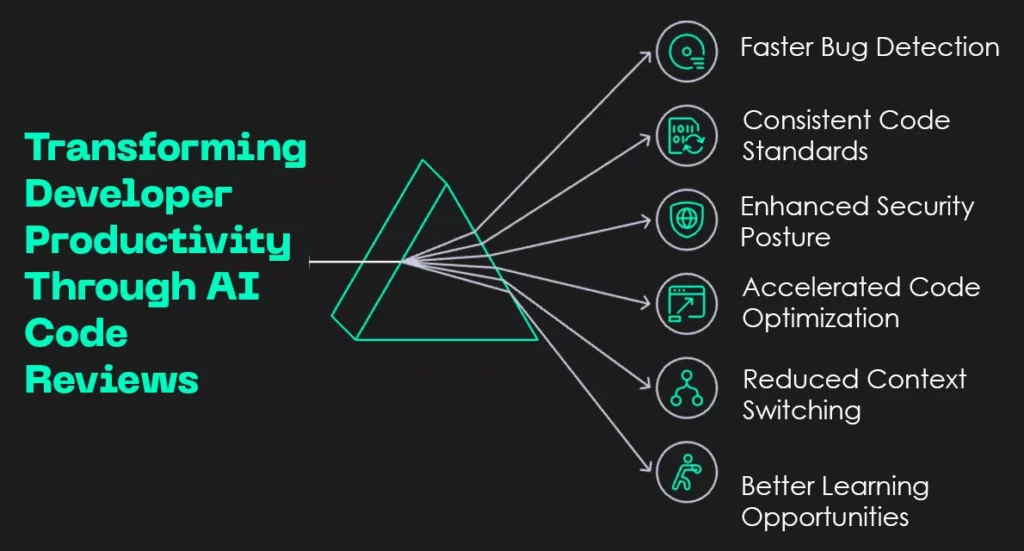
Fig: Transforming Developer Productivity Through AI Code Reviews
1. Faster Bug Detection
Remember spending hours hunting for that missing semicolon or mismatched bracket? AI can catch these issues instantly, along with more complex logical errors that could cause runtime failures.
2. Consistent Code Standards
Maintaining coding standards across a team can be challenging. AI automatically enforces style guidelines and suggests improvements, ensuring consistency without manual oversight.
How cool is that?
3. Enhanced Security Posture
AI helps identify security vulnerabilities early in the development process, including:
- Input validation weaknesses
- Authentication bypass risks
- Data exposure vulnerabilities
- Insecure cryptographic implementations
- Dependencies with known security issues
4. Accelerated Code Optimization
AI suggests performance improvements and cleaner code patterns, helping developers write more efficient code without memorizing optimization techniques.
5. Reduced Context Switching
With real-time feedback, developers can address issues immediately rather than switching between coding, testing, and debugging modes.
6. Better Learning Opportunities
Novice developers benefit enormously from AI code review, as it provides instant educational feedback and explains why certain patterns are problematic.
Next, I’ll share insights on how AI code reviews play a crucial role in ensuring high-quality code.
What Makes AI Code Reviews Key to High Quality Code?
AI code review helps maintain high coding standards by:
- Enforcing Consistent Style: Automatically flagging style inconsistencies and suggesting fixes across the entire codebase.
- Identifying Complexity Issues: Highlighting overly complex functions or classes that need refactoring for better maintainability.
- Catching Performance Problems: Spotting inefficient algorithms, memory leaks, and resource management issues before they impact users.
- Security Best Practices: Ensuring secure coding practices are followed consistently across all team members.
- Documentation Standards: Reminding developers to add necessary documentation and comments for complex logic.
As highlighted earlier, a human-in-the-loop remains essential when leveraging AI for code reviews. Let’s explore how humans and AI can collaborate effectively to achieve higher code quality and more reliable outcomes.
How can Humans and AI Partner in Code Review?
AI is designed to enhance human code reviewers, not replace them and the most effective code review process combines both. Here’s what the synergy looks like:
- AI handles the routine checks: Syntax errors, style violations, common security patterns, and performance anti-patterns.
- Humans focus on high-level concerns: Architecture decisions, business logic correctness, user experience implications, and complex design patterns.
- Collaborative learning: AI learns from human feedback, becoming more accurate and relevant to your specific codebase over time.
This partnership allows human reviewers to spend time on strategic thinking rather than mechanical checking.

Learn how our Cloud migration, DevOps, and code modernization expertise enabled a customer to achieve seamless transformation and reduce operational costs by 40%.
To truly gauge the effectiveness of AI code reviews, it’s important to track key success metrics. Let’s unpack that part!
Which Metrics Can Track AI Code Review Success?
Track these metrics to measure AI code review effectiveness:
- Bug Detection Rate: How many bugs are identified before production
- Review Time Reduction: Time saved in manual code review processes
- Code Quality Scores: Improvements in maintainability and readability
- Security Vulnerability Reduction: Fewer security issues reaching production
- Developer Satisfaction: Team feedback on the AI’s helpfulness
Feels like you’re ready to try some code review systems powered by AI? Keep reading to find the best option tailored to your business needs.
What Are Some Examples of AI-Powered Code Review Systems?
Here are a few examples of AI code review systems that you might consider:
Fig: Best AI Code Review Systems
1. CodeRabbit
CodeRabbit has emerged as one of the most popular dedicated AI code review tools, offering automated PR reviews with customizable rules and detailed analysis. It integrates seamlessly with GitHub and GitLab, providing context-aware feedback that catches bugs and enforces coding standards.
Some of its key features include:
- PR Summaries: Automatically generates comprehensive summaries of pull requests
- Interactive AI Chat: Allows developers to discuss findings with the AI reviewer in real-time
- Custom Rules: Teams can configure specific review criteria for their projects
- Multi-language Support: Works across different programming languages and frameworks
- Incremental Reviews: Reviews each commit within a pull request for continuous quality assurance
Best For: Teams wanting a dedicated, comprehensive AI code review with customizable feedback and detailed analysis.
2. GitHub Copilot
GitHub Copilot has added code review features to complement its well-known code generation capabilities. While the review quality isn’t as specialized as dedicated tools, it offers unbeatable convenience for teams already using GitHub.
Some of its key features include:
- Zero Setup: Already integrated with GitHub with no apps to install or permissions to configure
- Familiar Interface: Review comments appear like human reviewer comments
- Real-time Code Suggestions: Provides intelligent code completions and improvements
- IDE Integration: Works directly within Visual Studio Code and other popular editors
Best For: Teams already using GitHub who prioritize convenience and immediate setup over specialized review quality.
3. Qodo Merge (formerly CodiumAI)
Qodo Merge is the leading open-source AI code review tool that works with all major platforms (GitHub, GitLab, and Bitbucket) and is ideal for companies with strict security requirements who can’t send code to third-party services.
Some of its key features include:
- Multi-Platform Support: Works with GitHub, GitLab, and Bitbucket
- Self-Hosting Options: Can be deployed on-premises for maximum security and control
- Open Source: Transparent and community-driven development
- Comprehensive Analysis: Provides detailed AI-powered analysis and feedback on pull requests
- Unlimited PRs: No restrictions on the number of pull requests for open-source projects
- Security-First: Ideal for organizations that cannot send code to external services
Best For: Teams needing self-hosting capabilities, using GitLab/Bitbucket, or organizations with strict security requirements that prevent using cloud-based AI services.
Onwards to know about some of the bumps ahead, along with smart ways to smooth out the ride.
What Are the Common Challenges of AI-Powered Code Reviews and How to Address Them?
These are the three main challenges of AI-powered code reviews, along with solutions for each:
1. False Positives
Challenge: AI may suggest changes that aren’t actually a problem.
Solution: Many tools now offer prompt guidelines and documentation, suggesting users spend time customizing AI rules to match team priorities and avoid irrelevant suggestions.
2. Integration Complexity
Challenge: It might be difficult to set up AI tools in your existing workflows.
Solution: Start with simple IDE plugins before moving to complex CI/CD integrations.
3. Context Understanding
Challenge: AI tools often lack understanding of project-specific context, making them less effective than experienced developers working on the project.
Solution: Pick tools that emphasize contextual understanding and allow customization for your specific codebase patterns and business requirements.
Move on to know what’s beyond today!
Where is AI-Powered Code Review Headed?
AI code review will continue to evolve rapidly. Some of the emerging trends include:
- Automated Refactoring: AI that not only identifies issues but also automatically generates improved code solutions.
- Natural Language Explanations: AI that explains complex issues in plain English, helping developers understand and learn.
- Cross-Repository Intelligence: AI that learns patterns across your entire organization’s codebase for more relevant suggestions.
- Predictive Bug Detection: AI that predicts which code changes are most likely to introduce issues based on historical patterns.
So, the next chapter of software development promises to be fast and fascinating.
The bottom line: AI-powered code review represents a significant step forward in software development tooling. By handling routine quality checks automatically, AI frees developers to focus on creative problem-solving and building great software.
The most successful teams are those that embrace AI as a powerful ally in their quest for code quality. As these tools continue to improve, they’ll become as essential to development as version control and automated testing are today.
I wish you and your team success in this dynamic era of technological evolution. To ride the wave of change, action is key. Reach us at Nitor Infotech, an Ascendion company, where our experts help you build products that not only scale but also adapt and thrive as the market evolves day by day.