

Highlights
Traditional CI/CD pipelines struggle to meet today’s complex deployment demands. Enter Continuous Agentic and Continuous Deployment (CA/CD)—a new DevOps model powered by agentic AI. These intelligent agents perceive environments, learn from data, predict failures, and self-heal systems, ensuring faster, risk-aware releases. From proactive issue prevention and adaptive optimization to end-to-end risk-governed deployments, CA/CD delivers unmatched speed, scalability, and resilience. Our latest blog details CA/CD architecture, phased integration strategies, key success metrics, and future trends such as autonomous software factories and natural-language DevOps. For organizations aiming to cut lead times and strengthen reliability, this is must-read.
Imagine this: your team commits to delivering complete functionality to a crucial client within a set timeline. Yet, on launch day, the deployment crashes—causing downtime, customer frustration, and a lost high-value deal despite rigorous testing. Traditional CI/CD can’t always prevent such failures. The solution is beyond automation. It is – integrating agentic AI into the DevOps lifecycle—an emerging practice called CA/CD.
To provide some context, agentic AI refers to autonomous/intelligent agents that not only help automate tasks but also make real-time decisions with predictive and self-healing capabilities.
So, in this blog, you’re about to learn more about the why of such a transition, the abilities of agentic AI in DevOps, the architecture of DevOps integrated with an agentic flavor, and more.
Let’s start evolving!
How Is CI/CD Evolving into CA/CD?
Traditional CI/CD had its time. However, with operations getting complex and businesses expecting an efficient workflow, it’s almost obsolete. These systems function as sophisticated but ultimately rigid automation frameworks, executing predetermined sequences of tasks based on static configurations and predefined rules.
Here are some of the major limitations of traditional CI/CD in DevOps:
- Inability to adapt to changing conditions
- Lack of contextual decision-making capabilities
- Reactive nature that only responds to issues after they’ve occurred
Moral of the story: these systems cannot step beyond the norms. They cannot learn from historical data, nor can they make intelligent trade-offs between competing objectives like speed, security, and reliability.
This is why the software industry has been experiencing a paradigm shift from rule-based automation to intelligent, autonomous systems.
To address these challenges and stay relevant, it is essential to get the DevOps pipeline to evolve – with continuous agentic and continuous Deployment (CA/CD).
What is Continuous Agentic and Continuous Deployment (CA/CD)?
Continuous Agentic and Continuous Deployment (CA/CD) represents the next evolution of DevOps practices. It is an amalgamation of AI agents with humans to boost the software development lifecycle.
It leverages autonomous agents that can:
- Perceive their environment
- Reason about complex situations
- Make informed decisions
- Take appropriate actions to achieve desired outcomes
These systems include advanced technologies like machine learning, natural language processing, and reasoning capabilities, by which they can understand situations and adapt to them accordingly to make the best decisions.
By combining automation with such intelligent insights, CA/CD streamlines the DevOps pipeline, ensuring that software can be deployed continuously and with high reliability.
Curious to read more about the advantages of agentic? Well, the next section elaborates on the same.
Why Use Agentic AI to Enhance DevOps Pipelines?
Here are some of the new capabilities powered by agents that were previously impossible to achieve with conventional automation:
1. Intelligent Deployment Awareness:
By analyzing factors like historical release trends, current system health, overall business context, and anticipated demand, agentic AI adds deployment awareness to the DevOps pipeline.
Meaning, experienced DevOps engineers would typically use this contextual insight to make more intelligent decisions, like automatically modifying resource allocation to handle anticipated load spikes or determining the best deployment window based on real-time traffic patterns.
2. Proactive Issue Prevention in Pipeline:
Rather than just reacting to problems after they occur, agentic AI systems can identify potential roadblocks beforehand.
By continuously analyzing telemetry data, code changes, and environmental factors, these systems can predict failures, automatically implement preventive measures, and even roll back deployments preemptively when they detect anomalous patterns.
3. Adaptive Learning and Pipeline Optimization:
These systems learn from everyday experiences and stages – whether it be deployment, incident, or operational decision- continuously refining their understanding of what constitutes a successful outcome.
Thus, the system gains intelligence over time, developing increasingly sophisticated strategies to handle complex scenarios and optimize multiple objectives.
4. Accelerated Deployment Velocity at Scale:
AI agents can process a bulk of information at almost light speed while managing hundreds of other deployments in complex scenarios.
This helps organizations to achieve quick software deployment frequencies while maintaining all kinds of security standards.
5. End-to-End Risk Governed Release:
These systems can perform multi-dimensional risk analysis, keeping a note of factors like code quality, security vulnerabilities, infrastructure capacity, user impact, and business context to make informed deployment decisions.
They can automatically implement the right safeguards, testing strategies, and rollback plans based on assessed risk levels.

Learn how we helped a market leader cut release times with a 3-phase DevOps journey.
Yes, pretty much everything. If you’re curious about how the CA/CD architecture actually looks, I’ll break it down next.
How Is the Architecture of Continuous Agentic Delivery Structured?
The architecture of CA/CD is built on four fundamental layers that work in sync to create intelligent, autonomous delivery capabilities. They are:
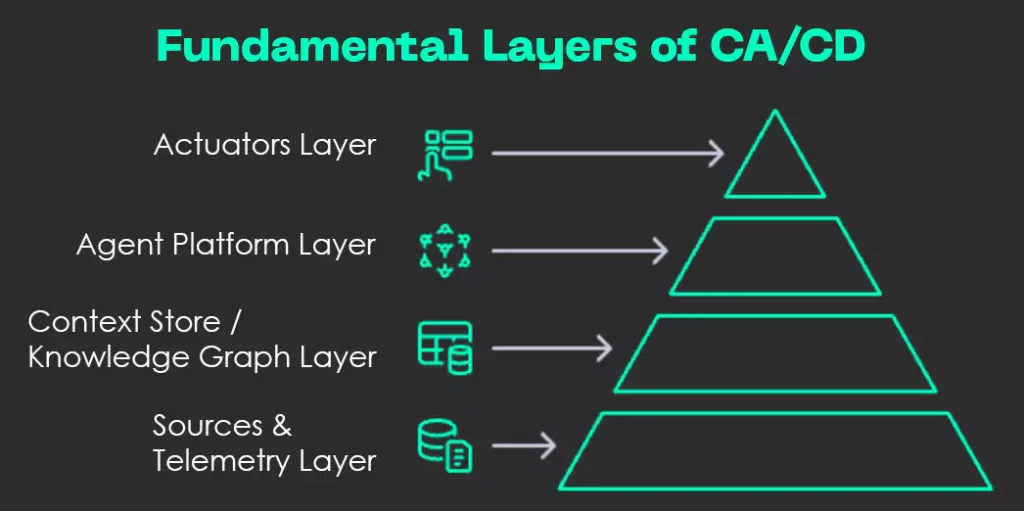
Fig: Fundamental Layers of CA/CD
1. Sources & Telemetry Layer
The foundation starts with data collection from APM (Application Performance Monitoring) tools, infrastructure metrics, code repositories, issue trackers, and user feedback. Advanced telemetry adds context like code changes, deployment environments, and business impact.
Modern systems also pull external inputs—market conditions, regulations, and threat feeds—giving agents real-time, historical, and predictive data for smarter decisions.
2. Context Store / Knowledge Graph Layer
This layer structures raw telemetry into interconnected knowledge, linking code commits to deployments, infrastructure changes to performance, and user actions to system outcomes.
It evolves continuously, combining explicit system relationships with patterns discovered through analysis. This context helps agents act on holistic system knowledge, not isolated data points.
3. Agent Platform Layer
The Agent Platform hosts specialized AI agents—deployment strategists, performance optimizers, security guardians, and incident responders. Each has its expertise but works together through orchestration.
The platform equips agents with reasoning, learning, and decision-making capabilities. With LLMs, they can also process natural language instructions and interact seamlessly with human operators.
4. Actuators Layer
This layer executes agent decisions via deployment tools, IaC platforms, monitoring systems, and communication channels—ensuring safe, logged, and reversible actions.
Modern actuators add safeguards like circuit breakers, gradual rollouts, and automated validation to prevent risky or harmful changes.
Next, I’ll walk you through the steps to follow to integrate agentic AI in DevOps.
How to Effectively Integrate Agentic AI into DevOps
Successfully integrating agentic AI into DevOps practices requires a strategic, phased approach that builds capability gradually while maintaining operational stability.
Here’s a quick walk-through that can be followed:
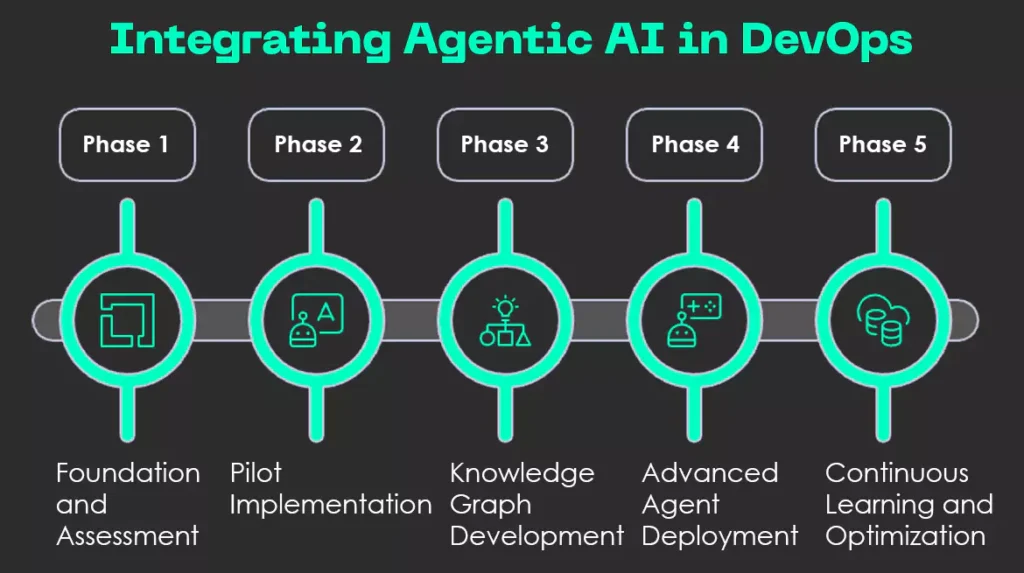
Fig: Integrating Agentic AI in DevOps
Phase 1: Foundation and Assessment
Establish observability across the delivery pipeline with monitoring, logging, and telemetry. Assess current DevOps practices to spot manual bottlenecks and areas suited for agentic automation.
Phase 2: Pilot Implementation
Begin with low-risk, high-value use cases like testing optimization or deployment scheduling. Deploy simple agents that make safe, bounded decisions to build confidence and experience.
Phase 3: Knowledge Graph Development
Create knowledge graphs linking code, infrastructure, deployments, and outcomes. Strong data engineering ensures agents access high-quality, structured information.
Phase 4: Advanced Agent Deployment
Introduce agents for complex tasks—strategy selection, intelligent rollbacks, and proactive issue resolution. Focus on change management and thorough testing for production reliability.
Phase 5: Continuous Learning and Optimization
Set up feedback loops so agents improve over time. Track effectiveness, test strategies with A/B methods, and integrate human feedback for ongoing refinement.
To experience a hassle-free integration, teams need to ensure these things:
- Strong governance frameworks
- Better transparency in agent decision-making
- Human in the loop for making critical decisions
Hold on – but do you measure the success of such complex integration?
Well, I’ve answered it in the next section, so keep reading!
What Metrics Should Be Monitored to Assess the Success of CA/CD?
Here is the set of metrics that needs to be monitored to assess the success of continuous agentic and continuous deployment:
1. Lead Time for Changes: Measure time from commit to production. Agentic systems cut delays with automated approvals and optimized strategies, reducing lead time without sacrificing quality.
2. Deployment Frequency: Track how often deployments occur and their success patterns. By removing manual bottlenecks, agents enable faster, smarter, and more frequent releases.
3. Change Failure Rate: Monitor how many deployments cause issues or need rollbacks. Agentic CA/CD lowers failures through smarter testing, risk checks, and proactive prevention.
4. Mean Time to Recovery (MTTR): Track recovery speed from incidents. AI agents accelerate diagnosis and fixes, showing major gains in recovery time.
5. Percentage of Incidents Auto-Remediated: Measure the share of issues resolved without human help. Higher values signal stronger maturity and effectiveness of agentic systems.
6. CI Minutes Saved: Calculate compute time saved through optimized testing, selective deployments, and automated decisions—reflecting efficiency and cost reduction.
7. Security Vulnerabilities Prevented: Track security issues caught and fixed by AI before production, covering both code flaws and risky configurations.
Some of the additional metrics should include agent decision accuracy, human override rates, system learning velocity, and business impact measurements that demonstrate the real-world value of agentic approaches.
Of course, it’s easier said than done. Integrating this kind of system comes with its own set of challenges. So, I’ve outlined a few key ones up next, along with strategies to help your team navigate them smoothly.
What Challenges Should One Address When Integrating Agentic AI into DevOps?
The integration of Agentic AI in DevOps brings several challenges organizations must address for successful adoption, such as:
- Trust and Explainability Challenges: Building trust in AI-driven decisions is way more difficult than it seems, especially for critical operations. To navigate it, developers must use explainable AI, audit trails, and phased low-risk rollouts to foster confidence.
- System Complexity and Reliability Risks: Agentic systems add complexity and potential new failure modes. Mitigate with strong AI testing frameworks, circuit breakers for human fallback, and continuous monitoring of decision quality.
- Security and Governance Concerns: Agents need broad access, raising security and compliance risks. To navigate this, apply zero-trust models, define clear authority limits, and enforce governance with audit trails for accountability.
- Skills and Cultural Adaptation: Teams need new skills to handle AI/ML concepts. Leaning toward training, hands-on projects, and knowledge-sharing communities to build capability and acceptance is a must in this case.
- Data Quality and Bias Issues: Poor or biased data leads to flawed agent decisions. Teams need to ensure rigorous data quality checks, diverse datasets, and ongoing monitoring for bias detection and correction.
Let’s look towards the next steps!
What Does the Future Hold for DevOps with Agentic AI?
The future of DevOps with Agentic AI promises a fundamental transformation in how organizations develop, deploy, and operate software systems, moving toward fully autonomous software delivery ecosystems.
These are the transformations likely to happen rapidly:
- Autonomous Software Factories: We’re moving toward pipelines that run end-to-end on their own, with AI agents managing everything from requirements and code to deployment and optimization. Thus, automatically translating business goals into technical execution.
- Predictive and Self-Healing Infrastructure: Agentic systems will predict issues, prevent failures, and self-heal without human input—handling scaling, optimization, patching, and configuration through predictive analytics.
- Natural Language DevOps Interfaces: Future CA/CD systems will take natural language instructions, letting business teams directly influence priorities. For example, “prioritize user experience over speed”—with agents adjusting decisions accordingly.
Quick tip – Organizations can stay prepared during the phase of dynamic changes by following these:
- Strengthening data infrastructure
- Building AI literacy
- Setting governance for autonomy
- Experimenting with simple agents to gain confidence
To simplify your roadmap, share your thoughts and requirements with us. Our AI experts will connect with you and provide tailored next steps.
So, the shift from CI/CD to CA/CD isn’t just an evolution—it’s a reimagining of software delivery powered by intelligent, adaptive, and autonomous systems.
The benefits are clear: faster lead times, proactive issue prevention, and self-learning systems. However, success demands trust, governance, and careful adoption.
Organizations that begin scaling their agentic AI capabilities today will be the ones leading the way. So, act now by reaching us at Nitor Infotech, an Ascendion company.