

The promise of Large Language Models remains clear with seamless automation, intelligent conversations/output, and smarter decisions. Large Language Models (LLMs) like GPT-4 and Claude are transforming businesses with their remarkable text generation and understanding capabilities. However, connecting these AI models to existing systems like customer relationship management (CRM) platforms, enterprise resource planning (ERP) software, legacy databases, internal knowledge bases, ticketing systems, and custom business applications often creates challenges for organizations. To solve this integration problem, Model Context Protocol (MCP) was developed by Anthropic in November 2024.
MCP creates a standardized way for LLMs to communicate with business systems. Think of MCP as the “USB-C of AI integrations” – a universal connector that makes AI implementation seamless, secure, and accessible even for those without deep technical expertise.
In this blog, you’re going to first learn about the scenario before GenAI came into the picture of integration. Then, you’ll learn everything about the Model Context Protocol, including its advantages, use cases, and integration process.
So, let’s get started!
What Were the Integration Protocols Before Generative AI (GenAI)?
Here are some integration protocols that were commonly used before the advent of GenAI:
- APIs (Application Programming Interfaces): Established methods for various software systems to communicate and exchange data
- ESBs (Enterprise Service Buses): Integration platforms that standardized communication between enterprise applications
- ETL (Extract, Transform, Load): Protocols for moving data between systems with transformation capabilities
- EDI (Electronic Data Interchange): Uniform formats for exchanging business documents between organizations
- Middleware Solutions: Software that bridged different applications, databases, and systems
- SOAP and REST: Web service protocols that facilitated communication between systems
These technologies all aimed to solve similar problems, creating standardized ways for different systems to communicate effectively.
Amongst these, the concept of a “Model Context Protocol” or “MCP” specifically for AI models represents an evolution of such integration approaches tailored to the unique requirements of generative AI systems that need to interact with business data and services.
Now, let’s explore what MCP is and why it holds significance.
What is MCP and Why Is It Essential?
Model Context Protocol, or MCP can be termed as a solution. It functions as a strategic bridge between your AI models and your broader IT ecosystem, enabling:
- Seamless data access: Connect your AI to databases, CRMs, knowledge bases, and other systems through a single standardized interface.
- Standardized communication: Establish consistent pathways for information exchange regardless of which underlying systems you’re using.
- Enhanced security: Implement proper authentication, authorization, and data protection through a unified framework.
- Improved context management: Help your AI understand conversations and information better by maintaining relevant context.
Note: Organizations trying to implement LLMs face three critical challenges, such as:
- Data Silos: Without MCP, valuable information remains scattered across different systems and databases, preventing AI from accessing the knowledge it needs.
- Communication Bottlenecks: Traditional integration methods create inefficient pathways between AI and business systems. This results in slow responses and poor user experiences.
- Security Concerns: Exchanging potentially sensitive data between AI and enterprise systems requires robust security protections that many organizations struggle to implement properly.
With MCP, these challenges are resolved. Keep reading to find out how!
What Are the Advantages of Using MCP?
MCP provides significant benefits that simplify AI adoption. Some of these advantages are as follows:

Fig: The MCP Advantage
1. Standardization
With MCP’s unified interface, organizations no longer need custom integrations for each system or model provider. This reduces development time by up to 60% while minimizing vendor lock-in risks.
2. Scalability
MCP supports dynamic scaling through horizontal server deployments and intelligent load balancing. Its stateless design ensures consistent performance even during usage spikes.
3. Security
It contains built-in authentication frameworks (API keys, OAuth) combined with encryption protocols to protect sensitive data throughout its lifecycle, from input validation to output filtering.
4. Flexibility
The modular architecture allows easy updates or replacements of individual components without disrupting the entire system, ideal as AI technologies evolve rapidly.
5. Maintainability
Standardized logging and monitoring interfaces provide insights into system performance, enabling continuous optimization while ensuring smooth upgrades without breaking existing integrations.
Now you’re familiar with the benefits. Next, you’ll learn about its advantages from a business standpoint.
What Are Some of the Business Benefits of MCP?
MCP delivers substantial business advantages beyond technical implementation. Some of them are as follows:
1. Faster Development
The standardized interface reduces development time by up to 60% compared to custom integrations, allowing you to deploy AI capabilities much faster.
2. Flexibility
MCP minimizes vendor lock-in, giving you the freedom to switch between AI providers as technologies evolve or as your needs change.
3. Enterprise-Grade Security
Built-in security protects sensitive data throughout the entire process, addressing a primary concern that often delays AI adoption.
4. Effortless Scaling
The architecture handles fluctuating workloads efficiently, ensuring consistent performance during usage spikes while optimizing resources during quieter periods.
5. Future-Proof Design
The modular architecture allows teams to update individual components without disrupting the entire system, making it easier to adopt new AI capabilities as they emerge.
Wondering what powers MCP or how it runs? Well, the next section should clear the blur.
How Does MCP Work?
Take a closer look at the architecture behind MCP:

Fig: a. Architecture of MCP
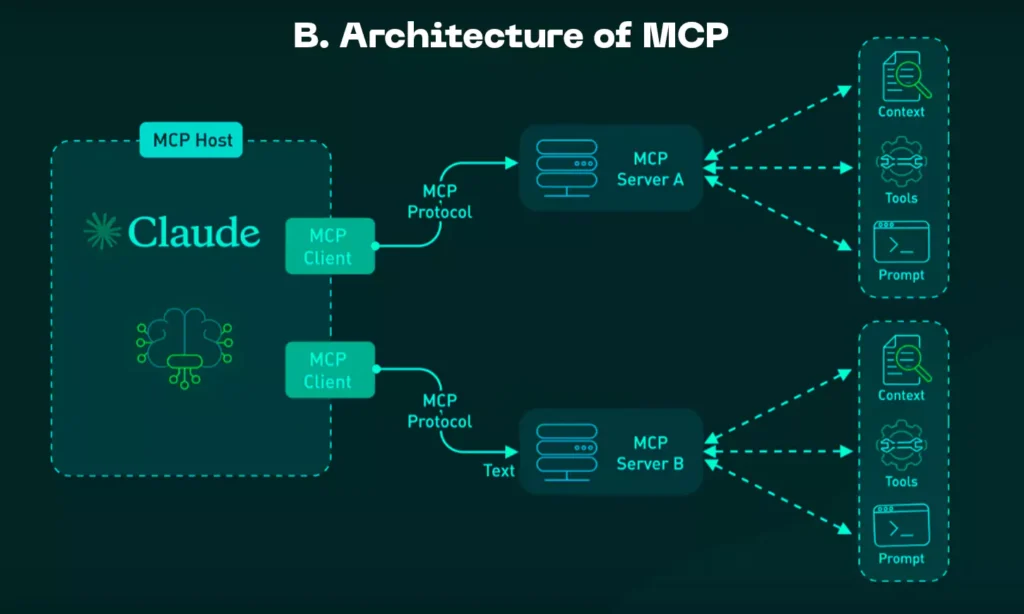
Fig: b. Architecture of MCP
MCP uses a straightforward client-server architecture that handles complex work behind the scenes. Here’s what happens:
- Your applications (websites, mobile apps, internal tools) send requests to the MCP server.
- The MCP server processes these requests and forwards them to your LLM provider.
- The LLM generates a response, which the MCP server processes.
- The server sends the final response back to your application.
This architecture ensures a clear separation between your business applications and AI models, enabling both to evolve independently without causing integration friction.
Knowledge boost: Here are the four key components of the MCP server:
- Request Handler: Acts as the gatekeeper, ensuring all incoming requests are valid and properly routed. It filters, authenticates, and directs requests to the appropriate internal modules for efficient processing.
- Context Manager: Maintains conversation history and important information across interactions, helping the AI remember previous exchanges. This continuity allows the system to provide more accurate, coherent, and personalized responses over time.
- LLM Interface: Provides a unified way to communicate with different AI providers (OpenAI, Anthropic, etc.) through a single integration point. This abstraction simplifies vendor management and allows easy switching or scaling across providers without major rework.
- Response Processor: Ensures AI responses are properly formatted, secure, and ready for delivery to your users. It may also include sanitization, localization, or enrichment layers to align responses with business standards.
FYI: This is how the MCP server facilitates seamless communication and data exchange:
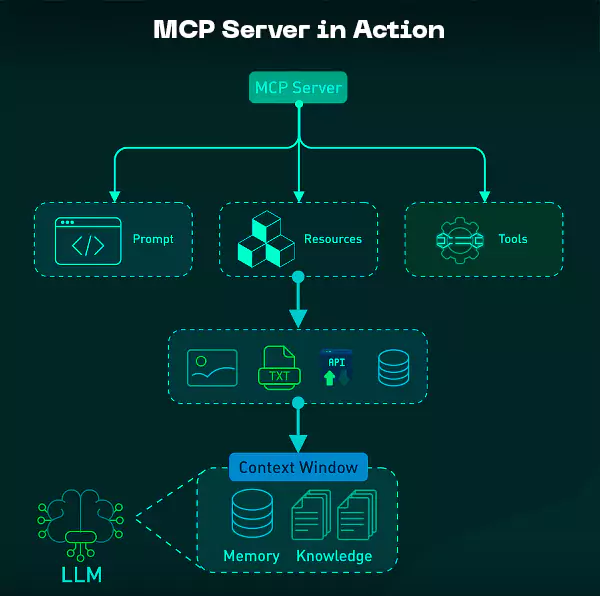
Fig: MCP Server in Action
Now let’s get practical—you’ll now learn how to implement MCP in just 5 straightforward steps.

Your roadmap to GenAI-powered product modernization starts here. Understand the why and plan the how.
How Can You Implement MCP?
Getting started with MCP doesn’t demand a massive engineering team or months of prep work. With the right approach, you can integrate it efficiently and confidently.
Here’s a streamlined way to do it in 5 easy steps:
Step 1: Choose Your Tools
Opt for Python with Fast API to build your MCP server. Fast API offers high performance and simplicity. This makes it ideal for developing APIs that interact with large language models (LLMs). Its asynchronous capabilities and automatic documentation generation streamline development.
Step 2: Set Up the Basic Structure
Initialize a FastAPI application and define endpoints to handle incoming requests. You can utilize Pydantic models for data validation and serialization, ensuring that your API can process and respond to client inputs effectively. This foundational setup allows your server to communicate seamlessly with clients.
Step 3: Connect to Your LLM
Integrate your application with your chosen AI provider’s API, such as OpenAI or Anthropic. This involves:
- Setting up API clients
- Managing authentication keys securely
- Creating functions that send user inputs to the LLM
- Return the generated responses
Step 4: Implement Security Basics
Secure your API by implementing authentication and authorization mechanisms. FastAPI supports OAuth2 and JSON Web Tokens (JWT) for managing user sessions and protecting endpoints. Additionally, ensure data protection by validating inputs and handling exceptions appropriately.
Step 5: Start Small and Expand
Begin with a minimal viable product or POC focusing on a specific use case to validate your setup. Once the core functionality is stable, incrementally add features and scale your application. This approach allows for manageable development and easier debugging.
That’s it!
Let’s move onwards to learn some of the real-world use cases of MCP!
What Are the Real Business Use Cases of MCP?
Here’s how MCP can transform various industries:
- Customer Support Automation
With MCP, you can integrate Large Language Models directly into your CRM systems, enabling AI-powered agents to deliver instant, context-aware responses. By maintaining conversation history and pulling in relevant customer data, support interactions become faster, more personalized, and far more efficient. This frees up human agents to handle complex cases. - Knowledge Management
MCP allows organizations to connect internal databases, wikis, and document repositories with LLMs, giving employees on-demand access to accurate, up-to-date information. Whether it’s onboarding a new hire or assisting a project team, this seamless knowledge retrieval reduces time spent searching and improves decision-making across the board. - E-Commerce Personalization
Through MCP, businesses can connect their product catalogs, user profiles, and behavioral data to LLMs, enabling highly tailored shopping experiences. From recommending products based on browsing history to assisting with purchase decisions in real-time, MCP helps boost engagement and drive conversions with intelligent personalization.
These use cases showcase how MCP unlocks the true potential of AI. They also reflect how MCP tackles integration challenges head-on—and believe me, this is just the beginning.
Before wrapping up this read, I’d like you to know about some important security measures that you need to consider while implementing MCP.
What Security Measures Should You Prioritize while Implementing MCP?
When implementing MCP, prioritize these essential security measures:
- Validate all inputs: Filter and sanitize user inputs to prevent potential attacks.
- Secure your credentials: Never include API keys directly in your code. Always use environment variables or a secrets manager.
- Implement proper authentication: Verify user identities before processing requests.
- Encrypt sensitive data: Protect information both in transit and storage.
- Filter AI outputs: Prevent accidental disclosure of sensitive information in responses.
By following such best practices, you should be in a secure spot!
Your Takeaway
MCP marks a pivotal shift in how businesses can seamlessly weave AI into their digital ecosystems. It addresses core integration challenges like fragmented data access, communication gaps, and security concerns, while maintaining the robustness required for enterprise environments.
Its standardized framework turns a once-daunting technical hurdle into a manageable, streamlined process. This way, it opens the doors for innovation across companies of all sizes, regardless of their technical maturity.
So, whether you’re laying the groundwork for AI adoption or scaling existing efforts, MCP is set to offer a future-ready foundation that aligns with business goals and accelerates meaningful outcomes.
With MCP in place, teams can move beyond the plumbing and focus on delivering impactful AI-powered experiences that drive efficiency, agility, and competitive edge.
Bonus: Stay tuned for the next part of the blog where I’ll bring you a brilliant proof-of-concept using MCP to help you understand the implementation better.
In the meantime, feel free to contact Nitor Infotech to explore even more ideas, get your questions answered, and kickstart your next big project powered by artificial intelligence (AI).