

Highlights
It is time to understand how AI has begun evolving from a limited tool to a genuine collaborator. This dramatic shift towards agentic science empowers AI systems to autonomously propose hypotheses, design experiments, and learn iteratively, compressing discovery cycles across biology, chemistry, and physics.
There are certain foundational elements that have already led to notable progress in various fields. It is true that there are also ethical implications and challenges that accompany these changes, but they can be overcome. It is time to navigate the path to using AI responsibly in scientific research and beyond.
Scientific discovery has always been a human-driven pursuit. It ranged from hypothesis formation to designing experiments, analyzing those, and iterating based on findings. In recent years, with artificial intelligence (AI) in the picture, the scientific landscape has transformed drastically — helping researchers process massive data, simulate complex systems, and make predictions at scales previously impossible. However, we stand at the cusp of a deeper transformation: AI not just aiding science, but becoming an agentic collaborator in scientific discovery. This is where “AI for science” is the current norm and “agentic science” is the emerging paradigm.
In this blog, you’ll unpack the journey — from what AI has already done for science, toward systems that can reason, plan, experiment, and learn autonomously. The blog also covers how agentic science is being built, real-world case studies of early successes, what the path ahead looks like, and what is needed so that this evolution yields maximal benefit with minimal risk.
Let’s get started!
How is AI Evolving from a Tool to a Collaborator in Science?
Scientific discovery has always been a human-driven enterprise: form a hypothesis, design experiments, analyze, iterate. With AI, much of this loop has been accelerated. Machine learning models help with pattern detection. Simulations model physical and biological systems; predictive tools guide experiments. But in most cases, the scientist still defines the questions, orchestrates the workflow, and interprets results.
Here, agentic science flips the approach. Meaning, AI systems are not passive responders but active partners. They:
- Propose hypotheses
- Select which experiments to run
- Adjust strategies based on results
- Collaborate with humans and other agents
This is a shift from AI as a tool to AI as a collaborator.
This evolution doesn’t happen overnight. It depends on multiple technical, infrastructural, ethical, and social enablers. In what follows, I explore where we are (AI for science), what agentic science means, the building blocks, case studies of emerging agentic systems, what the future might hold, and what we must ensure as we move forward.
Where Does AI Stand in Scientific Research Today?
Here is the list of things that AI is currently doing across the scientific terrain:
- Prediction and simulation: AI models have become excellent at simulating complex phenomena (for example, molecular dynamics, structure prediction, and climate models) and making predictions based on historical data.
- Data processing and pattern detection: In genomics, astronomy, particle physics, and climate science, AI helps sift through vast datasets (images, sensor data, satellite data) to extract signals, anomalies, and correlations.
- Optimizing workflows: AI helps design experiments more efficiently (for example, choosing parameter settings, selecting interesting candidates). It automates parts of the pipeline (image classification or measurement interpretation).
Here’s a concise overview of AI’s scientific advantages:
- Scale and speed: Tasks that once took months or years can often be done much faster.
- Handling complexity: Datasets of high dimensionality, noisy data, and subtle correlations are better handled by modern machine learning methods.
- Reproducibility (when done carefully): With standardized pipelines and data sharing, AI models improve reproducibility — for example, in structure prediction and materials modeling.
However, you need to consider the limitations of AI as well, like:
- Passive role: Most systems rely on humans for questions, data, and interpretation; AI rarely defines its own hypotheses or experiments.
- Interpretability and trust: Many AI models are black boxes, making their predictions and performance in new scenarios hard to trust.
- Experiment execution: Predictions are often not enough; physical experiments are costly, slow, and require human oversight. AI typically cannot run wet-lab or field experiments without significant human support.
- Bias, data quality, and domain gaps: Dataset bias and data gaps limit generalization, while many ML models lack domain knowledge and causal reasoning.
I’ve mentioned “agentic science” since the start of this blog, and you’re probably wondering what it means. Let’s define it clearly.
What is Agentic Science?
“Agentic science” refers to reimagining scientific discovery so that AI agents take on greater autonomy in the scientific process. It is not about replacing human scientists. It is about augmenting and extending what is possible when AI is more proactive.
Here are some of the key features of agentic science:
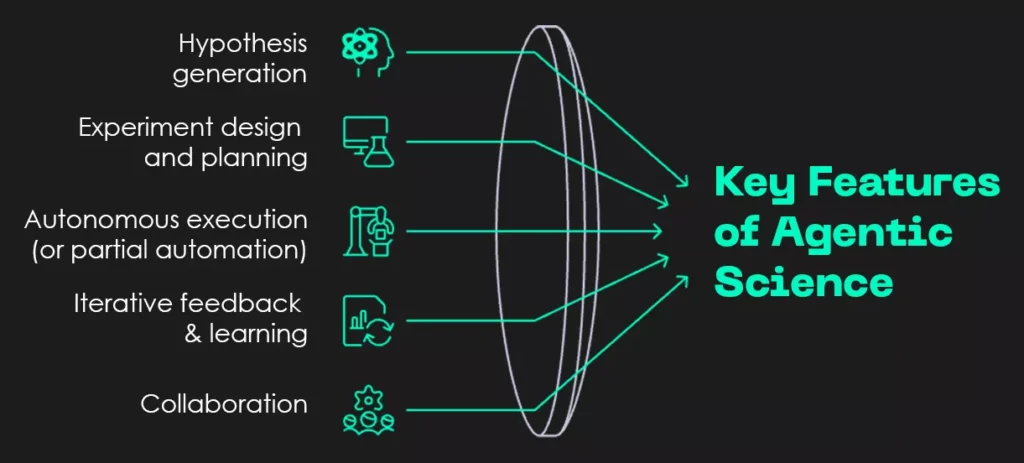
Fig: Key Features of Agentic Science
- Hypothesis generation: AI systems that can look across data, literature, and past experiments to identify gaps in understanding and suggest new hypotheses.
- Experiment design and planning: Deciding which experiments to run, how to vary parameters, which methods to use; prioritization under constraints (costs, safety, resources).
- Autonomous execution (or partial automation): Engaging robots, self-driving labs, or hardware/software pipelines to carry out experiments, gather data, and measure results.
- Iterative feedback & learning: An agent reviews outcomes, adjusts its models, learns from failures, and plans subsequent rounds of inquiry.
- Collaboration: Humans and AI agents work together—sharing knowledge, splitting tasks, and supervising as needed.
Curious how it all works? Next, I’ll break down the key building blocks of agentic science to answer this.
Why this matters
Agentic science has the potential to compress discovery cycles, explore larger or more complex design spaces, reduce human effort in routine decision-making, democratize access, and enable novel scientific questions to be asked. It also means we must think carefully about trust, transparency, resource allocation, and governance.
What Are the Key Building Blocks of Agentic Science?
To achieve agentic science, several technological, infrastructural, and methodological building blocks are needed. Here’s how it’s structured:
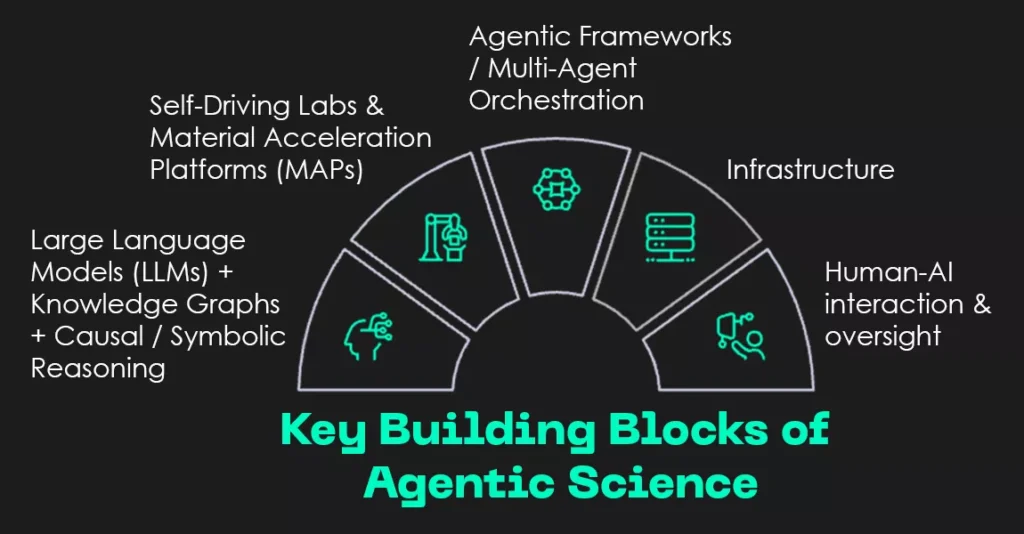
Fig: Key Building Blocks of Agentic Science
1. Large Language Models (LLMs) + Knowledge Graphs + Causal / Symbolic Reasoning
- LLMs help absorb large quantities of scientific literature, suggest hypotheses, and generate summaries.
- Knowledge graphs enable the grounding of facts, linking related concepts, and enabling reasoning across domains.
- Symbolic and causal reasoning help with understanding mechanisms, enabling more explainable hypothesis generation.
2. Self-Driving Labs & Material Acceleration Platforms (MAPs)
- Automated synthesis, measurement, and characterization systems.
- Feedback loops with machine learning models to select experiments intelligently rather than exhaustively.
3. Agentic Frameworks / Multi-Agent Orchestration
- Systems for multiple agents with specialized roles (for example, design agent, measurement agent, analysis agent) coordinated via communication protocols, shared memory, and provenance tracking.
4. Infrastructure
- High-performance computing (HPC), cloud access, robotics, and automated instrumentation.
- Standardization of data protocols, metadata, experiment logging, and versioning to preserve reproducibility and traceability.
5. Human-AI interaction & oversight
- Interfaces and oversight mechanisms so that humans can inspect, guide, and correct agents.
- Ethical, safety, and regulatory frameworks to manage risk.
Bonus: Agentic science could unlock these opportunities:
- Discovery acceleration: Faster material, drug, and catalyst discovery; quicker detection of emergent phenomena.
- Vast design exploration: Choose the most informative experiments when costs are high.
- Interdisciplinary breakthroughs: Link data and methods across biology, chemistry, physics, and more.
- Democratization of science: Enable remote self-driving labs and open agentic frameworks for wider access.
- Continuous learning: Agents share and evolve knowledge globally, uncovering patterns beyond human reach.
Next, let’s explore some real-world impacts.
How Is Emerging Agentic Science Showing Up in the Real World?
Here are concrete examples of systems and projects that already show agentic behavior — closed-loop hypothesis generation, experiment design, autonomous execution, and learning.
A: Redefining Prediction in Biology
What it does:
A computational system accurately predicts 3D protein structures from amino acid sequences. Previously, this required slow, costly experimental methods. Now, many predictions can be done in minutes.
Impact:
The system achieves near-experimental accuracy and supports a global database of predicted structures. It enables researchers to design therapeutics, explore binding sites, and understand disease mechanisms.
For instance, it has aided studies on vaccines, bone diseases, and protein malfunctions in neurodegenerative conditions.
Agentic aspect: Guides experimental priorities by suggesting which proteins to study experimentally.
Limitation: Does not perform experiments; humans still validate and refine predictions. Confidence varies for complex or disordered proteins.
B: Self-Driving Laboratories & Materials Acceleration Platforms (MAPs)
What it is:
Self-driving laboratories and materials acceleration platforms are automated systems combining robotics, AI/ML for experiment selection, and feedback loops to accelerate material discovery and optimize properties like conductivity, stability, or toxicity, often with minimal human intervention.
Impact:
These platforms enable autonomous experiment execution, measurement, and iterative improvement, effectively closing the scientific loop. Distributed networks and shared infrastructure make advanced experimentation more accessible.
Agentic aspects:
- Select experiments autonomously using predictive models (active learning).
- Execute experiments with minimal human intervention and update models based on results.
Challenges & limitations:
- Early-stage, expensive, and often domain-specific setups.
- Hardware limits, reproducibility issues, measurement errors, and safety constraints require oversight.
- Integration of prior knowledge, causal reasoning, and open-ended hypothesis generation is still limited.

Accelerate your digital transformation with our GenAI expertise. Transform your product vision into reality.
C: End-to-End AI in Drug Discovery
A strong example of combining prediction, design, and experimental realization is in the drug discovery pipelines.
What’s happening:
- Tools like generative chemistry models, in silico ADMET (absorption, distribution, metabolism, excretion, toxicity) prediction, and lab synthesis/testing are being brought together in coordinated workflows.
- For example, one study combined predicted protein structures, generative chemistry models, and computational target selection to identify a first-in-class small molecule inhibitor for a novel target in about 30 days, using only a handful of synthesized compounds.
Significance:
- Demonstrates that even when full autonomy isn’t available, integrating AI components creatively can dramatically shorten discovery time and raise productivity.
- Shows that predicted structures can feed downstream tasks (molecule generation, selection, synthesis, bioassays) in a near-agentic pipeline.
Limitations still present:
- Oversight is required: human decision on toxicity, safety, and experimental design.
- Regulatory, ethical, and cost constraints remain.
- Not every target or disease area is equally amenable to current AI pipelines; experimental validation, patenting, and scalability issues are nontrivial.
D: Robot Scientists – Closing the Scientific Loop
Among the earliest demonstrations of agentic science were autonomous “Robot Scientist” systems designed to carry out the entire scientific process, not just analyze data.
One system focused on functional genomics in yeast. It automatically generated hypotheses about gene function, designed and executed experiments using robotic labs, and interpreted the results, making novel discoveries for several previously uncharacterized genes.
Its successor targeted early-stage drug discovery. Equipped with automated compound screening and reasoning algorithms, it optimized which compounds to test, prioritized promising leads, and reduced experimental workload for costly drug pipelines, including neglected tropical diseases.
Agentic Aspects:
- End-to-end operation from hypothesis generation to experimental execution.
- Iteratively updated hypotheses based on new results.
- Bridged digital predictions with physical lab execution.
Limitations:
- Restricted to specific domains; scaling across fields was infeasible.
- Depended on predefined frameworks; lacked broad generalization or creativity.
- Required substantial human input for design, target selection, and result interpretation.
Why it matters:
These early systems demonstrated the potential of autonomous scientific agents, showing how AI can act as an active collaborator. Their limitations also highlight the gap between early automation and today’s more general, flexible agentic systems.
Yes, agentic science has the potential to achieve remarkable breakthroughs across many fields. But it’s important to also be aware of the challenges that come with it.
What Challenges and Risks Should You Consider in Agentic Science?
Here are some of the risks that one should consider when dealing with agentic science:
1. Trust, interpretability, and validation: These questions may often arise:
- How do we validate hypotheses generated by agents?
- When do we trust agentic predictions/experiments versus human intuition or prior knowledge?
2. Bias, fairness, and data coverage: Bias in training datasets, geographical biases, experimental contexts could lead agents to make spurious or unfair suggestions.
3. Safety, ethical, and regulatory issues: Autonomous experiments might have risks (chemical safety, biosecurity).
4. Infrastructure & cost: Self-driving labs and robots are costly, and keeping them standardized, compatible, and well-maintained is challenging.
Extra read: Mitigating Hallucinations, Bias, and Toxicity in LLMs – Part 1
Tip: Here’s what you should do to overcome such challenges:
- Decide which decisions should be automated vs overseen
- Ensure human judgment is used responsibly
- Avoid overreliance or complacency
Let’s proceed to what’s coming up!
What’s Next for Agentic Science, and How Should You Prepare?
Having seen what agentic systems can do already, the next decade (2025-2035) is likely to shape agentic science in several interlocking dimensions.
Here are some of the technological and scientific trajectories that you can expect:
- Deeper hybrid reasoning: A convergence of neural networks, LLMs, knowledge graphs, symbolic logic, and causal modeling. Agents that can understand mechanisms, make predictions, reason about “what if”, and not just interpolate.
- More robust closed-loop experimentation: Self-driving labs will become more affordable, modular, and distributed. Labs that can operate 24/7, automating more stages: not just measurement, but sample preparation, error recovery, and anomaly detection.
- Generalization across domains: As agents learn across tasks and domains, they can transfer knowledge and reuse past experiments in new contexts.
- Scalable multi-agent systems: Multiple specialized agents coordinate—e.g., for hypothesis, synthesis, measurement, or safety—or form networks that share insights while respecting local constraints.
Here are key trends in infrastructure, accessibility, and ecosystem development to watch for:
- Wider deployment of self-driving labs / MAPs: Shared facilities, cloud labs, national/international nodes accessible remotely. Such infrastructure will help smaller labs and institutions get access to agentic capabilities.
- Data, metadata, standardization, and provenance: To support reproducibility, agents must log experiments, parameters, failed experiments, results, methodologies, and safety data.
- Cost & resource sharing models: Since hardware, automation, and robotics are expensive, models like pay-per-use labs, collaborations, and public-private partnerships could reduce entry barriers.
- Open source & open science culture: Open code, open datasets, open publications will help verify, reproduce, and build on agentic science tools. This means that transparency will remain central.
Here are key trends in ethical, regulatory, and societal considerations to watch for:
- Safety and oversight mechanisms: Autonomous or semi-autonomous systems in lab environments must include fail-safes. Human-in-the-loop will become a must for high-risk decisions.
- Accountability & legal frameworks: As autonomous agents take on more decision-making, clear responsibility and liability structures will be crucial for handling errors, from chemical accidents to data breaches or mispredictions.
- Ethical use & dual-use concerns: Technologies, for example, drug discovery, synthetic biology, or materials, could be misused. So, oversight, transparency, and regulation will become essential.
- Equity and fairness: It will be vital to ensure that benefits extend beyond wealthy institutions or nations, providing equitable access to data and infrastructure while preventing bias and exclusion.
All said and done, agentic science marks a transformative shift in how we approach discovery. By moving beyond AI as a tool to autonomous hypothesis generation, experiment design, and learning, it promises faster, more accessible, and equitable science. With the right technology, infrastructure, and ethical frameworks, the future of scientific exploration is being reimagined already.
I recommend diving into the agentic science journey now to stay ahead and cut through the noise. For guidance or more insights, feel free to contact us at Nitor Infotech, an Ascendion company.