
Picture this: an intern builds a complete working customer feedback app in just two hours. No developers, no sprint planning, no technical debt – just a raw idea transformed into functional software. Long live the vibe coding king, long live its coding vibes!
Wondering what the backstory is? Well, the development game got a massive upgrade with better vibes!
What I mean is – software development is no longer just about writing lines of code. Now, it’s about solving problems quickly, experimenting freely, and delivering usable products/prototypes with minimal overhead. Over the past decade, this shift has been reflected in the rise of low-code platforms, no-code builders, and intelligent IDEs. However, most of these tools either come with limitations or still require a learning curve that excludes non-technical users. That’s where vibe coding steps in!
What emerged as a concept in early 2025 (by AI researcher Andrej Karpathy), is now a way to express software intent using plain English, allowing artificial intelligence to handle the rest.
The evolution of vibe coding parallels major advances in large language models (LLMs) and generative AI, such as GPT-4, which can now parse vague or abstract requests and generate viable code in seconds. It represents a convergence of AI, software engineering, and user-centric design. It’s a new phase in the software lifecycle where humans steer direction and AI fills in technical gaps.
So, in this blog, you’re going to learn everything you need to know about vibe coding, including its advantages, mechanisms, implementation process, and much more.
Let’s begin with the basics!
What Exactly is Vibe Coding?
Vibe coding is an emerging software development approach where users describe what they want, and the software executes the job. The software that the coder prefers is powered by artificial intelligence that generates code by analyzing and understanding simple English.
It doesn’t rely on GUI templates or drag-and-drop logic. Instead, it focuses on intent, expression, and iteration.
Simply put, the word “vibe” refers to the user’s desired outcome or behavior – whether it’s creating a web dashboard, building an animation tool, or connecting an app to a live data source.

Fig: A User teaching an AI Bot to Set the Vibe
What sets vibe coding apart are the following key differentiators:
- It doesn’t require rigid syntax.
- It’s collaborative. That is, AI generates the base, and humans guide refinement.
- It supports rapid, feedback-driven development cycles.
While it’s related to no-code/low-code, vice coding is more flexible and closer to full-code solutions. It empowers not only developers but also entrepreneurs, designers, educators, and business professionals to build functional tools without writing every line themselves.
This trend is not only shaping the way code is written but also redefining who gets to write it. Trust me, from startups to enterprise teams, the use cases are massive now.
Onwards to know about the major benefits that one can experience with vibe coding!
What Are the Key Advantages of Vibe Coding?
Vibe coding offers a multitude of practical advantages, especially in environments where time-to-market and experimentation are important.
Here’s a closer look at its key benefits:

Fig: Key Advantages of Vibe Coding
1. Rapid Experimentation and Prototyping
It enables users to turn ideas into functioning software within hours (instead of months). This is a significant boost for startups or small teams that need to test business hypotheses or gather user feedback quickly. The breakthrough – No need to wait weeks for wireframes to be translated into production-ready code.
2. Accessibility for Non-Developers
With minimal training, non-technical professionals can now build internal tools, apps, or dashboards. Whether you’re a product manager, teacher, or a creative professional, vibe coding is set to level up your field of play.
3. Enhancing Developer Productivity
For experienced programmers, vibe coding doesn’t replace traditional methods; rather, it enhances them. This means that developers can offload repetitive tasks to AI, allowing more time for logic design, performance optimization, or system integration.
4. Reducing Development Costs
Hiring developers is expensive, especially for early-stage founders. Vibe coding helps reduce reliance on large engineering teams by handling standard tasks and boilerplate code.
5. Supporting Agile Workflows
This method complements agile principles such as continuous feedback, iterative delivery, and working software over documentation. As prompts evolve, AI adapts to them. This makes it easier to integrate real-time stakeholder input.
6. Creative Freedom
It takes away the constraints of language syntax, which can foster a more creative and intuitive development process. It allows users to imagine functionality, describe it, and then refine it interactively.
If you’re not sure about how vibe coding differs from traditional programming, the next section breaks it down for you.
How Does Vibe Coding Differ from Traditional Programming?
Here’s a tabular comparison to highlight the distinctions between traditional programming and vibe coding:
| Aspect | Traditional Programming | Vibe Coding |
|---|---|---|
| Input Format | Written in a programming language | Natural language (text or speech) |
| Required Skills | High-level knowledge of syntax, logic, architecture | Basic understanding of functionality and goals |
| Development Speed | Slower, especially for new projects | Faster, especially for prototypes and internal tools |
| Debugging | Manual process through code review and testing | AI-supported with conversational feedback |
| Flexibility | High control but more effort | High automation, lower manual control |
| Ideal For | Production-grade applications, complex systems | MVPs, educational apps, internal tools, creative projects |
| Maintenance | Handled by dev teams using best practices | Requires AI-aware code review for maintainability |
| Scalability | Optimized for scaling | Limited by current AI’s understanding of complex architectures |
Moral of the section: Unlike traditional development, which emphasizes structure, syntax, and manual control, vibe coding is all about natural language input in plain English with real-time feedback loops and AI-generated output. It’s the perfect fit for a world that demands rapid product development and scalability.
Curious how the magic actually happens? Learn how vibe coding works behind the scenes next!
What’s the Underlying Mechanism Behind Vibe Coding?
At a technical level, the heart of vibe coding is driven by natural language processing, large language models, and code execution feedback. Here’s how its entire mechanism works:

Fig: Mechanism Behind Vibe Coding
1. Input Interpretation
It starts with the user who provides a clear, goal-oriented description (or prompt) of what they desire to achieve or build. This prompt may include a multitude of functional expectations, visual behaviors, and technological preferences.
2. AI-Code Generation
In this phase, AI models like GPT-4 analyze and interpret the language and start to generate code blocks (meaning the AI starts to work its magic at this point). This could involve various approaches as per the user’s demand/prompt, such as:
- HTML/CSS for layout
- React components for behavior
- API logic in Node.js
3. Execution
Next, the generated code then runs in a sandboxed or IDE environment (Integrated Development Environment), where the user can observe the preview in real-time.
4. Feedback
Imagine you’ve the perfectly curated prompt input and have asked the model to build a landing page. The results – wrong headings, distorted design, bad color contrast, etc. These issues are quite common. So, you must prompt again to fix the errors and make it better. The AI model then understands your input and starts to adjust.
5. Refinement Cycle
This process is repeated as needed. Each round improves alignment between the original intent and the functional result.
Behind the scenes, such models rely on:
- Pretrained datasets containing code examples across multiple languages
- Pattern recognition to map requests to code logic
- Token-based context windows to preserve project-level understanding
This continuous loop of input → generation → testing → refinement is the core engine that fuels vibe coding.

Don’t settle for mediocre. Upgrade, enhance, and lead with the power of GenAI to build market-ready products.
Now that you’re familiar with the theory and your vibe is in sync, let’s move on to how you can successfully implement vibe coding in practice.
How Can You Successfully Implement Vibe Coding?
Implementing vibe coding can be challenging when there’s resistance to adopting emerging development practices. However, by following a structured approach, you can effectively get started with vibe coding:
Step 1: Select the Right Platform
Choose an AI-powered IDE or assistant from a range of options. Here is a list of a few:

Fig: Range of Vibe Coding Platforms
These tools support various languages and real-time collaboration, ideal for greater coding vibes/experiments.
Step 2: Draft an Intent-Focused Prompt
In this phase, you need to describe what you wish to build in a detailed manner. A good prompt will always have these:
- The goal (e.g., create a music visualizer)
- Behavior expectations (e.g., animations that react to sound)
- Tech preferences (e.g., using React and Tailwind)
Here’s a sample prompt that I used to build an app called Taskonaut:
“Build a space-themed app called Taskonaut—a to-do list and project management tracker. It should include: task and project sections (for personal, work, and learning goals), a focus mode with timers and break intervals, an analytics dashboard with progress charts, a calendar for scheduling, an achievement-based gamification system, and an AI-powered summarization popup with improvement suggestions. Include a login screen where users enter a unique name to begin. The UI should evoke an astronaut-in-space experience. Use Tailwind, CSS, JavaScript, and HTML to build it.”
Step 3: Evaluate the Initial Output
Next, you need to run the code, interact with it, and take note of what works and what doesn’t work. Feel free to use breakpoints or console logs if needed.
Step 4: Refine the Prompt or Code
There are two approaches to making the necessary tweaks:
a) If you’re a non-technical person, you can use plain and simple English to describe the tweaks. For example, in my case, I described the changes with this prompt:
“I’d like you to make a few updates to the app. Please add a toggle button on the login screen that allows users to switch between dark and light modes. Also, enhance the UI by improving the color contrast and overall visual design for a better user experience.”
b) If you’re a technical user, you can choose to manually edit the generated code for precision. You can simply prompt the AI model/assistant saying, “Make the necessary changes using these code snippets”:
i) JavaScript code block:
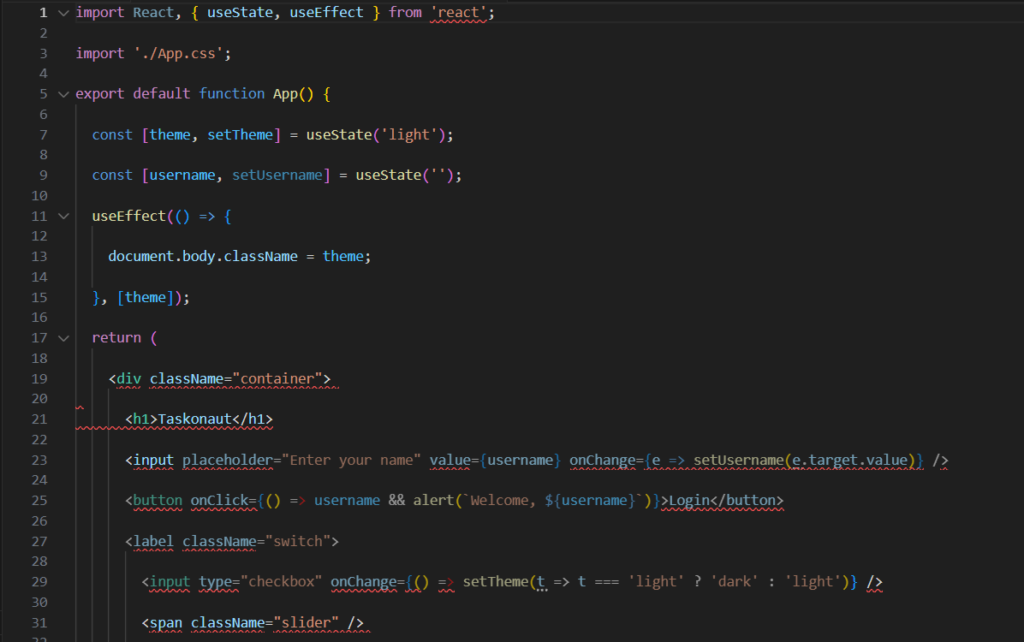
Screenshot: JavaScript code block 1

Screenshot: JavaScript code block 2
ii) CSS code block:

Screenshot: CSS code block 1

Screenshot: CSS code block 2

Screenshot: CSS code block 3
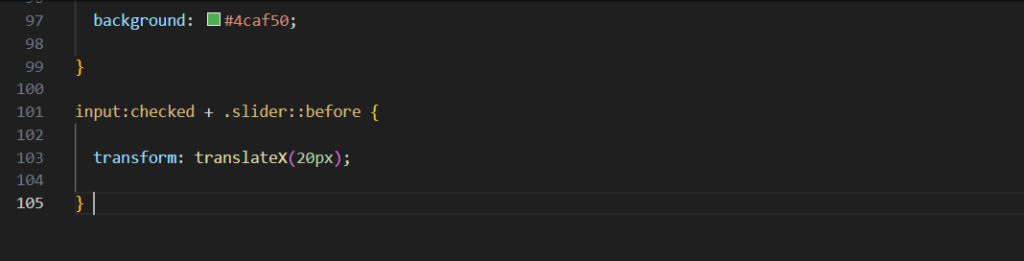
Screenshot: CSS code block 4
Step 5: Finalize and Ship
Once the code behaves as intended, conduct final reviews, integrate into repositories, and deploy using your preferred CI/CD setup.
That’s it!
Watch this demo of Taskonaut – a productivity app, I’m currently building on Lovable.dev:
Please note: While vibe coding opens exciting possibilities, it’s important to be aware of the practical challenges that come with adopting this approach. Let’s look at some of them!
What Challenges Might You Face While Embracing Vibe Coding?
Despite its potential, vibe coding comes with its own set of limitations, such as:
1. Code Quality Issues
AI-generated code may be faulty at times with logic flows, anti-patterns, or redundant logic. This may usually happen when the prompts are vague or the AI model hallucinates.
2. Debugging Difficulty
Since the structure isn’t always transparent, debugging AI-generated output can be tricky, especially for large components.
3. Maintenance Complexity
Teams inheriting AI-built apps might encounter unclear code flows unless documentation and context are preserved.
4. Limited Control for Complex Systems
Vibe coding is best suited for individual modules or tools, but not full-scale enterprise-grade applications. This is due to current limitations in architectural understanding.
5. Security Gaps
AI may not follow security best practices unless explicitly instructed. This introduces risks if the output is not thoroughly reviewed.
Despite all these roadmaps, vibe coding is the new magic that everyone wants to try out. Moreover, many system-related issues are expected to diminish as AI models continue to evolve.
Plus, I’ve got a bonus section for you before wrapping up. Keep reading to learn about the best practices that you can follow.
Which Best Practices Can Maximize the Impact of Vibe Coding?
To make the most of vibe coding, teams should adopt the following practices:
- Prompt Iteration: Treat prompts like living specs. Improve them with each iteration for better output.
- Follow Layered Design: Start with small features and gradually combine them. Avoid monolithic prompts.
- Review Each Coding Block: Just because it’s AI-generated doesn’t mean it’s safe or optimized. Manual code review is essential. (This is especially if you’re planning to deploy an app or site for commercial use.)
- Use Version Control: Always track changes in Git for rollback, collaboration, and traceability.
- Document the Process: Explain what the prompt was, what changed, and why. This helps with future maintenance.
- Combine with Tests: Use unit and integration testing to validate AI output at every stage.
Onwards to know what the future of vibe coding holds!
Where Is Vibe Coding Headed?
The future of vibe coding looks promising. However, it is yet to reach its full potential. Here are several trends that are likely to influence its next phase:
1. Voice-Based Coding
We’re already seeing experiments with speech-to-code interfaces. Imagine telling your IDE what to build, and watching it unfold.
2. Domain-Aware AI Models
Soon, AI coding assistants will have contextual knowledge specific to industries like banking, healthcare, and education. This will likely make the outputs even more tailored and usable.
3. Integration with DevOps
AI-generated code could automatically include deployment scripts, test cases, and monitoring hooks, making continuous delivery more seamless.
4. Hybrid Teams
Businesses may soon adopt hybrid development teams – composed of domain experts, developers, and AI tools—all working together in shared workspaces.
5. Regulation and Governance
As AI takes on more responsibility, organizations will likely need policies on usage, accountability, and code ownership.
That’s all for this time!
Vibe coding is not a trend that will fade – it’s a transformative development that aligns with the needs of modern software teams. By enabling natural language-driven creation, it offers faster iteration, improved accessibility, and a fresh way to collaborate with AI in the loop.
While it’s not without limitations, its potential to empower non-developers, streamline prototyping, and augment developer productivity makes it a valuable methodology for anyone building digital tools today.
As AI models become more intelligent and better aligned with domain-specific tasks, vibe coding will likely become a core component of how applications, be they simple or complex, are conceived and built.
So, whether you’re an entrepreneur testing an idea, a developer optimizing workflows, or a leader exploring AI integration, vibe coding is worth adding to your development toolbox.
Start vibing today: Interested in learning more about such emerging trends and advanced technologies? Contact us at Nitor Infotech, an Ascendion company.