

Highlights
This blog offers a detailed comparison of LangChain and AutoGen, two major frameworks driving today’s multi-agent AI systems. It explains how each framework works internally – their architectural foundations, core components, communication styles, and reasoning patterns. You will learn the strengths, limitations, and best-fit scenarios for each, supported by industrial use cases like research automation, customer support, debugging, data analysis, and role-based agent collaboration. The blog concludes with clear guidance on when to choose LangChain for deterministic workflows or AutoGen for conversational, emergent problem-solving. A complete guide for anyone building next-generation agentic AI applications.
One of the major growth factors of artificial intelligence (AI) is multi-agent systems orchestrated by agentic frameworks, which have generated significant excitement in the tech industry. Such complex architectures are moving forward from mathematical ideas to real-world business applications, in which AI agents form a holistic ecosystem of knowledge sharing and reasoning to achieve desired outcomes. At the heart of such developments lie strong frameworks like LangChain and Microsoft’s AutoGen.
These two agentic AI frameworks share the same goal of making multi-agent development easier. However, they differ in their architectural designs and the ways they operate.
In this blog, you will learn the main differences between LangChain and AutoGen, their technical architectures, common usage scenarios, and examples of the industrial sectors where they are used. After reading this blog, you will be able to decide wisely which of these you will leverage for your next AI project.
So, let’s get started!
What is LangChain and Why Is It Important?
LangChain has evolved as the go-to solution for building applications, powered by LLMs. Its core strength lies in providing a toolkit for binding LLMs with other components. This enables complex graph-level reasoning and interaction.
Here are some of the major advantages of LangChain that make it important:
- Extensive Ecosystem: LangChain is an open system that can be integrated with a multitude of LLMs, data sources, and different kinds of tools. In short, its flexibility stands out as an advantage for interacting with various components of an application.
- Modular Design: Its modular design allows unlimited customization for business solutions. Changing components, trying out different models, and integrating customs, you name it, with LangChain, all of these will feel like a breeze.
- Strong Community Support: It offers a huge community of users. This means that there are a lot of resources, tutorials, and support available for anyone to access and build greater products.
Onwards to learn about the core architecture of LangChain.
What Are the Core Concepts and Architecture of LangChain?
As discussed earlier, at its heart, LangChain promotes a modular design. So, here are the key components:

Fig: LangChain Architecture
- Models: Integrates with various Large Language Models like OpenAI, Hugging Face, etc., as well as with chat models and embeddings.
- Prompts: Templates for generating LLM inputs that generally use user input and previous states.
- Chains: A chain of calls to LLMs and other tools made for specific goals (for example, question answering, and summarizing).
- Retrieval: Methods used for enhancing LLM prompts by retrieving appropriate information from external resources (such as vector databases).
- Agents: Active items that decide how to act, assess their results, and keep operating until a task is done using an LLM. They use “tools” to interact with the outside world.
Wondering how all of the above works together? Well, here’s the answer –
Imagine we are constructing a “question-answering over documents” application:
- Load Documents: To get your data (for example, a PDF of the company report) ready, you employ a DocumentLoader.
- Split Documents: A TextSplitter takes the big document and cuts it down into smaller pieces.
- Create Embeddings & Store: An EmbeddingModel turns these pieces into numerical embeddings, and a Vectorstore keeps them, together with references to the original text.
- User Query: A user puts a question.
- Retrieve Relevant Chunks: The user’s query is transformed into an embedding, and a Retriever gets the most semantically similar document pieces to the query from the Vectorstore.
- Construct Prompt: A PromptTemplate uses the user’s question and the retrieved document pieces to prepare a prompt for the LLM.
- LLM Call: An LLM receives the prompt and based on the supplied context from the documents, generates a response.
- Return Answer: The answer is delivered to the user.
All these steps of the workflow could be wrapped up in LangChain, or an agent might decide dynamically to execute these steps if necessary.
Next, let’s talk about some of the industrial use cases of LangChain.
What Are Some of the Industrial Use Cases of LangChain
Here are some of the real-world industrial use cases of LangChain:
- Automated Research & Report Generation: Take an example of a multi-agent system that contains a “Researcher Agent,” “Summarizer Agent,” and “Fact-Checker Agent.”The Researcher Agent scans databases and APIs for information and then shares the data with the Summarizer Agent. This agent writes the sections of the report. Finally, a Fact-Checker Agent analyzes the report and tries to identify errors. In case it finds issues, it asks for revisions. This creates an ongoing cycle of refinement.
- Self-Correcting Customer Support Bots: Customer support bots that are capable of situation escalation, re-querying knowledge bases, or requesting human assistance based on user satisfaction and query complexity by utilizing the capabilities of LangChain (powered by LangGraph).
- AI-Powered Code Refactoring & Generation: Agents that are responsible for going through the current code, figuring out the parts that need improvement, suggesting ways of refactoring, and creating new code snippets. On the other hand, a “Reviewer Agent” provides feedback, which helps the “Coder Agent” to make iterative improvements again.
- Financial Fraud Detection with Analysis & Re-evaluation: In this case, the first agent, i.e., the “Initial Agent,” can identify fraudulent or suspicious transactions. Next, a “Detailed Analyst Agent” thoroughly investigates, fetching data from diverse financial systems. If its confidence is low, it can either prompt a “Human Reviewer Agent” for assistance or command a more extensive data pull, thereby returning to gather more context.

Loved the use cases? Feel free to watch how to Use LangChain for Agentic AI Applications.
Now, let’s transition to the next section of this blog, where I discuss AutoGen.
What is AutoGen and Why Is It Important?
Microsoft’s AutoGen introduces a new way of thinking about multi-agent programming. The main feature of AutoGen is “conversational programming”. This is where AutoGen agents interact using natural language (for example, plain English) both with each other and with a human. This feels similar to a conversation between colleagues.
Hence, this technique leads to the development of a more flexible and emergent problem-solving ability.
Here are some of the major advantages of AutoGen:
- Intuitive Conversational Model: Its key feature is its simple and conversational approach to communication. Agents interact via messages in a chatbox, making the whole process transparent and easy to create interaction models.
- Simplified Agent Definition: In many cases, one can find defining agents in AutoGen. These concentrate on their roles and capabilities instead of complex graph structures.
- Human-Agent Collaboration: It has been developed in a manner that supports human intervention. This makes it easier for people to easily join the dialogue, guide the agents, and provide their insights.
- Rapid Prototyping: If you have a situation in which agents need to ‘talk things out’ to find a solution, AutoGen will make it possible to quickly create an interactive workflow for such a scenario.
- Potential for Emergent Behavior: Due to their conversational nature, the agents sometimes show unexpected behaviors that lead to new problem-solving strategies since they tailor their communication to the task.
Equip your teams with AI-backed frameworks and best practices. Prepare them to build faster, smarter, and more resilient products.
Onwards to learn about the core architecture of AutoGen.
What Are the Core Concepts and Architecture of AutoGen?
AutoGen’s architecture is centered around several key abstractions, such as:

Fig: Architecture of AutoGen
- Agent: These are individuals that can be set up to do all this – sending and receiving messages, running code, and maybe even using LLMs to come up with their answers.
- UserProxyAgent: An agent of a special kind that represents a human user as a proxy. It can get input from the person, do code (either on its own or by asking other agents), and send back messages. In this way, it is very important for processes where the human is in the loop.
- AssistantAgent: An agent that is meant to work as an AI assistant, usually a large language model-based one. It takes messages, processes them, and answers them, maybe by asking for the use of a tool or code creation.
- GroupChat: A method of managing several agents chatting together. Agents in a GroupChat can talk one after another, see each other’s messages, and decide if they want to answer.
- Message: This is the main part of the interaction. Messages are made up of content (text, code), information about the sender, and maybe some other metadata.
Here’s how AutoGen operates:
1. Agent Instantiation: You instantiate a multitude of agents (for example, UserProxyAgent or AssistantAgent), and set them up with LLM models, system messages (descriptions of roles), and callable functions (tools).
2. Define Communication Pattern:
- Direct Communication: In this mode, agents can send messages to each other directly by calling:
agent.initiate_chat(recipient_agent, message="...")
- GroupChat: When the collaboration is beyond simple exchanges, agents are included in a GroupChat entity. This manages the conversational turns. The decision about which agent gets to speak next is usually made by a GroupChatManager that uses either a pre-defined strategy or an LLM’s decision.
3. Autonomous or Human-Guided: A UserProxyAgent is capable of being set in a mode where it automatically replies or asks a human for input. Thus, it is possible to smoothly switch between autonomous mode and human supervision.
4. Code Execution & Tool Use: AutoGen’s agent programs can generate and execute code, which is one of the platform’s key features.
For example, an AssistantAgent can provide a Python script for data analysis. A UserProxyAgent can then run the script in its local environment or a Docker container and return the results to the AssistantAgent for the next step. This creates a clear cycle of reasoning, action, and observation.
So, agents work out ways to collaborate step by step by exchanging messages, and they adjust their behavior according to their roles and surroundings instead of just sticking to a predetermined plan.
In effect, this method can result in the resolution of business problems in a manner the way human groups handle situations they are not familiar with.
Inspired by AutoGen’s capabilities? Well, there’s more!
Keep reading to learn about it.
What Are Some of the Industrial Use Cases of AutoGen?
Here are some of the major real-world industrial use cases of AutoGen:
- Automated software testing & debugging: Let’s say a “Test Engineer Agent” creates test cases, a “Coder Agent” develops features, and a “Debugger Agent” locates and resolves errors. These agents interact via plain conversation. The UserProxyAgent helps in carrying out the tests and communicates the results until all are successful.
- Data analysis & visualization: On request to analyze data, a “Data Analyst Agent” might ask the “Coder Agent” to generate Python scripts for data cleaning and statistical analysis. Post that, a “Visualizer Agent” can be instructed to create the charts. Then, the UserProxyAgent supplies the data and reviews the results.
- Interactive storytelling & role-playing simulations: Several agents representing different characters or personas (human-like personalities) could coordinate a common story in which a human directs the plot or participates as one of the characters.
- Complex process automation with human oversight: For example, in procurement or IT incident management situations, agents can work together to collect information, suggest solutions, and carry out tasks while the UserProxyAgent is at the most important decision points to get human approval or guidance.
To sum it up, next, I’ve created a comparison table that’ll help you strengthen your concepts even better – save it:
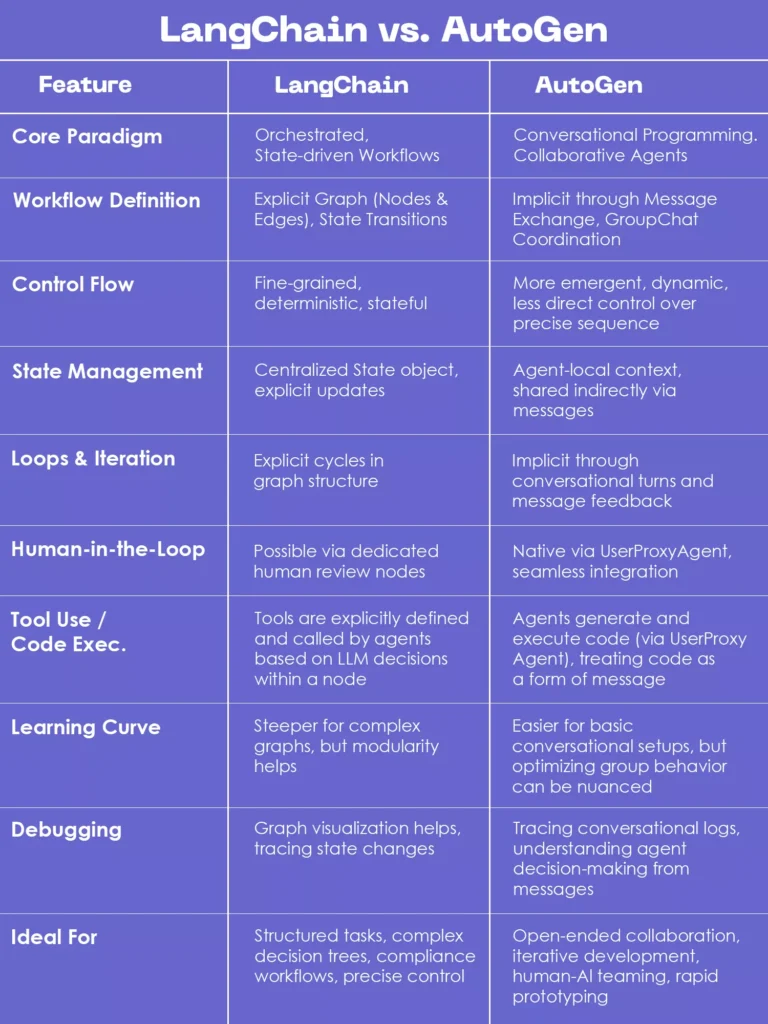
Fig: LangChain vs. AutoGen
Note: Both LangChain and AutoGen are highly regarded by modern tech organizations looking to enhance their tech stack. However, it’s important to understand some of their drawbacks.
What Are Some of the Limitations of LangChain and AutoGen?
Here are some of the limitations of LangChain:
- Steeper Learning Curve (Initially): While powerful, the sheer breadth of LangChain’s features can present a steeper learning curve for novice users.
- Boilerplate for Simple Cases: For very simple multi-agent interactions, LangChain might feel like overkilling, requiring more boilerplate code than strictly necessary.
- Debugging Complex Graphs: While offering control, debugging issues within highly complex, cyclical LangChain workflows can sometimes be challenging.
Here are some of the limitations of AutoGen:
- Less Explicit Control over Flow: Compared to LangChain, AutoGen offers less explicit control over the precise flow of execution. Agents communicate more freely, which can be both a blessing and a curse.
- Debugging Conversational Interactions: Debugging can sometimes be less direct. Instead of tracing a graph, you may often find yourself sifting through conversational logs to understand why an agent acted in a certain way.
- State Management (Potentially More Complex): While agents maintain their own context, managing complex shared states across multiple conversational turns might require more deliberate design.
Despite such limitations, these frameworks represent a significant improvement in making multi-agent systems accessible and powerful. Therefore, before concluding, I’ve decided to highlight which framework is best suited for different conditions.
Which Framework Should You Go For – LangChain or AutoGen?
I. Choose LangChain when:
- Your multi-agent system requires a highly deterministic and auditable workflow with explicit state transitions and conditional logic.
- You need fine-grained control over every step of the agent’s reasoning and action pipeline.
- Your solution integrates deeply with a diverse ecosystem of external tools, databases, and APIs, leveraging LangChain’s extensive connectors.
- The problem can be elegantly modeled as a directed acyclic or cyclic graph, allowing for robust iterative processes and self-correction.
- You are building mission-critical applications where predictable behavior and error handling are paramount.
II. Choose AutoGen when:
- You prioritize natural, conversational collaboration between AI agents and humans.
- The problem you’re trying to solve is open-ended or ill-defined, benefiting from emergent problem-solving.
- You need to enable human-in-the-loop interactions as a core part of the agent’s workflow, where human input guides or refines agent actions.
- Rapid prototyping and exploration of multi-agent dynamics are more important than rigid workflow enforcement.
- Your agents will frequently engage in code generation, execution, and debugging as part of their collaborative process.
As you embark on your multi-agent journey, my advice to you would be – carefully consider the nature of your problem, the level of control you require, and the desired interaction patterns.
The true potential of these frameworks lies in understanding their strengths and applying them thoughtfully to design the intelligent, collaborative AI systems of the future.
Found this piece insightful? Contact us at Nitor Infotech, an Ascendion company, to build seamless workflows or products powered by agentic AI.