
Multi-agent collaboration in AI is the process of specialized intelligent agents working together; much like human teams to solve complex problems. Unlike traditional single-AI systems, multi-agent architectures enable autonomous agents to communicate, coordinate, and share tasks, making development faster, more reliable, and scalable. This collaborative intelligence powers code generation, debugging, testing, and project management, while also transforming industries like healthcare, finance, and supply chain. By adopting multi-agent systems, organizations unlock accelerated innovation, improved reliability, and a competitive edge in the AI-driven economy.
The software development landscape is experiencing a seismic shift. Gone are the days when developers spent countless hours on repetitive coding tasks, debugging mysterious errors, or manually writing documentation. Today’s AI-powered development tools and multi-agent systems are not just changing how we code: they’re revolutionizing the entire software development workflow.
From AI code generation and intelligent debugging to automated testing and multi-agent orchestration, modern AI programming assistants are becoming the backbone of software engineering AI. This shift goes beyond automation; it’s about AI agents working collaboratively, fundamentally transforming what it means to be a developer in 2025.
But this transformation extends far beyond individual productivity; it’s creating entirely new paradigms for how complex AI systems operate across industries, setting the stage for a deeper understanding of how these systems actually work.
Now that we’ve explored the potential of agentic AI, it’s important to look under the hood and understand how these systems are actually built. At the core lies the multi-agent systems architecture; the backbone that makes collaboration between intelligent agents possible.
Understanding Multiagent Systems Architecture
Unlike traditional monolithic AI systems, multi-agent architectures deploy multiple specialized artificial intelligence (AI) agents that communicate, negotiate, and coordinate to achieve common goals. This architectural approach mirrors successful organizational structures with specialists working together under coordinated leadership.
Key components of AI agent architecture include:
- Autonomous agents: Each intelligent agent operates independently while maintaining system awareness
- Communication protocols: Standardized methods for agents and multi-agent systems to share information
- Coordination mechanisms: AI orchestration strategies that prevent conflicts and optimize resource allocation
- Specialized roles: Different types of AI agents focusing on specific domains or tasks
The architecture of modern multiagent systems is built on distributed intelligence ensuring no single point of failure, emergent behavior where collective intelligence exceeds individual capabilities, and adaptive coordination enabling dynamic reorganization. Advanced architectural patterns include hierarchical structures with master agents coordinating specialized worker agents, peer-to-peer networks, and hybrid approaches.
The result is agent systems that are more resilient, scalable, and capable than any single AI could be. This foundational architecture enables the sophisticated code generation capabilities we see emerging across development workflows.
With the foundation of multi-agent system architecture in place, the next evolution lies in how these intelligent agents are transforming software creation itself; ushering in a new era of AI-powered, collaborative code generation.
The Rise of Multi-agent AI-Powered Code Generation
Building on these architectural principles, modern AI agents are no longer standalone helpers; they are part of multi-agent systems designed to work collaboratively. Instead of one AI agency tool generating code, a network of artificial intelligence (AI) agents can share tasks: one intelligent agent might focus on syntax, another on documentation, while others check compliance and performance.
Consider how OpenAI Assistant and similar platforms are evolving toward multi-agent collaboration. Rather than a single large language model (LLM) handling everything, specialized agents work together; one focusing on code generation, another on security analysis, and a third on performance optimization.
Key benefits of AI code generation in multi-agent workflows include:
- Rapid prototyping with AI-driven coding teams that distribute tasks intelligently
- Cross-language support from specialized AI agents trained on specific programming languages
- Automatic documentation via dedicated agent software for technical writing
- Collaboration between multiple intelligent agents for more reliable, production-ready solutions
- Real-time validation through continuous communication between code analysis agents
The evolution of collaborative code generation involves syntax specialists, architecture agents, testing agents, and documentation agents working simultaneously on different aspects of the same codebase. This parallel processing approach not only increases development speed but also improves code quality. It achieves this by ensuring multiple perspectives are considered during generation.
This multi-agent collaboration lowers the barrier to entry in machine learning development tools and accelerates productivity across industries. However, generating code is just the beginning. When issues arise, these same collaborative principles revolutionize how we approach debugging.
Once intelligent agents prove their value in accelerating code generation, their true potential emerges in the next phase; turning debugging from a tedious, error-prone task into a collaborative and proactive AI-driven resolution process.
Intelligent Debugging and Agentic AI Resolution
While multi-agent code generation creates sophisticated software, the collaborative approach becomes even more powerful when addressing the inevitable challenges that arise during development. Traditional debugging was like searching for a needle in a haystack. But with agentic AI, debugging has become a proactive, collaborative process.
Instead of one system analyzing stack traces, multi-agent AI systems assign specialized roles: one AI agent identifies error causes, another checks performance bottlenecks, and others suggest fixes based on large language models (LLMs). The power of this approach becomes evident when dealing with complex AI systems that span multiple services.
Capabilities of multi-agent debugging assistants:
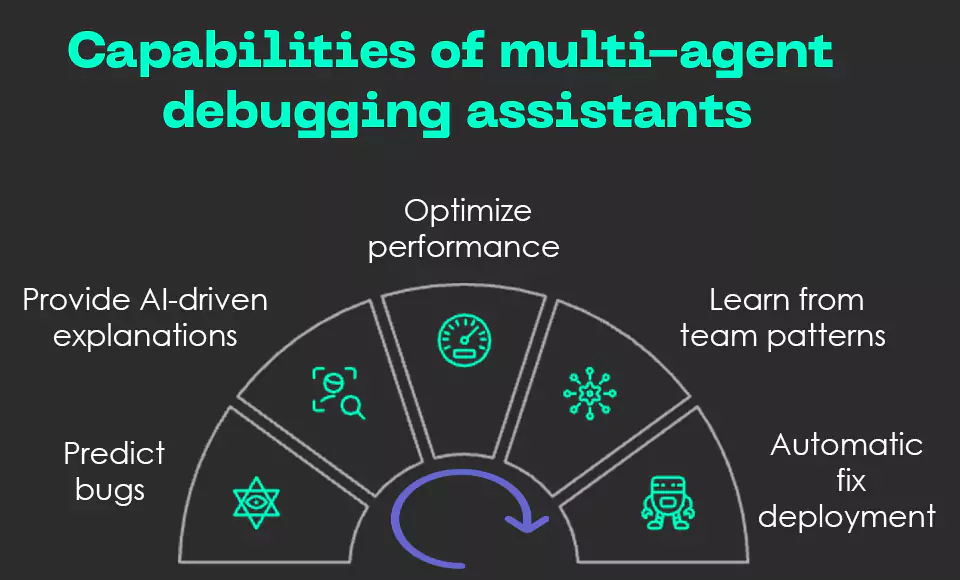
Fig: Capabilities of multi-agent debugging assistants
- Predict bugs before they occur through collaborative pattern analysis
- Provide AI-driven explanations of errors with context from multiple agent perspectives
- Optimize performance in distributed agent systems through coordinated monitoring
- Learn from team patterns for personalized fixes that improve over time
- Automatic fix deployment with validation from security and performance agents
Advanced debugging in multi-agent environments involves root cause analysis agents, predictive analysis agents, and resolution recommendation agents working together. The collaborative debugging process includes initial detection agents, diagnostic agents, analysis agents, and validation agents, ensuring thorough and efficient problem resolution.
This creates sophisticated AI orchestration, where multiple intelligent agents collectively improve reliability and minimize technical debt. The relevance AI approach ensures that debugging insights are contextually appropriate and actionable. As debugging becomes more intelligent, the same collaborative principles transform how we ensure code quality through comprehensive testing.
After debugging, the next natural frontier is testing; where multi-agent collaboration doesn’t just identify issues but ensures software is reliable, scalable, and secure through intelligent, distributed quality assurance.
Automated Testing and Quality Assurance in Multiagent Systems
Just as multi-agent debugging revolutionizes problem-solving, collaborative testing transforms quality assurance from a bottleneck into an accelerator. Testing is one of the biggest challenges in software development workflows. By leveraging multi-agent systems, automated testing can now be distributed among specialized AI agents, each bringing unique expertise to ensure comprehensive coverage.
Specialized roles in multi-agent testing include:
- Test case generation agents that create comprehensive scenarios based on code analysis
- Visual regression testing agents that detect UI changes across devices and browsers
- Performance simulation agents that model real-world usage patterns
- Test maintenance agents that automatically update tests when code changes
- Security testing agents that scan for vulnerabilities and compliance issues
The sophistication of multi-agent testing systems extends beyond simple test execution. Test planning agents analyze code changes to determine which tests to run, resource optimization agents distribute test execution across infrastructure, and result analysis agents identify patterns in failures that might indicate systemic issues.
Quality assurance in multi-agent systems also involves cross-agent communication testing, fault tolerance testing, and scalability testing to ensure the collaborative systems themselves remain reliable as they grow in complexity.
This multi-agent orchestration improves both developer productivity and software quality assurance, delivering faster, more reliable releases. The collaborative testing approach naturally extends into the code review process, where multiple agents can simultaneously evaluate different aspects of code quality.
Once testing has ensured stability, the development process moves to an equally critical stage: code review, where multi-agent collaboration enhances quality, security, and performance with unprecedented precision.
AI-Powered Code Review and Agent Collaboration
Building on the comprehensive testing capabilities of multi-agent systems, code review evolves into the most sophisticated form of AI agent collaboration. Instead of relying solely on humans, AI programming assistants within multi-agent systems automatically check for multiple quality factors simultaneously, creating more thorough and consistent reviews.
Multi-agent code review capabilities:
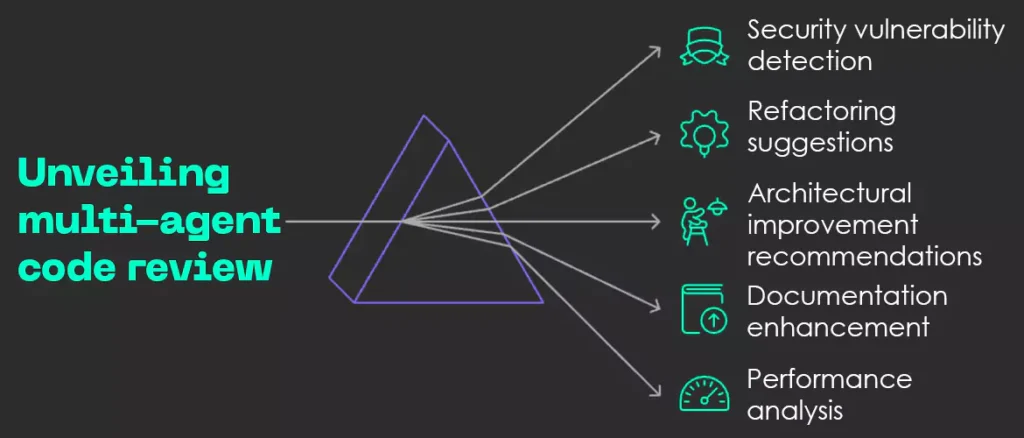
Fig: Unveiling multi-agent code review
- Security vulnerability detection by specialized cybersecurity agents
- Refactoring suggestions from code optimization agents
- Architectural improvement recommendations from system design agents
- Documentation enhancement via AI documentation agents
- Performance analysis from efficiency optimization agents
The collaborative review process involves static analysis agents, dynamic analysis agents, compliance agents, and integration agents working together. Advanced code review agents perform contextual analysis, impact assessment, and alternative suggestions. This is while continuously learning from developer feedback and historical patterns.
Here, AI orchestration allows agents to divide tasks intelligently, ensuring faster and more consistent reviews. Agent software can simultaneously analyze code for security issues, performance problems, and maintainability concerns; something that would take human reviewers much longer to accomplish.
The collaborative review process ensures that code quality is maintained throughout development, but this is just one aspect of broader project coordination. The same multi-agent principles that enhance code review are transforming entire project management workflows.
After strengthening software quality through AI-driven reviews, the next leap in multi-agent collaboration comes at the organizational level. This is where intelligent agents transform project management into a predictive, data-driven, and seamlessly coordinated process.
Intelligent Project Management with Multi-Agent Collaboration
While AI-powered code review ensures individual code quality, intelligent project management through multi-agent AI systems coordinates the entire development lifecycle. Beyond coding, multi-agent systems assign specialized roles that work together to provide comprehensive project insights and recommendations.
Specialized project management agents include:
- Timeline prediction agents that analyze historical data and current velocity
- Sprint analysis agents that optimize task allocation and team capacity
- Resource management agents that balance workloads and skill requirements
- Risk assessment agents that identify potential project bottlenecks
- Budget optimization agents that track costs and resource utilization
Advanced project management through multi-agent systems encompasses predictive analytics agents, stakeholder communication agents, dependency tracking agents, and quality assurance agents that ensure deliverables meet standards throughout the development process.
The integration of project management agents with development workflow agents creates a seamless development ecosystem where project planning, code development, testing, and deployment are all coordinated through intelligent agent collaboration. This end-to-end orchestration ensures that project management decisions are informed by real-time development progress.
These agent systems make software engineering AI more predictable, data-driven, and efficient. The collaborative approach ensures that project decisions consider multiple perspectives and potential impacts, leading to more successful outcomes. This sophisticated project coordination within software development is just one example of how multi-agent collaboration is transforming entire industries.
What begins as intelligent coordination within software projects quickly scales into something much bigger. Multi-agent collaboration expanding beyond development teams to transform entire industries.
Multi-Agent Collaboration Across Industries
The sophisticated project management capabilities we see in software development represent just the beginning of multi-agent transformation across industries. Picture this: instead of one super-intelligent AI trying to handle everything, imagine a team of specialized AI agents working together like a symphony across entire economic sectors.
Industry-specific multi-agent applications:
- Supply chain optimization where inventory agents coordinate with logistics and demand forecasting agents
- Healthcare systems where diagnostic agents collaborate with treatment planning and monitoring agents
- Financial services where risk assessment agents work with compliance and trading optimization agents
- Smart city management where traffic, energy, and emergency response agents coordinate in real-time
Cross-industry collaboration patterns are emerging where agents from different sectors work together to solve complex societal challenges. For example, healthcare agents collaborate with supply chain agents during medical emergencies, or financial agents work with environmental monitoring agents for sustainable investing.
The scalability of multiagent systems across industries is enabled by standardized communication protocols, common knowledge representation formats, and universal coordination mechanisms that can manage complex multi-stakeholder scenarios.
The relevance AI approach ensures that these cross-industry collaborations are contextually appropriate and deliver measurable value. Multi-agent systems in AI are particularly powerful when dealing with complex, interconnected challenges that span multiple domains. These current applications provide a glimpse into an even more collaborative future.

Unlock the power of Generative AI with our capability guide. Discover how Nitor Infotech drives innovation, efficiency, and growth.
As multi-agent collaboration proves its value across industries, the natural question becomes; what’s next? The future points toward even more advanced orchestration, where AI agents evolve into self-healing, cross-domain systems that redefine how humans and machines build together.
The Future of AI-Driven Development with Multi-agent Systems
The cross-industry applications we see today are laying the groundwork for even more revolutionary developments. The next frontier of AI development is multi-agent orchestration powered by sophisticated AI agent architecture that will fundamentally reshape how we approach complex problems.
Emerging developments include:

Fig: AI-Driven Development with Multi-agent Systems
- Conversational development environments with LLMs and agentic AI working together
- Self-healing multi-agent systems that automatically resolve issues and optimize performance
- Cross-domain AI orchestration connecting finance, supply chain, and logistics agents
- Seamless human-AI collaboration where people and agents work as integrated teams
- Global agent networks that coordinate across organizations and industries
Future multi-agent systems will feature adaptive learning capabilities, autonomous system evolution, and predictive coordination where agents anticipate each other’s needs before explicit communication occurs.
The convergence of multi-agent AI with quantum computing, edge computing, and blockchain will create new possibilities for distributed intelligent systems that operate across global networks with unprecedented speed, security, and reliability.
The integration of OpenAI Assistant and similar platforms into broader multi-agent ecosystems will create unprecedented capabilities for solving complex, multi-faceted challenges. These developments represent fundamental changes in how we approach problem-solving and system design, ushering in a new era of collaborative intelligence.
With the future of AI-driven development pointing toward self-healing systems and global agent networks, we now arrive at the defining moment; the multi-agent AI revolution that is already reshaping how organizations innovate and compete.
The Multi-agent AI Revolution
These future possibilities are not distant dreams; they represent the natural evolution of the collaborative intelligence we’re already seeing transform software development and multiple industries. The shift toward multi-agent systems represents more than automation. It’s about collaborative intelligence that mirrors the best aspects of human teamwork while exceeding human limitations in speed, consistency, and scale.
By leveraging the collective capabilities of specialized artificial intelligence (AI) agents, organizations can solve problems once thought impossible. The competitive advantages of early multi-agent AI adoption include faster innovation cycles, more reliable system operation, enhanced problem-solving capabilities, and improved resource utilization.
For developers and organizations, the message is clear: embracing multi-agent AI systems today means staying ahead in tomorrow’s AI-driven economy. The future of artificial intelligence agencies and multi-agent collaboration lies in AI agents working together, reshaping not just software development workflows but entire industries and business models.
The revolution is already underway. Companies that master agent systems and AI orchestration will define the next era of technological innovation. The age of collaborative AI is here, and it’s transforming everything from how we write code to how we solve humanity’s greatest challenges.
The implications of this revolution extend into organizational transformation, where companies must rethink structures and processes to integrate multi-agent AI systems effectively. Organizations that delay adoption risk falling behind competitors who leverage collaborative AI to achieve superior performance and customer satisfaction.
Ready to harness the power of multi-agent AI collaboration? Connect with Nitor Infotech to explore AI-driven solutions that boost efficiency, accelerate innovation, and transform your enterprise workflows.