
Highlights
Enterprises are at a crossroads with two emerging AI paradigms: vibe coding and agentic coding. Vibe coding empowers developers and non-technical users to build software using natural language, accelerating prototyping and democratizing innovation. By contrast, agentic coding leverages autonomous AI agents to handle complex, large-scale systems with reliability, compliance, and scalability in mind. While vibe coding offers speed and accessibility, agentic coding ensures sophistication and long-term efficiency. The future may not be about choosing one, but integrating both. Together, these approaches promise to reshape enterprise software development, enabling faster innovation, better collaboration, and enterprise-grade quality at scale.
The software development landscape is experiencing a seismic shift that’s reshaping how enterprises approach coding. Two revolutionary AI coding paradigms are emerging as frontrunners in this transformation: vibe coding and agentic coding. But here’s the million-dollar question every CTO and development leader is asking: which approach will dominate enterprise development AI in the coming years?
The software development landscape is experiencing a seismic shift that’s reshaping how enterprises approach coding. Two revolutionary AI coding paradigms are emerging as frontrunners in this transformation: vibe coding and agentic coding. But here’s the million-dollar question every CTO and development leader is asking: “Which approach will dominate enterprise development AI in the coming years?”
According to recent industry surveys, In 2025 84% of developers use or plan to use AI tools—up from 76% in 2024.(Stack Overflow’s 2025 Developer Survey reports), signaling that AI software development isn’t just a trend; it’s becoming the new standard. As we dive deeper into this comparison, you’ll discover how these two paradigms are revolutionizing the way teams build, deploy, and maintain software at scale.
As we explore what’s driving this transformation, let’s first examine the more intuitive approach that’s capturing developers’ attention worldwide.
Understanding Vibe Coding: The Intuitive Approach to AI Programming
Vibe coding represents a fresh take where users express their intention using plain speech and AI agents transform that thinking into executable code. Think of it as having a conversation with your computer where you describe what you want. Then, the intelligent agent translates your ideas into working software.
This approach embodies what experts call the “see it, say it, run it” philosophy. Instead of wrestling with complex syntax or spending hours debugging line-by-line code, developers can focus on the bigger picture. It comprises the business logic, user experience, and creative problem-solving that truly matter for modern software solutions.
To understand why vibe coding is gaining such momentum, we need to look deeper into its foundation: natural language programming.
The Power of Natural Language Programming
What makes vibe coding so appealing to enterprise teams is its accessibility, especially for beginners entering the development world. Rather than manually writing extensive code, developers communicate ideas, logic, and functionalities through natural conversation. This democratizes software development, allowing domain experts who understand business requirements to participate more directly in the coding process within an inclusive community environment.
The best AI for coding in this paradigm focuses on understanding context and intent. Imagine a product manager being able to sketch out a feature by simply describing it: “I need a user dashboard that shows real-time sales metrics, filters by region, and sends alerts when targets are missed.”
The AI that can code interprets this natural language input and generates the corresponding code structure, API calls, and user interface components.
The concept sounds promising. But the true test of vibe coding lies in how it performs in real-world development scenarios.
Real-World Impact on Development Speed
The numbers tell a compelling story about the effectiveness of vibe coding in web development (web dev) and beyond. Take Lovable, a Swedish platform with 30,000 subscribers and $17M in annual revenue: users build full apps using natural language alone. This isn’t just a proof of concept. It’s a thriving business model that demonstrates the commercial viability of AI programming.
For enterprise teams, this translates to dramatically reduced time-to-market. Projects that traditionally took months can now be prototyped in days. Thisallows for faster iteration and more experimental approaches to innovation. AI developers using these platforms report 3x faster delivery times compared to traditional coding methods.
Moving beyond the conversational approach, we encounter a more sophisticated paradigm that’s reshaping enterprise development at its core.
Diving Deep into Agentic Coding: Autonomous AI Development
Agentic AI represents an artificial intelligence system that can accomplish specific goals with limited supervision. It consists of AI intelligent agents and machine learning models that mimic human decision-making to solve problems in real time. In the context of software development, this means AI agents that can plan, execute, and iterate on complex coding tasks with minimal human intervention.
At the core of agentic coding lies a powerful framework: intelligent automation.
The Architecture of Intelligent Automation
Agentic coding goes beyond simple code generation; it creates comprehensive AI development tools that can understand project context, make architectural decisions, and even refactor existing codebases. These intelligent agents analyze requirements, break down complex problems into manageable tasks, and execute multi-step development processes autonomously.
Consider a scenario where your agentic AI system receives a request to “optimize our e-commerce platform for Black Friday traffic.” Instead of just generating code snippets, the AI agent would:
- Analyze current system performance bottlenecks
- Research best practices for high-traffic optimization
- Create a comprehensive implementation plan
- Generate optimized code across multiple services
- Test the changes in a staging environment
- Provide detailed documentation and monitoring recommendations
The AI model behind these systems learns from vast repositories of engineering knowledge. Not just that – it makes decisions that reflect industry best practices and enterprise-grade reliability standards.
Let’s move onwards to consider the strategic advantages for enterprise development.
Strategic Advantages for Enterprise Development
The strategic value of agentic AI lies in its ability to handle complex, multi-faceted development challenges that require sustained focus and deep technical expertise. For 2025, the dominant innovation narrative is the AI agent, and this trend is particularly pronounced in enterprise environments where consistency, scalability, and reliability are paramount.
Unlike the conversational approach that vibe coding takes, agentic AI excels at managing large-scale refactoring projects, maintaining code quality standards across teams, and ensuring architectural consistency across complex microservice environments. These AI coding tools can work continuously. They can implement changes across multiple repositories while maintaining compliance with engineering standards.
When evaluating these technologies for enterprise adoption, understanding their performance characteristics becomes crucial for strategic planning.
Comparing Performance: Speed vs. Sophistication
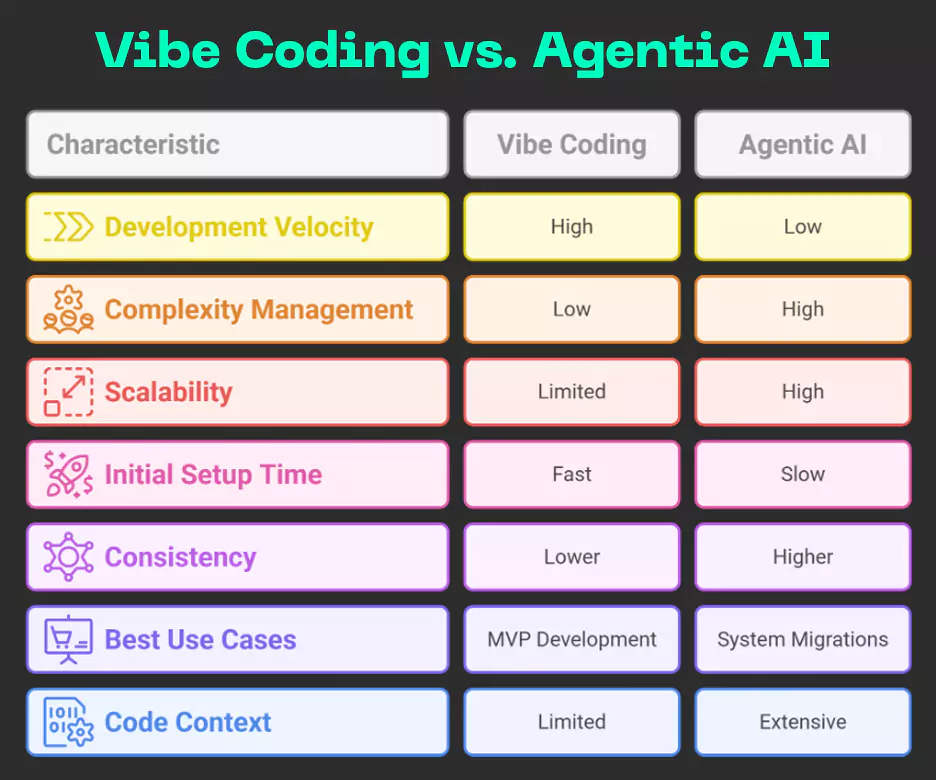
Fig: Vibe Coding Vs Agentic Coding
Development Velocity and Time-to-Market
Vibe coding shines in scenarios requiring rapid prototyping and quick wins, particularly in web dev projects where visual feedback is essential. Its natural language interface allows teams to move from concept to working prototype in record time. Beginners can start contributing immediately, while experienced AI developers can focus on higher-level architecture and system design.
The best AI for coding in rapid development scenarios offers real-time code generation and immediate visual feedback. For MVP development, proof-of-concepts, and iterative feature development, vibe coding offers unmatched velocity. Teams can test ideas quickly, gather user feedback, and pivot without the traditional overhead of extensive code rewrites.
AI writing code through vibe coding platforms has democratized software creation. It has enabled community contributions from diverse backgrounds and skill levels. In this way, it is making development more inclusive than ever before.
Complexity Management and Scalability
Agentic AI, on the other hand, excels in managing complex, interconnected systems where careful planning and systematic execution are essential. While it may take longer to set up initially, these intelligent agents provide superior results for:
- Large-scale system migrations
- Multi-service architecture optimization
- Compliance and security implementation
- Legacy system modernization
The AI code writing capabilities of agentic AI systems ensure consistency and adherence to enterprise coding standards, reducing technical debt and maintenance overhead over time. These AI development tools can maintain context across millions of lines of code, something that would be impossible for human developers to manage effectively.
As organizations weigh these technological options, several practical implementation factors will determine long-term success.
Enterprise Implementation: Practical Considerations

Fig: The Right AI Approach for your Team’s Needs
Team Skill Requirements and Learning Curves
Vibe coding offers a gentler learning curve, requiring minimal technical expertise to get started. Beginners can begin using natural language interfaces immediately, while experienced AI developers can leverage advanced features for complex software architecture. This approach makes development more accessible to community members regardless of their technical background. This fosters an inclusive environment.
Agentic AI demands a more sophisticated setup and configuration, but rewards teams with more powerful automation capabilities. Organizations with strong DevOps practices and mature development processes are better positioned to leverage these AI agents effectively. The AI model training and fine-tuning require engineering expertise but deliver exponential returns on investment.

Explore Nitor Infotech’s GenAI-powered Product Engineeringᴬᴵ approach – where ideas become intelligent products with speed, scale, and purpose.
Security and Quality Considerations
Code Quality and Maintainability
Both approaches face scrutiny regarding the quality of generated code. Vibe coding’s rapid iteration strength can become a weakness when quick fixes accumulate into technical debt. However, the conversational nature makes it easier to implement quality improvements through natural language feedback, particularly beneficial for beginners learning coding best practices.
The AI that can code through vibe platforms often produces readable, well-documented code that’s easier for human developers to understand and maintain. This transparency is crucial for community-driven projects and inclusive development environments.
Agentic AI systems, with their ability to maintain context across large codebases, often produce more architecturally consistent solutions. These intelligent agents can enforce coding standards, implement security best practices, and maintain documentation automatically. The AI model learns from enterprise-specific patterns, ensuring consistency with existing engineering practices.
Security Implications and Risk Management
Software development automation introduces new security considerations that enterprises must address. The accessibility of vibe coding means that more people can generate code, potentially including those without deep security expertise. Organizations need robust review processes and automated security scanning to mitigate these risks. This is while maintaining the inclusive nature of the platform.
AI agents can be programmed with comprehensive security policies and compliance requirements, potentially offering superior security outcomes through consistent application of best practices. However, the complexity of these systems requires careful monitoring and validation by experienced AI developers.
Current market dynamics and adoption patterns provide valuable insights into how these technologies will shape the future of enterprise development.
Industry Adoption Trends and Future Outlook
Current Market Penetration
The adoption patterns reveal interesting insights about enterprise preferences and community trends. By 2030, vibe coding – AI software development using natural language prompts – has transformed how organizations innovate, scaling rapidly from startups to global enterprises. This prediction suggests that conversational coding interfaces will become increasingly mainstream, particularly in web dev and rapid prototyping scenarios.
AI programming adoption accelerates across industries, with beginners entering the field at unprecedented rates. The inclusive nature of these tools is expanding the development community to include professionals from diverse backgrounds who previously found traditional coding barriers insurmountable.
Meanwhile, agentic AI adoption is accelerating in sectors requiring high reliability and complex system integration. Financial services, healthcare, and manufacturing are leading AI agent implementation, driven by the need for consistent, auditable, and compliant development processes.
Emerging Hybrid Approaches
The future may not require choosing between these paradigms. Forward-thinking organizations are exploring hybrid approaches that combine vibe coding’s accessibility with agentic AI’s sophistication. AI development tools increasingly incorporate both conversational interfaces for rapid ideation and autonomous systems for production implementation.
The best AI for coding solutions emerging in 2025 blend multiple approaches, allowing AI developers to switch seamlessly between natural language input and autonomous AI agent execution. This flexibility enables teams to match the right tool to the specific development challenge at hand.
Picture AI integration is also emerging, where visual design mockups can be converted directly into working code through AI writing code systems, bridging the gap between design and development teams.
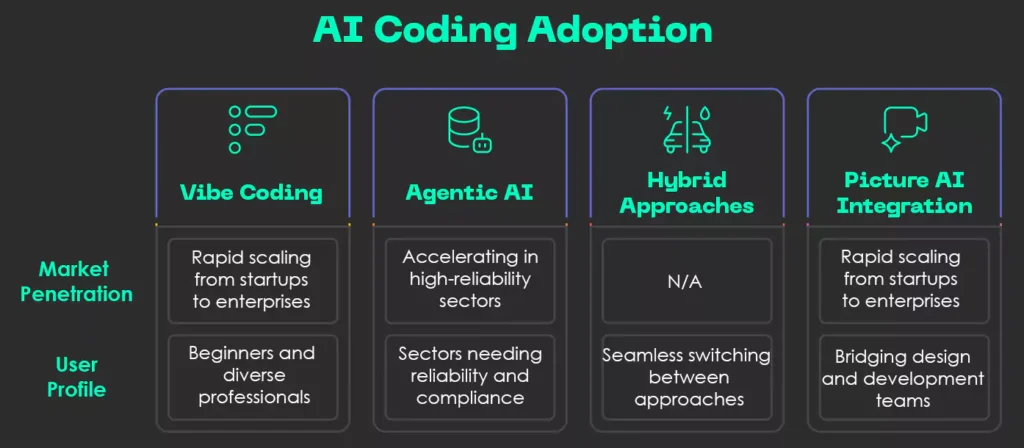
Fig: AI Coding Adoption
With these technological foundations established, organizations must now focus on making strategic decisions that align with their specific needs and objectives.
Making the Strategic Choice for Your Organization
Assessment Framework for Decision Making
The choice between vibe coding and agentic AI isn’t binary; it’s contextual. Organizations should evaluate their specific needs, team composition, and long-term strategic objectives when selecting AI coding tools.
Choose Vibe Coding When:
- Speed-to-market is the primary competitive advantage.
- Team includes many beginners or non-technical stakeholders.
- Projects involve frequent iteration and experimentation.
- Building customer-facing applications or web dev projects.
- Budget constraints favor immediate productivity gains.
- Community and inclusive development practices are priorities.
Choose Agentic AI When:
- You are managing complex, interconnected software systems.
- Code quality and consistency are paramount.
- Long-term maintenance costs are a concern.
- Regulatory compliance requires extensive documentation.
- Your team has strong DevOps and engineering capabilities.
- You need to develop AI software at enterprise scale with reliability requirements.
So, does the future belong to vibe coding or agentic coding, or could the real answer lie in their integration?
The Path Forward: Integration and Evolution
Rather than viewing these as competing technologies, smart enterprises are positioning themselves to leverage both paradigms strategically. AI coding tools continue evolving, and the most successful organizations will be those that match the right AI model to the right challenge.
The evidence suggests that the future of enterprise AI software development lies not in choosing between vibe coding and agentic AI, but in understanding when and how to apply each approach effectively. The future AI developers will be fluent in both conversational coding and autonomous AI agent management.
AI programming is becoming more accessible through inclusive platforms that welcome beginners while providing advanced capabilities for experienced engineers. The community around these tools continues growing, sharing best practices and pushing the boundaries of what’s possible with AI that can code.
The revolution in AI-driven software development is just beginning, and organizations that embrace both paradigms thoughtfully will be best positioned to thrive in this new landscape. The question isn’t which paradigm will win. It’s how quickly your organization can master both coding approaches to stay ahead of the competition in this rapidly evolving development ecosystem.
Nitor Infotech empowers enterprises to accelerate innovation with AI-driven development. Connect with us.