

What if your next diagnosis came before the first symptom? Sounds like a fairy tale? Well, not quite. Healthcare is undergoing a shift from reacting to problems to predicting and preventing them. Thanks to machine learning, doctors are now able to spot diseases earlier, personalize treatments with precision, and forecast patient outcomes more accurately than ever before. What once seemed futuristic is now becoming the new normal with the help of new-age technologies (AI, GenAI, agentic AI, and more) powered by ML algorithms.
In the age of digital transformation, some of the most powerful applications of machine learning aren’t in driverless cars or smart assistants. Rather, they are happening quietly in hospitals, labs, and clinics.
In simpler terms, from radiology scans to hospital workflows, ML is transforming how care is delivered faster, smarter, and more efficiently.
So, in this blog, we’ll look at how machine learning is making waves across the healthcare sector — helping doctors detect diseases earlier, speeding up drug development, and making care more personal and precise. You’ll also learn about where things stand today, what’s getting in the way, and where this powerful technology might take us next.
Before moving to the main meat, it’s essential to know the core machine learning algorithms driving change in healthcare.
What Are the Key Machine Learning Algorithms Used in Healthcare?
Machine learning offers a wide variety of algorithms designed to solve classification, regression, and prediction problems. Whether you’re just starting or brushing up your knowledge, here’s a crisp breakdown of some of the most important machine learning methods:
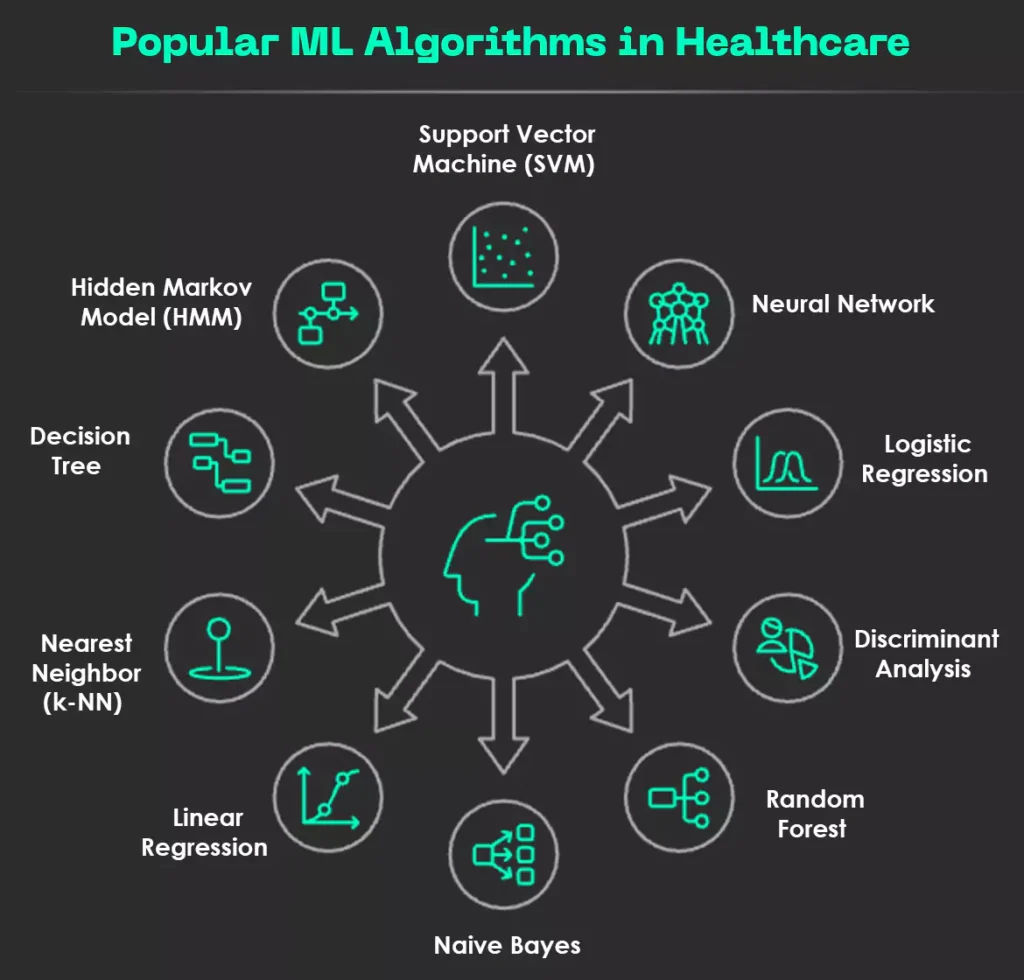
Fig: Popular ML Algorithms in Healthcare
1. Support Vector Machine (SVM)
Support Vector Machines are robust supervised learning models commonly used to solve classification problems. SVMs work by drawing the best possible line (or boundary) that separates different groups of data. They perform exceptionally well in high-dimensional spaces and are ideal for small to medium-sized datasets with complex relationships.
2. Neural Network
Inspired by the human brain, neural networks work as the fundamental building blocks of deep learning. They consist of interconnected layers of nodes (often referred to as neurons) that learn patterns from data. Neural networks excel at handling complex inputs like medical images, human language, and large-scale data patterns, making them ideal for tasks like image recognition, NLP, and predictive analytics.
3. Logistic Regression
Although it’s referred to as regression, logistic regression is technically employed to label things into two categories—such as whether a customer will remain or depart. It estimates the probability that a given input belongs to a particular class using a logistic (sigmoid) function.
4. Discriminant Analysis
This is used to model the differences between categories. It assumes that each class has a normal distribution and calculates the probability that a data point belongs to each class. It is particularly effective when class distributions are well-separated.
5. Random Forest
This is a method that uses many decision trees together to make better predictions and avoid mistakes from relying on just one tree. It is robust, handles missing values well, and works for both classification and regression tasks.
6. Naive Bayes
Naive Bayes classifiers apply Bayes’ Theorem with a naive assumption—that all features are independent given the class label. This makes the model very simple and fast. Even though it’s not complex, it is highly effective for tasks like spam detection and text classification.
7. Linear Regression
Think of it as the “straight shooter” of machine learning. This means that it predicts continuous values by assuming a nice, neat line between inputs and outputs. It’s perfect for when your data behaves and doesn’t throw curveballs.
This is a staple in machine learning for predicting continuous values. It assumes a linear relationship between input features and the output variable, making it ideal for forecasting and trend analysis in numerical data.
8. Nearest Neighbor (k-NN)
Nearest Neighbor or k-Nearest Neighbor (KNN) is a non-parametric, instance-based learning algorithm. For a new data point, it looks at the closest points (‘k’) in the training set and assigns the most common class (for classification) or averages the values (for regression). It is simple, intuitive, and works well for smaller datasets.
9. Decision Tree
Decision trees split data into branches based on feature values, making a tree-like structure of decisions. They’re easy to understand and work with both numbers and categories. However, without proper limits, they can make overly complex decisions that don’t generalize well.
10. Hidden Markov Model (HMM)
These are used for modelling sequential data where the actual state is hidden, and only observable outputs are known. HMMs are widely used in speech recognition, bioinformatics, and natural language processing to model time-series and other temporally structured data.
Did you know?
For years, logistic regression was the default algorithm for healthcare AI—straightforward, speedy, and intuitive, particularly for classification. However, as more sophisticated data appeared in healthcare, the spotlight turned elsewhere. Today, more sophisticated models such as Support Vector Machines and neural networks are increasingly being used to achieve higher accuracy and handle complex patterns.
Now you have a basic understanding of machine learning and its most popular algorithms. Next, get to learn about how these technologies are being applied in the healthcare industry.
How Is Machine Learning Reshaping Healthcare?
Healthcare pumps out mountains of data every second. Be it from patient records, test results, real-time monitoring, insurance claims, etc. Human cognition, even with advanced software tools, has a hard time sorting through all this information quickly and effectively. That’s where machine learning shines: spotting hidden patterns in massive data piles, learning on the fly, and getting smarter with every new piece of information.
Here are a few critical ways in which machine learning algorithms are making a difference in the healthcare sector:
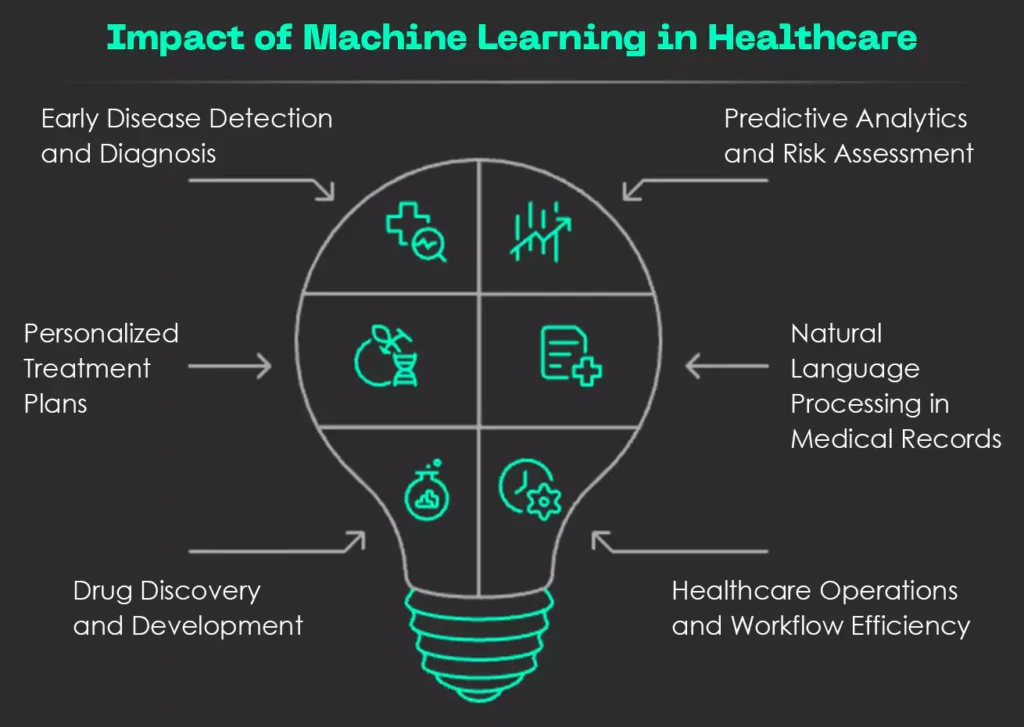
Fig: The Impact of Machine Learning in Healthcare
Machine learning isn’t just a futuristic buzzword; it’s already embedded in many aspects of modern healthcare, delivering real value to clinicians, researchers, and patients alike. The ability of ML algorithms to learn from complex, high-dimensional datasets makes them uniquely suited to solving some of the industry’s most pressing problems. Let’s take a closer look at several key areas where ML is making a tangible impact.
1. Early Disease Detection and Diagnosis
Machine learning’s greatest strength in healthcare lies in accelerating and enhancing the accuracy of diagnoses. Diseases like cancer, heart disease, and neurological disorders can often go undetected until they’ve progressed to advanced stages.
ML models, especially those backed with deep learning, can analyze medical images, lab results, and patient histories. This can help flag abnormalities earlier than traditional methods.
Moreover, algorithms like Support Vector Machines (SVM), Convolutional Neural Networks (CNNs), and decision trees can be applied for early diagnosis of diseases such as cancer, diabetes, and Alzheimer’s.
For example: Convolutional Neural Networks (CNNs) are now widely used in radiology to detect tumors in X-rays, CT scans, and MRIs, sometimes with accuracy rivalling or exceeding that of trained radiologists (yes, you read it right!).
In dermatology, machine learning models trained on thousands of skin lesion images can accurately distinguish between benign and malignant growth, providing a valuable screening tool, especially in regions with limited access to specialists.
2. Predictive Analytics and Risk Assessment
Machine learning excels at identifying patterns and forecasting outcomes. In healthcare, this means predicting which patients are at risk of complications, deterioration, or readmission. These critical insights enable healthcare providers to anticipate and address high-risk cases before issues arise, shifting from reactive to proactive care.
Algorithms like random forests, gradient boosting machines, and Recurrent Neural Networks (RNNs) are used to forecast patient outcomes such as the likelihood of hospital readmission, risk of sepsis, or progression of chronic conditions.
Hospitals are increasingly tapping into these predictions to stay ahead with early intervention. For instance, an ML model might flag a hospitalized patient at high risk for sudden deterioration, prompting staff to take pre-emptive action before complications arise.
This is a huge impact as ML can literally save lives!
3. Personalized Treatment Plans
Every patient is unique, and machine learning helps bring precision medicine to life. By analyzing genetic information, clinical history, and treatment outcomes, ML models can recommend tailored therapies for individual patients.
Clustering algorithms and k-nearest neighbors (KNN) are often used to group similar patients and infer which treatments may be most effective based on prior outcomes within the group. This is particularly valuable in oncology, where treatment responses can vary widely between individuals.
4. Natural Language Processing in Medical Records
A vast amount of clinical information is trapped in unstructured formats like doctor’s notes, discharge summaries, and transcribed consultations. Natural Language Processing (NLP), which is a branch of ML, enables the extraction of useful information from these texts.
Models like BERT (Bidirectional Encoder Representations from Transformers) and domain-specific models like BioBERT can summarize clinical notes. It helps to identify adverse events or even code diagnoses, thereby reducing the administrative burden and increasing the speed of care delivery.
5. Drug Discovery and Development
It takes over ten years to formulate a new drug and costs billions of dollars. The solution? Of course – machine learning!
ML is drastically accelerating this timeline by identifying promising compounds, predicting how drugs interact with the body, and even simulating clinical trial outcomes. Algorithms help find promising compounds, predict how they interact with proteins, and check their safety. This is before any testing happens in the lab.
Apart from that, reinforcement learning and generative models are particularly powerful in simulating chemical reactions and optimizing molecules with desirable properties.
Bonus: Discover deeper insights on LLMs from the developers at Nitor Infotech.
6. Healthcare Operations and Workflow Efficiency
Machine learning also supports the business side of healthcare by streamlining operations, enhancing resource planning, and reducing inefficiencies.
For example:
- Forecasting patient inflows in emergency departments using time-series models,
- Scheduling staff shifts based on predicted patient volume and care complexity,
- Automating tasks like appointment reminders, insurance claims processing, prioritizing patient inquiries, and many more.

Learn how we helped a US-based home care software provider transform legacy code with AI-driven precision, delivering 50–60% better accuracy.
Let’s head onwards to learn about what lies ahead!
Machine Learning in Healthcare: What’s Ethical, What’s Not?
As machine learning reshapes healthcare, it brings remarkable possibilities, partnered with some serious ethical puzzles.
Here’s what you should keep in mind when navigating the ethical dos and don’ts of using machine learning in healthcare:
What’s Ethical?
Using machine learning to detect diseases early, tailor treatments, or predict patient risks, when done with proper safeguards is a big win for healthcare. It’s ethical when systems are transparent, patient data is protected, and clinicians stay in the loop, not out of it.
What’s Not?
Things start to go wrong when ML models are built on biased data, leading to unfair treatment. Or when decisions come from “black box” systems no one can explain. Moreover, if patient data is handled carelessly or without consent, it crosses the ethical line fast.
Where’s the Line?
Right now, regulations are still catching up with the tech. That means AI tools need to go through serious testing before being used with real patients. It might slow things down, but it’s a necessary step to make sure the tech is safe, fair, and trustworthy.
So, machine learning is no longer a concept reserved for tech labs or academic journals. It is actively shaping the healthcare systems we rely on every day.
Here’s my final thought:
With the usage of any powerful tool, success depends not only on the technology itself, but on how thoughtfully we apply it. The path forward must include rigorous clinical validation, clear regulatory standards, and an ongoing commitment to transparency.
The road ahead is filled with both promise and responsibility. If we can harness the full potential of machine learning while addressing its ethical and operational challenges, we won’t just enhance healthcare; we’ll reimagine it for the better.
Bonus: I’d love for you to explore Nitor Infotech, an Ascendion company, dedicated to delivering cutting-edge GenAI and Agentic AI solutions across industries (including the healthcare space). Contact us to reshape your future.