

From morning alarms to midnight scrolls, mobile apps are the silent companions of our daily lives. What began as simple tools has now evolved into a multibillion-dollar ecosystem shaping the way we live, work, and connect. The mobile app industry is on a strong upward trajectory, with revenues anticipated to hit $613 billion by the end of 2025.
As we advance further into the digital era, the mobile app industry is undergoing significant transformation. Emerging technologies and evolving consumer demands are reshaping how apps are developed and used. Today’s apps are smarter, faster, and more immersive than ever. Users now expect not just utility, but seamless, personalized experiences, pushing businesses and developers to constantly raise the bar.
In this blog, you’ll read about the future of mobile apps and discover how emerging trends are set to redefine user experiences and drive business opportunities.
Which Trends Are Revolutionizing the Future of Mobile Apps?
Here’s a closer look at the trends defining the future of mobile apps in 2025:
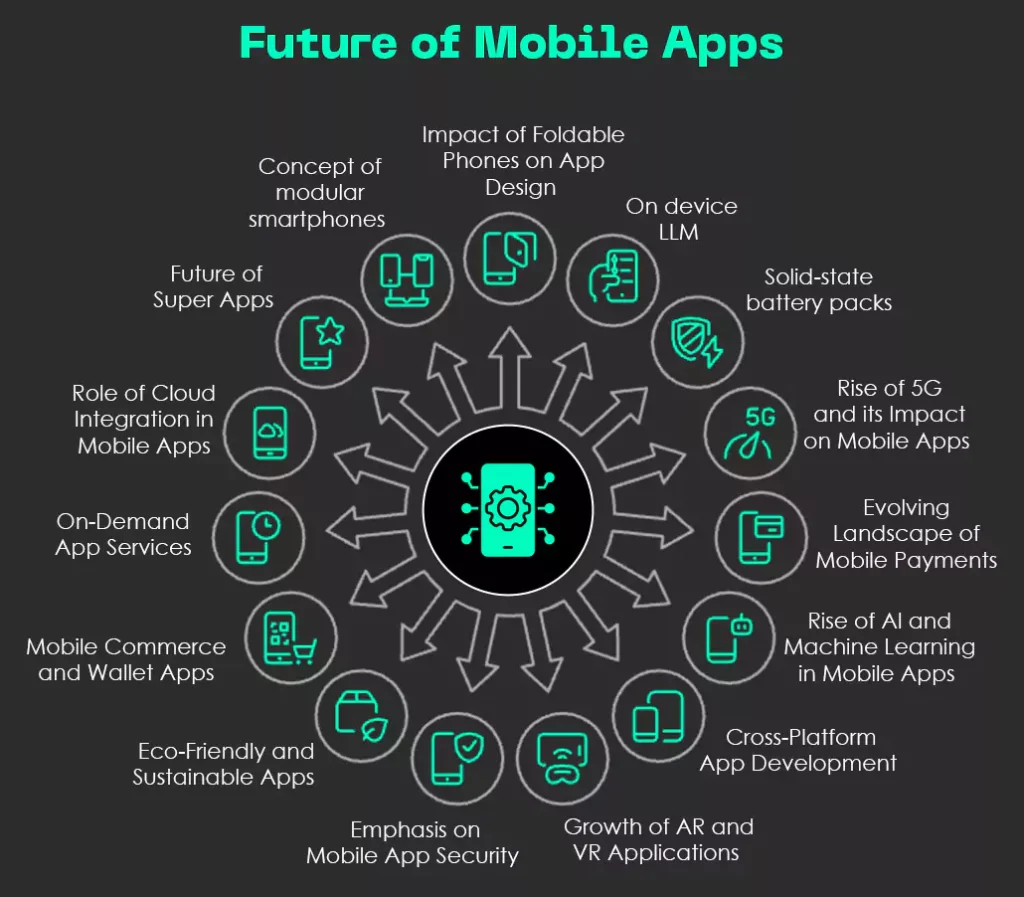
Fig: Future of Mobile Apps
1. Impact of Foldable Phones on App Design
Foldable phones are no longer a novelty. They are influencing app design in profound ways.
These kinds of mobile phones demand adaptable app design to seamlessly transition between folded and unfolded states. This requires flexible layouts and responsive user interface (UI). They also enable enhanced multitasking through multi-window support and offer larger canvases for richer experiences like immersive gaming or detailed data visualization.
In 2025 and beyond, app developers will need to place greater emphasis on content prioritization and user experience (UX) optimization tailored to foldable form factors, balancing the roadblocks of device fragmentation with the exciting potential for innovation in app design. This shift pushes app design beyond traditional mobile conventions, focusing on continuity and leveraging the unique capabilities of foldable phones.
Note: Mobile apps that will adapt to these devices will stand out in an increasingly competitive market.
2. On device Large Language Models (LLMs)
On-device large language models (LLMs) represent the future of mobile apps by enabling faster, more personalized experiences without relying on cloud servers. LLMs help to process data locally. This results in improved privacy, real-time interactions, and reduced latency, which boosts user experience.
These models can seamlessly adapt to individual preferences, offering smarter recommendations and more intuitive interfaces. As processing power improves, mobile apps will become even more capable, intelligent, and independent of external networks.
For instance, an AI-powered smartphone interface can learn that you typically check the weather and emails first thing in the morning, so it begins to display those updates on your home screen automatically. That is, you don’t need to tap or search.
3. Solid State Battery Packs
Solid-state battery packs in smartphones promise to revolutionize battery technology with higher energy density, offering longer battery life in a more compact form.
Unlike traditional lithium-ion batteries, solid-state batteries are safer, reducing the risk of leaks or fires due to their non-flammable electrolyte. They also charge faster and have a longer lifespan. This makes them ideal for powering next-gen mobile devices. As this technology matures, smartphones will become more efficient and reliable, meeting the increasing demands of users for sustainable and long-term usage.
4. Rise of 5G and its Impact on Mobile Apps
One of the most immediate impacts of 5G is its ability to improve app performance in areas like video conferencing, gaming, and live streaming. Apps that rely on real-time data, such as social media platforms, messaging services, and collaborative tools, can now provide seamless, lag-free interactions. Moreover, the ultra-low latency offered by 5G technology enables better responsiveness in mobile gaming, where every millisecond counts.
For a quick read, here’s the impact of 5G on mobile apps:
- Real-Time Usage: Powering rich and responsive live-streaming, gaming, and video calling experiences.
- IoT Integration: Improved connectivity for smart homes, wearables, and autonomous vehicles.
- Larger File Transfers: Seamless handling of high-resolution media and large data sets.
In short, 5G allows mobile apps to become faster, smarter, and more efficient, a trend that will only accelerate in the coming years.
5. Evolving Landscape of Mobile Payments
I’m sure when you step outside to purchase an item, 90% of the time you use your mobile to make those digital payments. Today, mobile payments are evolving, offering users greater convenience and security. Here are some of the trends worth watching:
- Contactless Payments: NFC and QR code technologies are becoming the norm.
- Cryptocurrency Adoption: Apps are beginning to integrate crypto wallets.
- Biometric Authentication: Secure logins powered by facial recognition and fingerprint scanning will continue and likely evolve.
Such innovations are making mobile commerce more accessible and trusted worldwide.
6. Rise of Artificial Intelligence and Machine Learning in Mobile Apps
One of the hottest topics globally, AI and ML are set to transform mobile applications by:
- Personalization: Delivering customized content based on user behavior.
- Automation: Streamlining customer support with AI-powered chatbots.
- Predictive Analytics: Helping businesses anticipate user needs and trends.
Such advancements in AI are driving apps to be more adaptive, insightful, and centered around a user-first mindset.
7. Cross-Platform App Development
Cross-platform frameworks such as Flutter and React Native are steadily gaining popularity among developers. Here is its impact on mobile apps:
- Cost Efficiency: Single codebases reduce development and maintenance costs.
- Wider Reach: Apps can run on both iOS and Android seamlessly.
- Faster Development Cycles: Accelerated time-to-market for new apps.
My advice for businesses would be to begin embracing these frameworks and other tools to accelerate development and optimize resource utilization, paving the way for their next standout app.

Don’t just build apps, build experiences! Embrace innovative technologies and best practices to create apps that not only meet user needs but also exceed expectations.
8. Growth of AR and VR Applications
Augmented Reality (AR) and Virtual Reality (VR) have broken free from their gaming roots and are now making significant strides across various industries, such as:
- Retail: Virtual try-ons for clothing, eyewear, and home decor.
- Education: Interactive simulations for training and learning.
- Healthcare: Assisting in diagnostics and therapy sessions.
In short, with improved hardware and 5G connectivity, AR and VR apps are the new mainstream.
9. Emphasis on Mobile App Security
Cybersecurity has become a critical focus for both developers and end-users, as the growing reliance on mobile apps brings increased exposure to digital threats. Some of the key trends include:
- End-to-End Encryption: Securing sensitive user data.
- Zero-Trust Security Models: Strengthening authentication and access controls.
- Regulatory Compliance: Adhering to global privacy laws such as GDPR and CCPA.
10. Eco-Friendly and Sustainable Apps
Eco-friendly and sustainable apps are reshaping development practices by prioritizing energy efficiency and responsible resource usage. From minimizing data and battery consumption to promoting green user habits, these apps align with the growing demand for conscious technology.
Here are some of the trends following eco-friendly and sustainable apps:
- Green Features: Encouraging users to adopt eco-friendly habits.
- Energy Optimization: Reduction in battery and data consumption.
- Sustainable Development: More companies to adopt environmentally conscious workflows.
11. Mobile Commerce and Wallet Apps
Mobile commerce is surging in 2025, fueled by digital wallets and app-based shopping. These apps are reshaping consumer behavior, making shopping more intuitive and efficient.
Here are some of the trends following the same:
- Seamless Transactions: Integrated payment gateways for quick purchases.
- Reward Systems: Loyalty programs and cashback offers via apps.
- Global Reach: Cross-border e-commerce apps are breaking barriers.
12. On-Demand App Services
On-demand apps are thriving across diverse sectors. Their ability to offer instant access, personalized experiences, and time-saving solutions has made them indispensable in today’s fast-paced digital economy. As consumer expectations continue to evolve, these apps are set to become even more versatile and embedded in our daily lives.
Here are some of its impacts across various fields:
- Transportation: Ridesharing and delivery services.
- Healthcare: Telemedicine and prescription deliveries.
- Freelancing: Platforms connecting clients with skilled professionals.
13. Role of Cloud Integration in Mobile Apps
Cloud technology has been fundamentally transforming the way mobile apps are developed, deployed, and scaled. This shift not only enhances the overall user experience but also reduces infrastructure costs and improves reliability for businesses.
Here are the key roles that cloud integration plays:
- Data Storage: Enables apps to access vast amounts of data without local storage.
- Collaboration: Facilitates real-time teamwork.
- Scalability: Adapts to growing user demands effortlessly.
14. Future of Super Apps
Super apps are all-in one platforms that combine multiple services, such as messaging, payments, e-commerce, and entertainment, in a single mobile application. They provide a seamless user experience by integrating various digital functions into one interface, offering convenience and efficiency.
Here are the benefits that super apps offer:
- Multi-Functionality: Combines messaging, payments, shopping, and more in one app.
- Integrated Ecosystems: Partnerships with third-party services to expand offerings.
- User Retention: Provides convenience that keeps users engaged.
When we talk about the future of super apps, you should be aware of these trends as well:
1. Ultra-High Speeds and Low Latency
6G is expected to deliver speed up to 1 terabit per second (Tbps) and ultra-low latency, potentially as low as 1 millisecond or less. This will be crucial for critical IoT applications, such as autonomous vehicles and industrial automation, where split-second decision-making is essential.
2. AI and Machine Learning Integration
This will lead to intelligent device interactions where IoT devices can not only collect data but also analyze and make decisions independently in real time. This will enhance automation and responsiveness in areas like healthcare, logistics, and smart cities.
3. Holographic and Immersive Communication
With 6G in place, there will be a push for more immersive forms of communication, like holographic calls or real-time 3D video conferencing, powered by ultra-high speeds and low latency.
The network will support mixed reality environments, where mobile and IoT devices seamlessly interact with physical and digital worlds.
15. Concept of Modular Smartphones
Just imagine a world where your smartphone isn’t just a static device, but a dynamic, modular companion that evolves with your needs. Whether you’re a passionate photographer who wants to snap high-resolution images with a premium camera module, a traveler who prefers extended battery life, or a gamer seeking specialized hardware for peak performance—your phone transforms with you.
This level of customization empowers users to configure their devices based on their lifestyle, without being tied down by a one-size-fits-all approach. Even better, it supports a meaningful cause of minimizing electronic waste. Instead of discarding an entire device for a single upgrade, users can simply swap out specific modules, extending the phone’s life and reducing their environmental footprint.
So, modular design simplifies repairs, as users can easily replace faulty modules themselves, reducing costs and electronic waste.
In a nutshell, the future of mobile apps is exciting and full of opportunities. From the rise of 5G and AI to the growth of super apps and eco-friendly solutions, developers have myriad ways to innovate and captivate users. My advice would be to stay on top of these trends to thrive in the dynamic mobile app landscape.
Bonus: Wish to know more about the latest mobile app development solutions offered by Nitor Infotech? Write to us!