
The Minimal Viable Product (MVP) has long been admired in the product development industry. I mean, why not – when it’s lean, fast, and it allows teams to validate their ideas with minimal intervention, right? MVPs are all about testing hypotheses. That is, it’s about getting the core idea for the users to test and interact quickly. However, today’s market demands products that don’t just function but actively learn, adapt, and evolve based on user interactions and changing requirements. In layman’s terms, today, businesses need AI-powered products to cut through the noise. To deal with this situation, the concept of Minimum Viable Agentic Products or MVAPs stands tall as the next evolution of product thinking and building powered by agentic AI.
The shift from traditional MVPs to MVAPs represents a fundamental paradigm change in how we conceptualize and build products. This evolution isn’t just about adding AI features to existing products. Rather, it’s about reimagining the product architecture to be inherently intelligent and self-improving. So, as such agentic flavor matures, organizations can no longer afford to ship static MVPs.
The above concept may seem overwhelming at first, but trust the process. In the upcoming section, I will thoroughly explain all aspects of MVAPs as you continue reading this important blog.
We’re starting with the basics!
What Exactly Are Minimum Viable Agentic Products (MVAPs)?
An MVAP or a Minimum Viable Agentic Product is the leanest version of a product that incorporates agentic AI capabilities. This means it can act independently, make contextual decisions, and learn from data continuously to evolve into a better version.
MVAPs are built on these three core pillars:

Fig: 3 Core Pillars of MVAPs
- Independent decision-making: This allows MVAPs to scan the situations and respond with corresponding actions with less human involvement, enabling them to act independently without any assistance. This freedom not only makes them more effective but also frees teams to focus on more important strategic tasks.
- Continuous Learning Mechanisms: They can improve their performance using user data on a continuous basis, learning from experience to provide improved responses. Their continuous development means that the product becomes increasingly adapted to changing user needs, providing a more and more personalized service over time.
- Adaptive Response Systems: These allow MVAPs to modify their behavior in real time, responding dynamically to shifting user needs and environmental situations. This kind of adaptability boosts user satisfaction by making the product meaningful and impactful across different contexts.
Bonus: Build MVPs that resonate with customers and succeed in today’s fast-changing market.
How Does the MVAP Approach Transform Product Development?
MVAP (Minimum Viable Agentic Product) transforms product development. This transformation happens through the introduction of Agentic AI into both the creation and functionality of the product engineering process.
From a development standpoint, it speeds up the entire engineering process. Well, here’s what happens:
Agentic AI helps product teams automate research, generate user stories, suggest design elements, and even write initial code, reducing time-to-market and increasing alignment with actual user needs.
But it doesn’t stop there.
At this stage, it is no longer just a prototype; rather, it’s intelligent. MVAPs are embedded with Agentic AI capabilities that allow the product to observe user behavior, learn from interactions, and autonomously adapt its features and flows. This means your product evolves post-launch without waiting for manual updates or new releases.
Sounds amazing, right?
So, MVAP reimagines product development as a quicker, more responsive, and insight-driven process—where agents become a partner, and the product is a self-improving system from day one.
Now, let’s dive into the evolution story.
How Does an MVP Evolve Into an MVAP?
Before delving into how the big transformation takes place, I want you to understand the difference between MVP and MVAP with the help of this table:
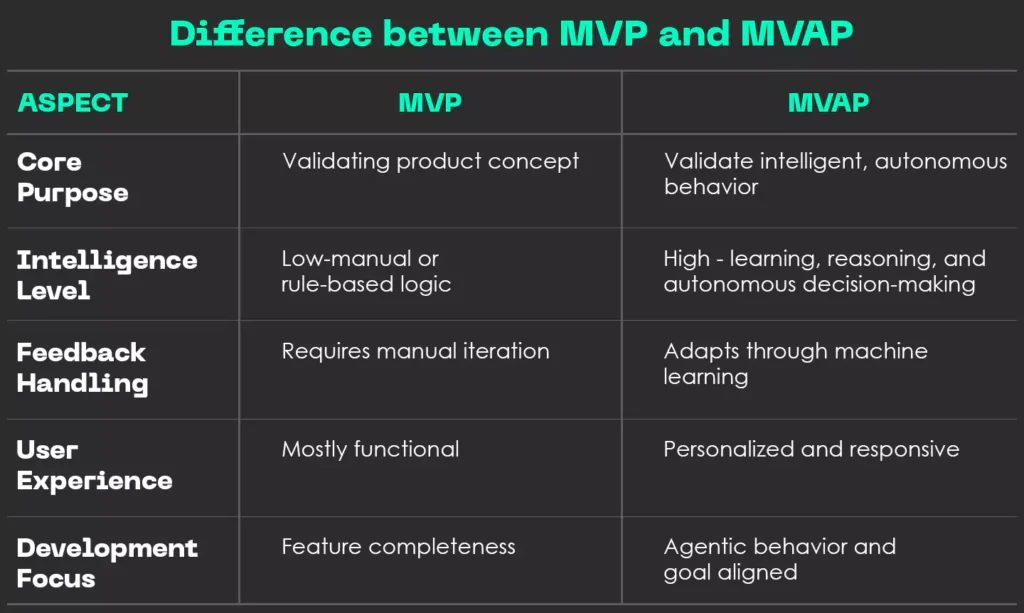
Fig: Difference between MVP and MVAP
I hope that the above-mentioned distinction helped you!
This is how an MVP becomes an MVAP:
1. Building on the MVP Foundation
An MVP is essentially about shipping the minimum number of features to address a specific problem for the users. It’s most often a static application where users engage with locked-down interfaces directly to accomplish a purpose. The intelligence behind it is basic—just some preset rules or simple automation.
2. Identifying Agentic Opportunities
The process of evolution starts by looking for places in the MVP where Agentic AI can add autonomy, proactiveness, and reasoning. The purpose is to minimize user effort or accomplish goals more effectively.
3. Embedding Agentic AI Capabilities:
This is the most important shift. During this phase, Agentic AI is layered onto the MVP, enabling it to understand goals, reason with context, plan actions, execute via tools, remember past interactions, learn over time, and reflect on outcomes. Together, these capabilities turn a static MVP into a self-improving, intelligent product system.
4. The MVAP Outcome:
This version of the product is the first version where core agentic capabilities start delivering value. You must remember that this is not the full-scale AI. It is the essential features that allow the product to get its enhanced capabilities built with agents.

Learn how we replaced a rigid legacy system with a flexible, high-impact MVP for a leading oil & gas company—delivered in just 10 weeks.
Can Building an MVAP Help Create the Perfect AI-Powered Product?
To answer the question in the heading, I’d say yes, absolutely!
MVAPs are somewhat like strategic shortcuts to building truly intelligent, agentic AI-powered products.
When we talk business, every organization is chasing that “Aha!” moment—a breakthrough product that stands out. This pursuit has sparked a wave where nearly everything being built today comes with some form of AI.
Even refrigerators now boast AI features (haha).
Silly jokes apart, MVAPs can bring great value to businesses. Here’s how:
1. Quicker Market Launch: MVAPs enable you to get a product out of the door sooner by building high-impact steps early on with agents playing the main game. So, you get to launch the product quickly and achieve higher ROI.
2. Reduced Costs: By performing mundane, manual steps internally, MVAPs save you operational costs, reduce errors, and allow your people to focus on what they excel at.
3. Enhanced User Experience: These products work on behalf of users, anticipating, deciding, and removing friction. The outcome? Users are happier, and they participate more.
4. Designed to Scale: MVAPs don’t get fatigued. They scale seamlessly, delivering consistent performance even as user demand increases.
5. Driven by Innovation: They change the direction of business models with the AI leap. In this way, they end up driving growth with real-time intelligence. They also provide your basic MVP with a competitive advantage in the marketplace.
Here are some of the real-world examples of MVAPs:
- AI-Powered Financial Assistants: Apps that not only track your expenses but also recommend savings plans and execute transactions autonomously
- Smart Healthcare Agents: Early versions of systems that proactively flag anomalies in patient health data and suggest interventions
- AI-based DevOps Copilots: Tools that autonomously detect, analyze, and remediate issues in CI/CD pipelines or infrastructure setups
If you’re looking to build your own MVAP, the next section walks you through the key steps to get started.
How to Start Building Your First MVAP Today
Here’s how you can start building your first Minimum Viable Agentic Product (MVAP):
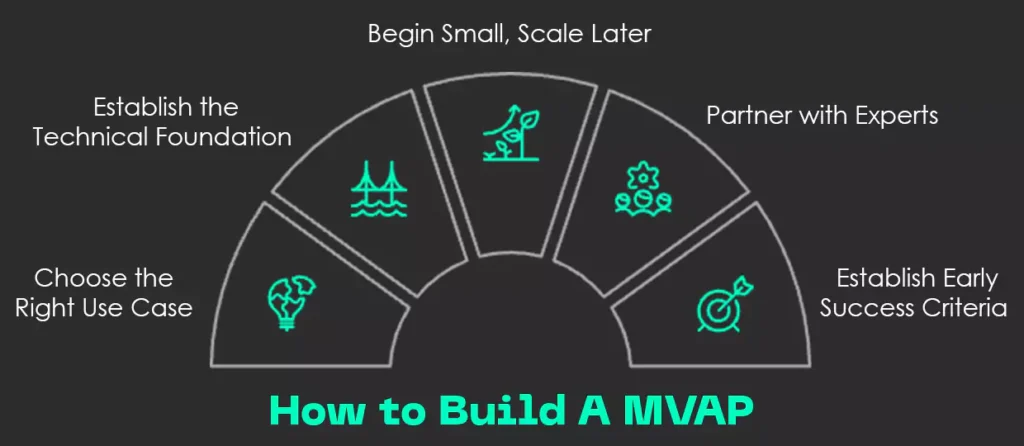
Fig: How to Build A MVAP
1. Choose the Right Use Case
Begin with a rapid scan of your product category. Target spaces with high data volume, quantitative results, and containable scope, such as customer service, content customization, or operations.
2. Establish the Technical Foundation
Next, develop scalable data pipelines and processing infrastructure. Here, cloud infrastructure may provide elasticity and compute resources for AI workloads.
3. Begin Small, Scale Later
Start with basic AI agents on low-risk activities. Then, gradually increase autonomy as they earn belief. During this phase, always have monitoring and feedback loops for control.
4. Partner with Experts
Work with seasoned teams to tap into established MVAP development practices, speed up delivery, and bypass common pitfalls.
5. Establish Early Success Criteria
Set clear, MVAP-specific goals early. These will guide your development journey and help you measure real progress.
At Nitor Infotech, an Ascendion company, we’ve embraced the Agentic AI revolution from day one, passionately developing powerful MVPs enhanced with intelligent agents. With deep expertise and a proven track record, we’re ready to help you unlock the full potential of agentic AI. Partner with us and let’s build the next generation of smart, autonomous, and scalable products together.
Though the roadmap looks straightforward, you might encounter some challenges that will need careful attention and resolution.
Keep reading to learn about them!
What Are Some Challenges in Building MVAPs?
Here are some challenges that you may encounter while building MVAPs:
- Scope Ambiguity: Defining the precise degree of useful agent autonomy
- Reliability and Hallucination: Providing persistent, fault-free, reliable agent action
- Data & Privacy: Providing useful data and maintaining confidential data
- Complex Error Handling: Allowing agents to recover gracefully from new disorders
- User Trust & Explainability: Building user trust for autonomous decision-making
To navigate such a bumpy road, you need a set of best practices. I’ve laid them down in the next section.
What Are Best Practices When Creating an MVAP?
Developing an MVAP isn’t about how to implement AI. It’s about strategic thought and change in approach. These are certain best practices to bear in mind:
1. Think Agentic
Pin down one user objective that can be tackled through autonomous action. Then, build a lean but smart agent.
2. Choose Appropriate Tools
Utilize frameworks like LangChain, Haystack, or other Agentic RAG configurations. Also, LLM orchestration and prompt engineering are essential here.
3. Bring Human-in-the-Loop (HITL)
Keep human oversight in place during early rollouts to stay in control of what the system does and decides.
4. Embed Ethics
Make your agents breathe transparency and fairness. That is, log their decisions, reduce bias, and ensure their actions can be easily understood.
5. Check Cross-Functionally
Make sure cross-functional collaboration takes place among product teams, ML engineers, prompt engineers, DevOps, and data scientists to build and check the competence of the product.
Let’s move onwards to learn about some alternate terminologies that will remind you of an MVAP.
What Are the Key Alternatives to MVAPs?
Here are some other concepts that can work as an alternative:
1. Minimum Lovable Product (MLP): A natural evolution of the MVP idea, MLP exceeds functionality to provide a truly great and emotionally rich user experience. It aims to not only meet but delight the early adopters. It thereby creates strong brand love and enthusiastic advocacy from day one.
2. Minimum Marketable Product (MMP): This is a product version that contains enough features to be profitable and sellable in the general market. It’s the point where the product is good enough to be released to users, even if it’s not fully polished yet.
3. Minimum Desirable Product (MDP): An MDP is built to not just solve a user’s problem affordably, but also to impress and surprise them beyond their expectations. This prioritizes user enjoyment and tries to surpass the initial impression. This makes the resulting experience long-lasting and extremely pleasant.
4. Minimum Awesome Product (MAP): This is an extremely developed, completed, and well-refined lean product. It combines the best functionality, marketability, and lovable user experience and places the product extremely close to its ultimate, completed commercial release with higher quality.
5. Proof of Concept (PoC): These are extremely early-stage implementations of a feature or a product, usually non-working prototypes or even minimal-functioning ones. They serve only to rigorously test the technical viability of an idea or to validate some key underlying assumptions before serious development efforts are committed.
Even though similarities exist with other approaches, MVAPs stand apart as the most forward-looking and impactful path in product development today.
They’re a bold redefinition of how digital products are imagined and built in the age of AI. So, my final advice for you would be to pave the way for truly intelligent, dynamic user experiences that go far beyond what traditional products can offer.
Feel free to contact us and take the next step toward Agentic AI!