

Highlights
Integrating large language models (LLMs) into enterprise systems isn’t just a technical upgrade—it’s a transformation journey filled with both opportunity and complexity. From safeguarding data privacy and meeting compliance standards to scaling reliably across departments, enterprises face multifaceted challenges. Many struggle to bridge the gap between cutting-edge AI potential and existing business processes while balancing ethical and operational risks.
This blog dives deep into these real-world hurdles and reveals actionable solutions. Discover how forward-thinking enterprises are unlocking innovation, efficiency, and competitive edge through strategic LLM integration.
Think of enterprise AI like introducing a high-end smart appliance into your kitchen. You wouldn’t replace your chef overnight – rather, you’d let the new gadget handle repetitive chopping, mixing, and timing tasks so the chef can focus on creativity. Similarly, enterprise LLMs (Large Language Models) aren’t replacing strategy – they’re optimizing the effort behind it. According to a 2025 study, over 55% of enterprises in North America have either deployed or are experimenting with LLM-based tools to automate work. But like teaching a brilliant yet unpredictable genius to fit into a corporate environment, enterprise LLM integration, i.e., integrating LLMs into enterprise systems, is not without challenges.
Think of them as a brainy assistant that never sleeps—ready to write reports, summarize thousands of customer interactions, or even help engineers debug code.
This blog dives deep into the key roadblocks enterprises face when deploying LLMs and offers realistic, actionable solutions that CIOs, data leaders, and innovators can use.
We’ll also explore how companies can blend human intelligence with machine learning to make LLM adoption both safe and strategic.
Let’s begin!
Why Enterprises Are Betting on LLMs
LLMs like GPT-4, Claude, and Mistral AI are transforming how organizations handle knowledge. Imagine having a full-time employee who knows every document, contract, and customer email your company has ever processed. That’s the promise of enterprise-level LLMs.
From financial forecasting and compliance to supply chain optimization, LLMs now aid decision-making in billions of data transactions daily. Studies suggest that AI-driven decision systems could boost productivity by up to 40% by 2035 across major sectors such as banking, healthcare, and telecom.
Yet, much like installing complex machinery in an already-running factory, integrating an LLM into enterprise ecosystems requires precision. Let’s look at what makes it tricky.
Delight Your Customers with Futuristic AI-ML Technology
Nitor Infotech is ready to catapult your customer satisfaction goals to the next level by helping you create game-changing products.
Help me heighten customer satisfaction
The Major Challenges of LLM Integration

Fig: The Major Challenges of LLM Integration
1. Accuracy and the Hallucination Problem
LLMs are powerful—but not infallible. One of their quirks is hallucination, where the model confidently produces false information. For instance, when used in legal or healthcare contexts, even slight inaccuracies can lead to costly mistakes.
A certain percentage of initial LLM outputs during enterprise pilots can contain factual errors or outdated data that require human correction. For enterprises, this isn’t just inconvenient—it’s risky.
Solution: Adopt retrieval-augmented generation (RAG) systems and fine-tune LLMs with proprietary data. RAG connects the model to real-time enterprise databases, ensuring every answer is rooted in verified knowledge. Think of it as giving your AI a GPS—it ensures it never gets lost in the sea of misinformation.
2. Data Privacy and Security
Data is every enterprise’s most trusted asset. Letting an LLM access sensitive internal or customer data can raise alarms around compliance, especially under strict frameworks like GDPR or HIPAA.
Solution: The best fix lies in on-premises or private cloud deployments of LLMs. Using secure fine-tuning with anonymized datasets ensures that no confidential data leaves corporate firewalls. Adding techniques like differential privacy and zero-knowledge proofs can protect personal and financial data during model training.
3. Cost Efficiency and Resource Optimization
Running an LLM at enterprise scale is like fueling a jet—it’s fast but expensive. The infrastructure for high-performance GPUs, cloud storage, and data pipelines can cost millions annually.
Solution: Cost optimization starts with model-right sizing. Instead of deploying a massive general-purpose model, use smaller specialized models fine-tuned for your tasks (e.g., document review or customer support). In addition, LLM orchestration frameworks that switch between models based on complexity can reduce inference costs by approximately 40–60%.
4. Integration with Legacy Systems
LLMs don’t always play well with others. Many enterprise systems—ERP, CRM, and HRM—use older tech stacks or proprietary data formats. Plugging a modern AI brain into a decades-old system is like trying to fit a smart thermostat into a house built in 1920.
Enterprise data, often scattered across silos, poses another challenge. Synchronizing internal databases with the inputs and outputs of an LLM can be a long, error-prone process.
Solution: The answer lies in creating a middleware layer—an integration ‘bridge’. Tools like vector databases and APIs enable smooth interoperability between legacy databases and AI infrastructure.
5. Ethical and Governance Concerns
As LLMs start making real-world decisions—approving credit lines, screening candidates, or responding to customers—the stakes skyrocket. Bias or toxic output can lead to reputation damage or legal trouble.
Solution: Create an AI governance framework that includes bias testing, internal audits, and human-in-the-loop validation. Think of this as a “seatbelt” for every AI decision—keeping it safe, compliant, and accountable. Ethical committees should also ensure that LLMs align with a company’s brand, culture, and tone.
6. Keeping Models Up to Date
LLMs have a knowledge cutoff—like a library frozen in time. This means that without updates, models can give outdated answers. In industries like finance or law, that’s problematic.
Solution: Enterprises can continuously retrain their models using incremental learning, where fresh data refines the knowledge base over time. Using APIs for real-time knowledge retrieval ensures the AI always refers to the newest information source, much like updating a GPS map before a road trip.
7. Domain-Specific Contextualization
Generic LLMs are often too broad. They might excel at generating creative text but falter when asked to interpret niche data—say, manufacturing protocols or complex tax regulations.
Research from Raga AI (2024) observed that generic LLMs showed a 20–35% drop in accuracy on specialized enterprise tasks without fine-tuning.
Solution: Domain fine-tuning and hybrid models are the key. This means combining general intelligence with company-specific expertise—training your LLM on internal documents, customer tickets, or past transactions. The result is an AI that ‘talks’ like your business, not a random encyclopedia.
8. Explainability and Transparency
One common criticism of LLMs is that their decision-making process is a “black box.” For regulated industries like banking or healthcare, not understanding why an AI generated an answer can be a dealbreaker.
Solution: Implement explainable AI (XAI) methods. Techniques such as attention mapping and output scoring can trace a model’s reasoning pathway, showing what data influenced its output. Think of it as switching on the headlights in a foggy road—visibility leads to trust.
9. Cultural and Workforce Adjustment
Integrating AI into human workflows also challenges workplace dynamics. Employees might fear being replaced or overwhelmed by complex new tools. Yet, in most successful enterprises, LLM integration created new roles instead of reducing them.
According to a 2025 PwC Future Workforce Survey, 72% of employees using AI tools reported increased productivity, while only 18% felt their jobs were threatened.
Solution: Encourage AI upskilling programs and foster a co-pilot mindset—where AI assists, not replaces, employees. In simpler terms, treat LLMs like GPS for your talent: they guide the journey, but the driver (human) still controls the wheel.
Read our detailed post on – The Importance of LLM Observability and Monitoring
Strategies for Successful LLM Integration
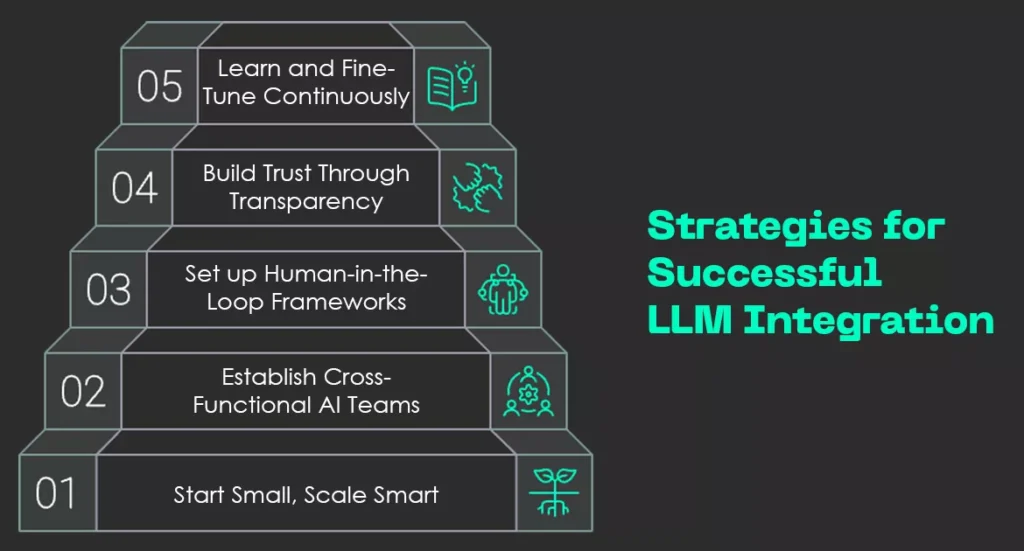
Fig: Strategies for Successful LLM Integration
Start Small, Scale Smart
Select a narrow, impactful use case first. It could be automating customer FAQs or summarizing policy documents. Once the system proves its reliability and ROI, scale it across departments.
Enterprises pursued phased rollouts that allowed them to benchmark results without heavy upfront risks.
Establish Cross-Functional AI Teams
Successful integration needs collaboration between data scientists, IT experts, compliance officers, and end-users. Building a unified team ensures all concerns—technical, ethical, and operational—are addressed early.
A typical team structure might look like this:
- AI Product Manager: Defines business goals.
- Data Engineer: Ensures data integrity.
- Security Specialist: Manages compliance risks.
- End-user Advocates: Represent employee or customer experience feedback.
Set up Human-in-the-Loop Frameworks
Automation doesn’t mean full independence. In safety-critical environments, human oversight remains vital. A hybrid setup—where employees validate model outputs—can improve quality and minimize risk.
For example, AI-generated marketing content can undergo review by brand managers before publishing, ensuring tone consistency.
Build Trust Through Transparency
Transparency drives adoption. Users are more likely to trust LLM tools if they understand how outputs are generated and verified.
Implement dashboards showing model accuracy, update logs, and feedback loops. Much like a car’s dashboard indicators, this visibility gives decision-makers control and confidence.
Learn and Fine-Tune Continuously
Unlike traditional software, LLMs evolve. They require continuous monitoring, retraining, and updating to stay effective. Enterprises should build feedback loops that capture user corrections and reroute them as training data.
This not only sharpens future performance but also keeps AI aligned with real-world shifts—new regulations, market changes, or customer behavior trends.

Fuel software dev with AI to make it swifter and smarter, without compromising one bit on quality.
Human + Machine Synergy: The Future of Enterprise AI
The most successful enterprises won’t simply install LLMs—they’ll integrate them into a culture of collaboration and innovation.
In the coming years, enterprise AI will move toward composable architectures, allowing multiple smaller models to work in sync. Instead of one gigantic LLM, several specialized agents—each handling tasks like compliance, summarization, or recommendation—will communicate through APIs. There could be a remarkable improvement in speed and reliability through this modular approach.
As automation deepens, the human element remains irreplaceable. An LLM can process millions of lines of data, but judgment, empathy, and creative problem-solving remain domains of human excellence.
What are the Metrics for LLM Performance?
Measuring LLM performance is crucial. Consider these KPIs as suggestions for enterprise-level tracking:
| Metric | Description | Benchmark |
| Throughput | Rate at which the LLM processes requests or tokens, indicating system scalability and capacity | Enterprise-scale benchmarks measure tokens per second or requests per minute under peak loads |
| Task Success Rate | Percentage of tasks correctly and fully completed by the LLM according to business criteria | Benchmarks use end-to-end accuracy on domain-specific tasks like financial document analysis |
| Cost per Request | Total operational cost per request factoring token usage and model pricing | Benchmarking compares costs normalized to task completion, factoring cloud pricing and efficiency |
| Hallucination Rate | Proportion of generated outputs that contain factually incorrect or irrelevant information | Benchmarked by automated fact-checkers or manual audits on domain-relevant datasets |
These ensure that the LLM not only performs well but also stays economically and operationally sustainable.
********
The road to LLM integration in enterprises is complex but promising. Challenges like hallucination, data privacy, and cost won’t vanish overnight. But with the right governance, iterative experimentation, and human oversight, enterprises can transform these hurdles into growth levers.
In many ways, it’s like upgrading from manual driving to autonomous mode—demanding at first, but eventually smoother, safer, and more efficient.
By 2030, LLM adoption will likely become as ubiquitous as cloud computing today. Enterprises that start building their AI maturity now—anchored in trust, transparency, and domain excellence—will lead the next decade of digital transformation.
For organizations ready to step into this AI-driven future, the journey isn’t just about integration. It’s about reinvention.
Contact us at Nitor Infotech to learn more about the latest in the generative AI world.