

Artificial intelligence has experienced a revolutionary shift through the development of Agentic AI systems. Conventional AI models function primarily as reactive systems that process inputs and generate outputs. But Agentic AI introduces autonomous digital entities that can independently plan strategies, apply reasoning, and execute sophisticated tasks with limited human oversight.
These advanced systems demonstrate the ability to understand their operational context, make strategic decisions, and implement actions toward achieving defined objectives. In this sense, they create a paradigm shift in how enterprises tackle complex problem-solving challenges.
In my blog today, I’m going to share how CrewAI can help you build intelligent multi-agent systems.
Let’s start with an understanding of agentic AI!
The Evolution Toward Autonomous Systems
The progression from responsive AI to proactive, self-directed systems represents a crucial breakthrough in artificial intelligence advancement. Conventional AI frameworks operate within a query-response model. They process information and deliver results without retaining contextual awareness or working toward sustained objectives. Agentic AI transcends these constraints by incorporating:
- Purpose-driven behavior,
- Continuous memory retention, and
- Sophisticated interaction capabilities with external tools and infrastructure.
This technological evolution directly addresses significant gaps in enterprise implementations where intricate workflows demand seamless coordination among multiple specialized functions. Rather than orchestrating separate AI models for distinct tasks, organizations can now implement intelligent agents that work collaboratively to accomplish strategic business goals.

The missing link between food delivery and POS systems was costing our client time and money – until we closed the gap and delivered 20% better performance. The result? Heightened end-user experience.
Components of Agentic AI Systems
Agentic AI systems comprise several fundamental components that enable autonomous operation:
- Perception and Environment Interaction: Agents must understand their operational context, including available tools, data sources, and environmental constraints. This includes the ability to process various input types and maintain situational awareness.
- Goal-Oriented Planning: Unlike reactive systems, agents maintain clear objectives and develop strategies to achieve them. This involves breaking down complex goals into manageable sub-tasks and adapting plans based on changing circumstances.
- Decision-Making and Reasoning: Agents employ sophisticated reasoning capabilities to evaluate options, assess risks, and make informed decisions. This includes both logical reasoning and learned patterns from training data.
- Memory and State Management: Persistent memory allows agents to learn from past interactions, maintain context across conversations, and build upon previous work. This is crucial for complex, multi-step processes.
- Tool Integration and External Interaction: Modern agentic systems can interact with external APIs, databases, and tools, extending their capabilities beyond text generation to real-world problem-solving.
What is CrewAI?
CrewAI stands as an innovative framework specifically engineered for constructing and managing multi-agent AI ecosystems. It was created to meet the increasing demand for collaborative AI solutions. CrewAI empowers developers to build specialized agent teams that collaborate effectively. The collaboration aims to resolve intricate challenges that would prove difficult for individual agents to manage independently.
Fundamentally, CrewAI operates as a Python-based development framework. It delivers a systematic methodology for designing, deploying, and supervising multiple AI agents within a unified coordination system. The framework simplifies the intricacies of agent-to-agent communication, task allocation, and outcome synthesis. It helps developers to concentrate on defining agent behaviors and operational workflows rather than handling complex coordination mechanisms.
CrewAI’s distinctive approach emphasizes role-specific specialization and collaborative problem resolution. Each agent within a CrewAI ecosystem is engineered with particular capabilities, knowledge specializations, and operational responsibilities. These agents can then be organized into teams that address complex projects requiring varied expertise. This is similar to how human teams function in professional settings.
The framework supports integration with various large language models (LLMs), including OpenAI’s GPT series, Anthropic’s Claude, and open-source alternatives. This provides flexibility in choosing the most appropriate AI backend for specific use cases. This model-agnostic approach ensures that CrewAI remains adaptable to evolving AI technologies and organizational requirements.
In the following section, let me walk you through the functionality of CrewAI.
How CrewAI Works
CrewAI functions through a structured hierarchy that reflects authentic team collaboration patterns. The framework manages agent interactions via a clearly defined process workflow. This guarantees efficient task completion while preserving quality standards and consistency across outputs.
The operational sequence initiates with objective definition, where complex goals are decomposed into manageable segments. Each segment receives an assignment to the most suitable agent. This is based on their established capabilities and domain expertise. Agents perform their designated tasks while sustaining communication with team members to share updates, seek guidance, or contribute input for interdependent activities.
The framework utilizes smart routing algorithms that identify the most effective sequence for task execution. This encompasses parallel processing functionalities where independent tasks run simultaneously, and sequential processing for activities with established dependencies. The system continuously tracks progress and can dynamically modify task assignments based on agent performance and resource availability.
Communication between agents is facilitated through structured message passing and shared memory systems. This ensures that all team members have access to relevant information while maintaining appropriate boundaries between different agents’ responsibilities. The framework also provides mechanisms for conflict resolution when agents produce contradictory results or recommendations.
Results from individual agents are aggregated and synthesized to produce final outputs. This process includes quality assurance checks, consistency validation, and result formatting to ensure that the final deliverable meets specified requirements and standards.
One of the questions on your mind could be, “What do I stand to gain from the use of CrewAI?”
Why Use CrewAI
CrewAI offers significant advantages over traditional single-agent systems and competing multi-agent frameworks. The primary benefit lies in its ability to leverage specialized expertise across multiple domains within a single workflow. It dramatically improves output quality and reduces the likelihood of errors that can occur when a single agent attempts to handle diverse tasks.
Comparative Analysis with Alternative Frameworks
- Versus Single-Agent Systems: Traditional single-agent approaches often struggle with complex, multi-faceted problems that require diverse expertise. CrewAI’s multi-agent approach allows for specialization. This is where each agent can be optimized for specific tasks, resulting in higher-quality outputs and more reliable performance.
- Versus AutoGPT and Similar Frameworks: While AutoGPT focuses on autonomous task execution, CrewAI emphasizes collaborative problem-solving. This approach reduces the risk of agents pursuing suboptimal strategies in isolation and provides better oversight and control over the overall process.Think of it this way: AutoGPT is like a brilliant but overly enthusiastic intern who sometimes reorganizes your entire filing system when you just asked them to find one document. CrewAI, on the other hand, is like having a well-coordinated team where everyone knows their role and nobody accidentally deletes the quarterly reports.
- Versus LangChain: LangChain excels at building AI applications with tool integration, but CrewAI specifically addresses the orchestration of multiple AI agents working together. CrewAI can complement LangChain by providing the coordination layer for complex multi-agent workflows.
- Versus Microsoft Autogen: Both frameworks target multi-agent systems, but CrewAI provides a more structured approach to agent roles and responsibilities. This makes it easier to design and maintain complex agent teams.
Key Features and Benefits of CrewAI
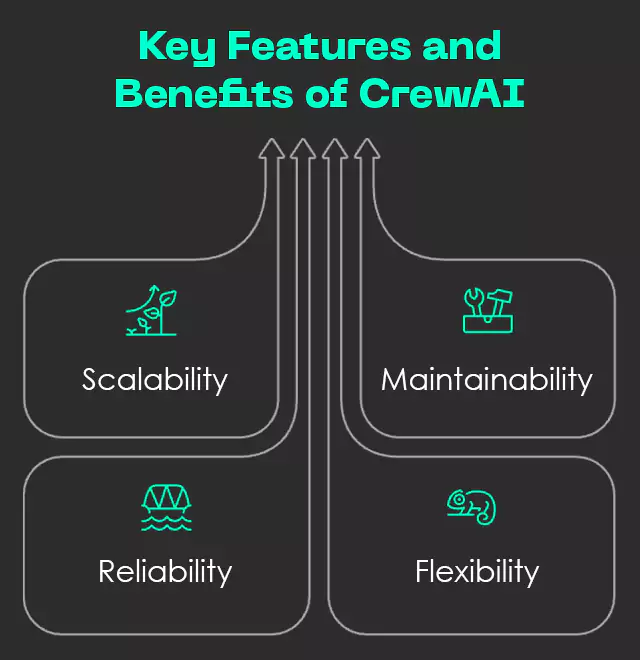
Fig: Key Features and Benefits of CrewAI
- Scalability: CrewAI systems can easily scale from small teams of 2-3 agents to large organizations with dozens of specialized agents. Each contributes their unique capabilities to the overall workflow.
- Maintainability: The framework’s modular design makes it straightforward to update individual agents, modify workflows, or integrate new capabilities without disrupting the entire system.
- Reliability: By distributing tasks across multiple agents and implementing validation mechanisms, CrewAI reduces single points of failure and improves overall system reliability.
- Flexibility: The framework supports various LLM backends, custom tool integration, and adaptable workflow patterns. This makes it suitable for diverse use cases and organizational requirements.
Let’s head onwards to understand the core components of CrewAI.
Core Components of CrewAI
CrewAI’s architecture revolves around five fundamental components that work together to create effective multi-agent systems: Agents, Tasks, Crews, Processes, and Flows. Understanding these components is crucial for designing and implementing successful CrewAI applications.
Agent: The Fundamental Building Block
Agents represent the core intelligence units within CrewAI systems. Each agent is designed as a specialized entity with specific capabilities, knowledge domains, and behavioral patterns. The agent architecture includes several key attributes that define their operational characteristics and capabilities.
Agent Attributes:
- Role: Defines the agent’s primary function and area of expertise. This could be “Data Analyst,” “Content Writer,” “Code Reviewer,” or any specialized role relevant to the application domain.
- Goal: Specifies the agent’s primary objective and success criteria. Goals should be clear, measurable, and aligned with the overall system objectives.
- Backstory: Provides context about the agent’s background, experience, and perspective. This helps the underlying LLM understand how to approach problems from the agent’s viewpoint.
- Tools: Specifies the external tools and capabilities available to the agent. This includes API integrations, databases, file systems, and specialized software.
- LLM Configuration: Defines which language model the agent uses and any specific configuration parameters such as temperature, max tokens, or custom prompts.
Implementing an Agent in CrewAI:
python

from crewai import Agent

from crewai_tools import SerperDevTool, FileReadTool

# Define tools for the agent

search_tool = SerperDevTool()

file_tool = FileReadTool()

# Create a specialized research agent

research_agent = Agent(

role="Market Research Analyst",

goal="Conduct comprehensive market analysis and provide actionable insights",

backstory="You are an experienced market research analyst with expertise in analyzing industry trends, competitor analysis, and market opportunities. You excel at gathering information from multiple sources and synthesizing it into clear, actionable recommendations.",

tools=[search_tool, file_tool],

verbose=True,

)
Task: Defining Work Units
Tasks represent discrete work units that agents must complete to achieve the overall system objectives. Each task is specifically designed to leverage an agent’s capabilities while contributing to the broader workflow.
Tasks include detailed descriptions of what needs to be accomplished, expected deliverables, and quality criteria. They can be independent or have dependencies on other tasks, allowing for complex workflow orchestration.
Task Implementation:
python

from crewai import Task

market_analysis_task = Task(

description="Conduct a comprehensive analysis of the electric vehicle market, including current trends, key players, market size, and growth projections for the next 5 years.",

agent=research_agent,

expected_output="A detailed report including market size data, trend analysis, competitive landscape, and future projections with supporting data and sources."

)
Crew: Organizing Agent Teams
Crews represent collections of agents working together toward common objectives. The crew structure defines how agents interact, share information, and coordinate their efforts to complete complex projects.
Think of a CrewAI crew like a professional kitchen during dinner rush. You have the head chef (a senior agent) who oversees the entire operation, specialized sous chefs (domain-specific agents) who handle particular cuisines or techniques, prep cooks (data processing agents) who prepare ingredients, and expeditors (coordination agents) who ensure dishes are completed and delivered on time.
Each team member has distinct responsibilities, but they all work together seamlessly to create a cohesive dining experience. Without this coordination, you’d have perfectly prepared appetizers sitting cold while the main course is still being prepped, and desserts arriving before the salad.
Crews can be organized in various configurations, including hierarchical structures with manager agents, peer-to-peer networks, or specialized teams focused on specific project phases.
Crew Implementation:
python

from crewai import Crew

# Assemble multiple agents into a research crew

research_crew = Crew(

agents=[research_agent], # List of Agents

tasks=[market_analysis_task ], # List of Tasks

verbose=True

)
Process: Workflow Orchestration
Processes define how tasks are executed within the crew structure. CrewAI supports sequential, hierarchical/parallel processes for now and custom workflow patterns.
The process component handles task scheduling, dependency management, and result aggregation. It ensures that tasks are executed in the correct order and that agents have access to necessary inputs from previous tasks.
Two Main Process Types:
1. Process.sequential
- Agents work one after another.
- Each agent completes its task and passes output to the next.
- Useful when tasks depend on each other.
- Example: Research agent → Writer agent → Reviewer agent.
from crewai import Process
process = Process.sequential
2. Process.hierarchical
- All agents run independently and at the same time.
- No output handoff between agents.
- Useful for independent sub-tasks.
- Example agents doing market analysis for different products.
process = Process.hierarchical
Why Process Matters
Choosing the right process:
- Keeps the workflow efficient
- Ensures agents don’t work in conflict
- Matches how humans often collaborate: step-by-step or divide-and-conquer
Flow: Advanced Workflow Management
CrewAI Flows orchestrates multi-agent workflows using event-driven architecture, allowing you to chain crews together with automatic triggers and conditional routing.
Flows can handle dynamic task creation, iterative processes, and adaptive workflows that respond to intermediate results.
This component is particularly valuable for applications requiring flexible, context-aware processing where the exact sequence of tasks may not be predetermined.
Core Concepts
Flow: A class that defines the workflow structure and manages agent interactions
- @start(): Entry point method that begins the workflow
- @listen(): Event listeners that trigger when specific tasks complete
- @router(): Conditional branching based on results or conditions
Event-driven: Tasks automatically trigger subsequent tasks based on events
Example: Blog Writing Flow: How It Works
- @start() kicks off with research_topic() – researches AI in Healthcare
- @listen(“research_topic”) automatically triggers write_blog() when research completes
- @listen(“write_blog”) automatically triggers review_content() when writing finishes
from crewai import Agent, Task, Crew

from crewai.flow import Flow, start, listen, router

class BlogWritingFlow(Flow):

@start()
def research_topic(self):
"""Step 1: Research the topic"""
researcher = Agent(
role="Researcher",
goal="Research blog topics and gather information",
backstory="Expert researcher with strong analytical skills"
)
research_crew = Crew(
agents=[researcher],
tasks=[
Task(
description="Research the topic 'AI in Healthcare' and gather key insights",
agent=researcher,
expected_output="Research summary with key points about AI in Healthcare"
)
]
)
research_result = research_crew.kickoff()
return research_result


@listen("research_topic")
def write_blog(self, research_result):
"""Step 2: Write blog post based on research"""
writer = Agent(
role="Content Writer",
goal="Write engaging blog posts",
backstory="Professional writer with expertise in technology content"
)
writing_crew = Crew(
agents=[writer],
tasks=[
Task(
description=f"Write a 500-word blog post about AI in Healthcare using this research: {research_result}",
agent=writer,
expected_output="Complete blog post with title, introduction, body, and conclusion"
)
]
)
blog_post = writing_crew.kickoff()
return blog_post
@listen("write_blog")
def review_content(self, blog_post):
"""Step 3: Review and edit the blog post"""
editor = Agent(
role="Editor",
goal="Review and improve written content",
backstory="Experienced editor focused on clarity and engagement"
)
editing_crew = Crew(
agents=[editor],
tasks=[
Task(
description=f"Review and edit this blog post for clarity and engagement: {blog_post}",
agent=editor,
expected_output="Edited blog post with improvements and suggestions"
)
]
)
final_post = editing_crew.kickoff()
return final_post


if name == "main":

flow = BlogWritingFlow()

result = flow.kickoff()

print("Blog writing flow completed!")

print(f"Final result: {result}")
Key Benefits
- Automatic Orchestration: No manual coordination between crews – events trigger automatically
- Clean Structure: Each step is isolated and focused on specific tasks
- Error Handling: Built-in flow control and state management
- Scalability: Easy to add new steps by adding listeners
This creates a seamless pipeline: Research → Write → Edit, where each crew focuses on its expertise and results flow automatically to the next step.
Tools: Extending Agent Capabilities
Tools represent one of the most critical aspects of CrewAI implementations, as they enable agents to interact with external systems and perform actions beyond text generation.
Pre-defined Built-in Tools:
CrewAI provides a comprehensive library of pre-built tools that cover common use cases:
- SerperDevTool: Enables web search capabilities for information gathering
- FileReadTool: Allows agents to read and process various file formats
- DirectoryReadTool: Provides file system navigation and directory listing
- WebsiteSearchTool: Specialized tool for searching specific websites
- CodeDocsSearchTool: Enables searching through code documentation
- DatabaseTool: Provides database query capabilities
- EmailTool: Enables email sending and management
- APITool: Generic tool for REST API interactions
Custom Tool Integration:
python

from crewai_tools import tool

@tool("Calculate ROI")

def calculate_roi(investment: float, return_value: float) -> str:

"""Calculate Return on Investment (ROI) percentage"""

roi = ((return_value - investment) / investment) * 100

return f"ROI: {roi:.2f}%"

# Assign custom tool to agent

financial_agent = Agent(

role="Financial Analyst",

goal="Perform financial calculations and analysis",

tools=[calculate_roi],

# ... other configurations

)
Complete Example
To illustrate CrewAI’s practical applications, let’s explore a specific use case that demonstrates the framework’s capabilities in a real-world scenario.
Example: Software Development Code Review
python

# Code review crew implementation

code_reviewer = Agent(

role="Senior Code Reviewer",

goal="Identify code quality issues and security vulnerabilities",

backstory="Senior developer with expertise in code quality and security best practices",

tools=[FileReadTool(), CodeDocsSearchTool()]

)

security_analyst = Agent(

role="Security Analyst",

goal="Perform security-focused code analysis",

backstory="Cybersecurity expert specializing in application security",

tools=[FileReadTool()]

)

# Tasks for code review

code_review_task = Task(

description="Review Python code for quality, performance, and maintainability issues",

agent=code_reviewer,

expected_output="Detailed code review report with recommendations"

)

security_review_task = Task(

description="Analyze code for security vulnerabilities and compliance issues",

agent=security_analyst,

expected_output="Security assessment report with risk ratings"

)

review_crew = Crew(

agents=[code_reviewer, security_analyst],

tasks=[code_review_task, security_review_task],

verbose=True

)
Integrating Custom LLMs
CrewAI supports integration with various language models beyond the default options. This flexibility allows organizations to use proprietary models or specific LLM configurations optimized for their use cases.
python

from crewai import Agent, LLM

# Configure custom LLM

custom_llm = LLM(

model="custom-model-name",

base_url="https://api.custom-provider.com/v1",

api_key="your-api-key"

)

# Create agent with custom LLM

specialized_agent = Agent(

role="Domain Expert",

goal="Provide specialized knowledge in specific domain",

backstory="Expert with deep domain knowledge",

llm=custom_llm

)
Now, what awaits us on the horizon? Let’s explore future possibilities.
The Future of Multi-Agent Systems

Fig: Trends Shaping the Future of Multi-Agent Systems
The future of multi-agent systems extends far beyond current capabilities. Several key trends are shaping this evolution:
- Enhanced Autonomy and Self-Organization: Future multi-agent systems will exhibit greater autonomy, with agents capable of self-organization, dynamic role assignment, and adaptive behavior based on changing requirements. This will reduce the need for explicit coordination mechanisms and enable more resilient, flexible systems.
- Integration with Physical Systems: The convergence of AI agents with robotics and IoT devices will create hybrid systems where digital agents coordinate with physical entities to accomplish real-world tasks. This integration will be particularly transformative in manufacturing, logistics, and smart city applications.
- Improved Reasoning and Planning: Advanced reasoning capabilities will enable agents to handle more complex, multi-step problems requiring deep understanding and long-term planning. This includes better causal reasoning, strategic thinking, and the ability to work with incomplete or uncertain information.
- Ethical and Governance Frameworks: As multi-agent systems become more prevalent, robust frameworks for ensuring ethical behavior, accountability, and governance will emerge. This includes mechanisms for transparency, audit trails, and ensuring that agent decisions align with organizational values and regulatory requirements.
- Democratization of AI Development: Frameworks like CrewAI are making it easier for organizations to implement sophisticated AI solutions without requiring extensive AI expertise. This trend will continue with more user-friendly tools and pre-built components that enable rapid deployment of multi-agent systems.
CrewAI is a great advancement in making multi-agent AI systems accessible and practical for real-world applications. By providing a structured framework for coordinating multiple specialized agents, CrewAI enables organizations to tackle complex problems that would be challenging for individual AI systems to handle effectively.
The framework’s emphasis on role-based specialization, collaborative problem-solving, and tool integration makes it particularly well-suited for enterprise applications where quality, reliability, and maintainability are paramount. The modular architecture allows for gradual adoption and scaling. This makes it feasible for organizations to start with simple multi-agent implementations and evolve toward more sophisticated systems over time.
As the field of Agentic AI continues to evolve, frameworks like CrewAI will play a crucial role in bridging the gap between cutting-edge AI research and practical business applications. The ability to create teams of specialized AI agents that work together seamlessly opens new possibilities for automation, decision-making, and problem-solving across industries.
The future success of multi-agent systems will depend on continued improvements in agent reasoning capabilities, better integration with existing enterprise systems, and the development of robust governance frameworks. CrewAI’s current architecture and roadmap help it to address these challenges while maintaining its core strengths in simplicity and effectiveness.
For organizations considering the adoption of multi-agent AI systems, CrewAI offers a compelling combination of power, flexibility, and accessibility. Its comprehensive toolset, active community, and continuous development make it an excellent choice for building the next generation of intelligent, collaborative AI applications.
Write to us sharing your experience of exploring CrewAI.
Contact us at Nitor Infotech to understand even better how you can harness the power of Agentic AI to add greater value to your software systems.