

Highlights
Stop guessing about agentic AI and start understanding how it actually works in healthcare. This blog breaks down everything from why these new systems outperform traditional AI by 15+ percentage points to how they’re transforming robotic surgery and hospital workflows. You’ll discover the exact differences between old-school AI tools and autonomous agents, learn how AI is revolutionizing medical diagnosis and drug discovery, and get practical insights on implementation challenges like talent shortages and data quality issues. Whether you’re evaluating AI investments or planning digital transformation, you need to know what’s working, what’s failing, and where the $4.46B market is headed by 2030.
Medical technology has reached an inflection point, don’t you think?
Traditional AI tools that once required constant human supervision are evolving into autonomous agents capable of independent decision-making. Agentic AI in MedTech represents this paradigm shift, where AI agents now analyze AI images, coordinate treatment protocols, and optimize healthcare workflows without waiting for human input at every step.
The Agentic AI in MedTech transformation spans diagnostic accuracy improvements, where Artificial Intelligence applications achieve 61.4% success rates compared to 46.5% with conventional methods, operational efficiency gains through workflow automation, and the emergence of entirely new healthcare roles. The numbers tell the story: the Agentic AI in MedTech market reached USD 0.70 billion in 2025 and is expected to climb up to USD 4.46 billion by 2030. This reflects a stellar 44.83% CAGR. Consider these developments reshaping medical practice:
- AI agents now perform real-time adaptation during surgical procedures, adjusting strategies based on patient responses.
- Computer vision systems integrated with natural language processing generate comprehensive medical reports autonomously.
- Machine learning algorithms predict equipment failures and optimize supply chain optimization before shortages occur.
- Virtual health assistants provide 24/7 patient monitoring while addressing talent shortages in rural healthcare settings.
Okay, to begin with, in this blog, we’re going to explore what makes agentic AI different from traditional tools. In addition, we’ll look at how AI agents are changing medical diagnosis, clinical decisions, and patient care. Further, we’ll also cover their impact on hospital operations, drug discovery, and robotic surgery. Finally, we’ll discuss implementation challenges, cost savings, and the MedTech agentic AI future.
Ready? Let’s get started!
What Makes Agentic AI Different from Traditional AI Tools?
Remember when AI in healthcare meant simple pattern recognition and rule-based systems?
Agentic AI flips this entire script. These systems think, plan, and act independently. While your old AI image analysis tool would identify a tumor and call it a day, XAI or explainable AI, showed its work, agentic AI agents analyze the tumor, cross-reference patient history, suggest treatment protocols, coordinate with other systems, and schedule the follow-up appointment.
Here’s what sets Agentic AI apart in the MedTech landscape:
- Autonomous Decision-Making: These systems can evaluate complex medical scenarios and make informed decisions without constant human intervention.
- Multi-Modal Integration: They seamlessly combine AI images, text data, sensor information, and real-time patient monitoring into coherent insights.
- Adaptive Learning: Unlike static AI tools, agentic systems continuously learn from new interactions and improve their performance.
- Dynamic Workflow Management: They can orchestrate entire healthcare processes, from patient triage to discharge planning.
The technical backbone powering this transformation involves sophisticated architectures that integrate pretrained deep learning encoders with large language models (LLMs). But here’s where things get interesting: how exactly are these intelligent systems transforming the core functions of healthcare delivery?
How Are AI Agents Revolutionizing Medical Diagnosis?
Medical diagnosis has always been part detective work, part educated guesswork, and part pure clinical intuition. Now, AI agents are stepping into the role of the world’s most obsessive medical detectives, and they never miss a clue.
Modern diagnostic AI agents don’t just look at one AI picture or scan – they’re analyzing entire patient ecosystems. When an AI agent encounters a brain MRI, it doesn’t just identify anomalies. It considers the patient’s symptoms, medical history, genetic markers, and even lifestyle factors to provide comprehensive diagnostic insights.
The diagnostic revolution with AI agents is happening across multiple fronts:

Fig: Diagnostic Revolution with AI Agents
- Medical Imaging Intelligence: AI agents now integrate computer vision with natural language processing to generate automated radiology reports while maintaining clinical accuracy.
- Multimodal Diagnostic Fusion: Systems combine 2D AI images with textual data, achieving up to 20% higher diagnostic accuracy than existing models.
- 3D Medical Analysis: Advanced systems analyze complex 3D medical scans, representing a quantum leap in AI-powered medical imaging.
- Predictive Analytics Integration: These agents identify early disease indicators, from diabetes to cardiovascular conditions, enabling proactive intervention strategies.
But diagnostic AI agents aren’t just about accuracy – they’re about speed and accessibility. In emergency departments where every second counts, these systems can instantly analyze AI images, prioritize cases, and alert specialists to critical findings while human doctors are still logging into their systems.
The real magic happens when these diagnostic capabilities extend beyond individual cases to transform entire healthcare delivery systems.
What Role Do AI Agents Play in Clinical Decision Support?
Agentic AI systems integrate with electronic health records, analyzing patient data in real-time and providing contextual insights that help clinicians make better decisions faster. Unlike traditional AI applications that required manual data entry and separate interpretation steps, modern AI agents execute these processes cohesively and adaptively.
Here’s how AI agents are transforming clinical decision-making:
- Real-Time Data Integration: AI agents continuously analyze patient monitoring data, lab results, and imaging studies to provide instant clinical insights.
- Evidence-Based Recommendations: These systems access vast medical databases to suggest treatment options based on the latest research and best practices.
- Risk Assessment Automation: AI agents evaluate patient risk factors and alert clinicians to potential complications before they become critical.
- Treatment Protocol Optimization: Systems can suggest personalized treatment plans based on individual patient characteristics and outcomes data.
Vision-Language Models (VLMs) represent a particularly exciting development in this space. These AI agents combine advanced language processing with medical imaging analysis, enabling radiologists to generate structured reports more efficiently while reducing diagnostic errors. Studies show that AI-assisted report generation significantly improves workflow efficiency and diagnostic accuracy.
As clinical decision support evolves, these capabilities naturally extend into the realm of patient care and treatment optimization.
How Is Agentic AI Transforming Patient Care and Treatment?
Patient care has traditionally been a very human-centered process, and rightfully so. But agentic AI isn’t trying to replace the human touch. It’s amplifying it in ways that were previously impossible.
AI agents in patient care manage everything from treatment planning to patient monitoring while maintaining the personal connection that makes healthcare meaningful. These systems can simulate doctor-patient interactions through platforms that autonomously collect patient information, make diagnostic decisions, and recommend treatments through natural dialogue.
The Agentic AI transformation is happening across multiple dimensions of patient care:
- Personalized Treatment Planning: AI agents analyze genomic profiles and patient histories to recommend tailored treatment protocols (precision medicine), then validate these recommendations against extensive medical databases.
- Continuous Patient Monitoring: Through integration with wearable devices and IoT sensors, AI agents track vital signs and detect abnormalities in real-time, alerting caregivers only when intervention is necessary.
- Therapeutic Optimization: These systems simulate potential complications and adjust therapy plans proactively, helping clinicians anticipate and prevent adverse outcomes.
- Patient Engagement Enhancement: AI-powered virtual health assistants provide 24/7 support, symptom checking, and medication reminders while maintaining conversational and empathetic interactions.
One of the most promising applications involves AI agents that can predict and prevent medical emergencies. By continuously analyzing patient data streams from multiple sources, these systems can identify subtle changes that might indicate developing complications hours or even days before they become clinically apparent.
The technology behind this transformation leverages advanced machine learning algorithms that can process vast amounts of real-time data while maintaining the contextual understanding necessary for quality patient care.
As efficiency improves through AI implementation, these advances create opportunities for even more sophisticated applications in specialized medical fields.
Sorry to break your flow, but I promise this will be worth it.

Digital healthcare giving you a headache? So ironic. But don’t worry, we’ve got the cure for industry challenges!
How Are AI Agents Advancing Drug Discovery and Research?
Drug discovery has traditionally been a process that makes watching paint dry seem exciting. It takes decades, costs billions, and fails more often than a teenager’s attempts at cooking. AI agents are finally bringing some much-needed acceleration to this glacial process, and pharmaceutical companies are paying attention.
The integration of agentic AI into drug discovery represents a fundamental shift from manual, labor-intensive research processes to automated, intelligent systems that can explore vast chemical spaces and identify promising compounds at unprecedented speed. These AI agents analyze existing data, generate new hypotheses, design experiments, and validate findings autonomously.
Modern AI agents are transforming drug discovery through several key mechanisms:
- Automated Compound Screening: AI agents conduct high-throughput experiments and molecular simulations to identify promising drug candidates from massive compound libraries.
- Clinical Trial Optimization: These systems analyze patient databases to improve recruitment strategies and design adaptive protocols that adjust in real-time based on emerging data.
- Genomic Analysis Acceleration: AI agents process large-scale sequencing data to detect disease-linked mutations and propose personalized therapeutic approaches.
- Laboratory Integration: Advanced systems integrate directly with lab instruments and data platforms to automate decision-making and reduce experimental errors.
However, as impressive as these technological advances are, they come with their own set of challenges that the healthcare industry must address.
What Implementation Challenges Face Agentic AI in MedTech?
Let’s be honest – implementing agentic AI in healthcare isn’t all smooth sailing and revolutionary breakthroughs. Some genuinely thorny problems keep healthcare executives awake at night, and pretending they don’t exist won’t make them go away.
The healthcare industry faces unique challenges when deploying AI agents, ranging from regulatory compliance nightmares to the simple fact that medical data is incredibly messy and complex.
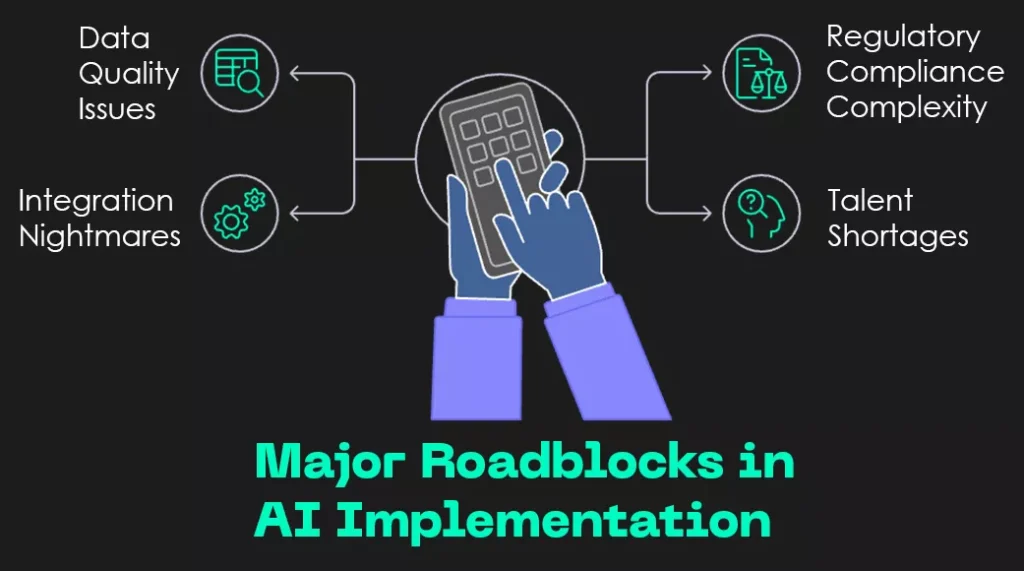
Fig: Major Roadblocks in AI Implementation
Here are the major roadblocks currently slowing AI implementation:
- Data Quality Issues: Medical records contain unstructured text, missing information, and inconsistent formatting that makes training reliable AI agents incredibly challenging.
- Regulatory Compliance Complexity: Healthcare regulations lag AI technology advancement, creating uncertainty around approval processes and liability frameworks.
- Integration Nightmares: Many healthcare institutions rely on legacy systems that weren’t designed to accommodate modern AI tools, requiring expensive infrastructure overhauls.
- Talent Shortages: The healthcare industry faces a critical shortage of professionals who understand both medical practice and AI technology implementation.
The AI bias problem in healthcare AI deserves special attention. AI systems can inherit and amplify biases from training data, potentially leading to discriminatory decisions that disproportionately affect underrepresented populations. Addressing this requires diverse dataset curation, bias-mitigation techniques, and ongoing fairness evaluations in real-world clinical deployments.
Adversarial attacks represent another serious concern. AI systems in healthcare are vulnerable to maliciously crafted inputs that can manipulate outputs, posing significant risks in high-stakes scenarios like diagnostics and surgical planning. Recent research shows that these vulnerabilities exist across all types of medical AI applications.
The good news is that these challenges aren’t insurmountable, and the solutions being developed today are paving the way for safer, more reliable AI implementation.
How Will Resource Optimization Transform Healthcare Economics?
Healthcare economics has always been a delicate balancing act between providing quality care and managing costs. However, agentic AI is about to tip the scales in favor of both efficiency and effectiveness. We’re talking about systems that can optimize resource allocation with the precision of a Swiss watch and the intelligence of a seasoned hospital administrator.
AI agents excel at resource optimization because they can process vast amounts of data simultaneously, identify patterns humans might miss, and make predictions about future resource needs based on historical trends and real-time conditions. This capability is particularly valuable in healthcare, where resource misallocation can literally be a matter of life and death.
The economic transformation in healthcare is happening across several key areas:
- Predictive Capacity Management: AI agents analyze patient flow patterns, seasonal variations, and community health trends to predict hospital capacity needs and optimize staffing levels.
- Equipment Utilization Optimization: These systems track medical equipment usage patterns and automatically schedule maintenance, upgrades, and replacements to minimize downtime and maximize return on investment.
- Supply Chain Cost Reduction: AI-powered supply chain management systems predict demand fluctuations, optimize inventory levels, and identify cost-saving opportunities across procurement processes.
- Energy and Facility Management: Smart building integration allows AI agents to optimize heating, cooling, and lighting systems based on occupancy patterns and operational requirements.
The financial impact of these optimizations can be substantial. Hospitals implementing comprehensive AI-driven resource optimization typically see 15-30% reductions in operational costs while maintaining or improving patient care quality.
One particularly interesting development is the use of AI agents for predictive maintenance in medical equipment. These systems can detect early signs of equipment failure, schedule maintenance during low-usage periods, and even predict when equipment upgrades will become necessary based on technological advancement cycles.
As healthcare organizations become more efficient through AI implementation, they’re discovering new opportunities to expand access and improve care delivery.
What Does the Future Hold for Agentic AI in MedTech?
The future of agentic AI in MedTech isn’t just about incremental improvements to existing systems – we’re looking at a complete reimagining of how healthcare operates at every level. The convergence of AI technology, medical expertise, and patient needs is creating possibilities that seemed like pure fantasy just a few years ago.
Looking ahead, several major trends are shaping the future of healthcare AI:
- Universal AI Healthcare Ecosystems: Integration of AI agents with electronic health records, imaging platforms, and robotic systems to enable truly proactive, personalized, and preventive medicine.
- Edge AI Medical Devices: Real-time AI inference capabilities built directly into medical equipment, reducing dependence on centralized cloud infrastructure and improving accessibility in resource-limited environments.
- Federated Learning Networks: Secure, decentralized medical data sharing that preserves patient privacy while enabling AI systems to learn from global healthcare experiences.
- Self-Evolving AI Architectures: AI agents that continuously improve their capabilities through interaction with patients, clinicians, and other AI systems.
Agentic AI in MedTech is accelerating beyond what most people realize. We’re moving toward Agentic AI systems that don’t just react to medical situations – they proactively identify potential health issues, suggest preventive interventions, and coordinate care across multiple providers and specialties.
The integration of blockchain technology with AI agents promises to revolutionize medical record management and patient data security. These systems will enable seamless information sharing while maintaining strict privacy controls and audit trails.
So, here’s the deal.
While everyone else is still debating whether AI in healthcare is ready for prime time, the smart money is already implementing agentic AI solutions that are transforming patient outcomes, operational efficiency, and bottom-line results. The question isn’t whether agentic AI will revolutionize MedTech – it’s whether you’ll be leading that transformation or playing catch-up?
We’ve built our reputation on delivering AI solutions that work in the real world. Don’t let your competitors gain the AI advantage while you’re still forming committees to discuss AI strategy. The healthcare landscape is changing rapidly, and organizations that embrace agentic AI now will define the industry for the next decade.
Ready to see what agentic AI can do for your organization? Contact us today and let’s start building the future of healthcare together.