

Highlights
Business process reengineering (BPR) is the radical redesign of core business processes to achieve dramatic gains in efficiency, quality, speed, and customer satisfaction. The blog explains that BPR goes beyond incremental improvement by reimagining how work is done, aligning people, technology, structure, and strategy to organizational goals. It highlights key benefits such as lower operational costs, faster cycle times, higher product and service quality, improved customer experience, and increased profitability and ROI. The blog also contains insights into how to ensure redesigned processes deliver sustainable business impact.
Ford, a renowned automobile manufacturer, underwent a remarkable business process reengineering initiative in the mid-2000s. The company wished to improve its production process by eliminating bottlenecks, reducing waste, and enhancing quality. Ford’s existing production system had numerous handoffs, excessive inventory, and long lead times.
To revamp its production process, Ford adopted the principles of lean manufacturing and implemented a system called the ‘Ford Production System’ (FPS). FPS emphasized waste reduction, continuous improvement, and employee empowerment.
Ford applied techniques such as just-in-time production, standardized work processes, and cross-functional teams. This way, it heightened its production efficiency, reduced costs, and accelerated time-to-market for new vehicle models.
The reengineered process allowed Ford to adapt instantly to changing customer demands and improve overall product quality!
This is Business Process Reengineering (BPR). It is a complete reimagining of business processes to attain spectacular improvements!
Michael Hammer, a former MIT professor, introduced BPR in the 1990s. He opined that a “radical redesign” of business processes was needed, to keep up with the swift changes in markets and technology taking place during that decade.
Hammer defined BPR as “the fundamental rethinking and radical redesign of business process … to achieve dramatic improvements in critical contemporary measures of performance … such as cost, quality, service, and speed.”
BPR focuses on how important business elements are connected to one another. It also highlights how they work with or against one another, based on the structure of relationships. Put simply, it is business process improvement. We can also view it as remarkable process management.
For superior results, there needs to be collaboration among the company’s structure, people, technology, strategy, and other resources. This will help them to meet organizational goals.
Now, what are the benefits of BPR? The following section answers this crucial question.
Benefits of Business Process Reengineering
Take a look at the following important benefits of Business Process Reengineering:
Illuminated purpose:
Business process reengineering helps you to get to know your employer’s mission all over again. This way, changes that occurred over time can be nicely evaluated.
Heightened quality of products or services:
Changing the company’s workflow allows employees to focus more energy on the output. This is seen to cause higher quality.
Lowered operational costs:
The company’s operational costs can be cut by removing unnecessary fees that could be part of outdated processes.
Better customer service:
Adding pace to the operations process can reduce customer wait time. Smiles on their faces automatically widen!
Lifted profits:
BPR is a style of reorganizing the company so that efficiency and output are at the center of the game. This can lead to higher profits.
Swifter business operations:
Through the thoughtful streamlining of operations, aspects that slow the process drop off.
Maximized ROI:
All these benefits join forces to maximize the ROI on your investment in process improvement!
Let’s now turn to the process of BPR.
How to successfully reengineer your business processes in 7 steps
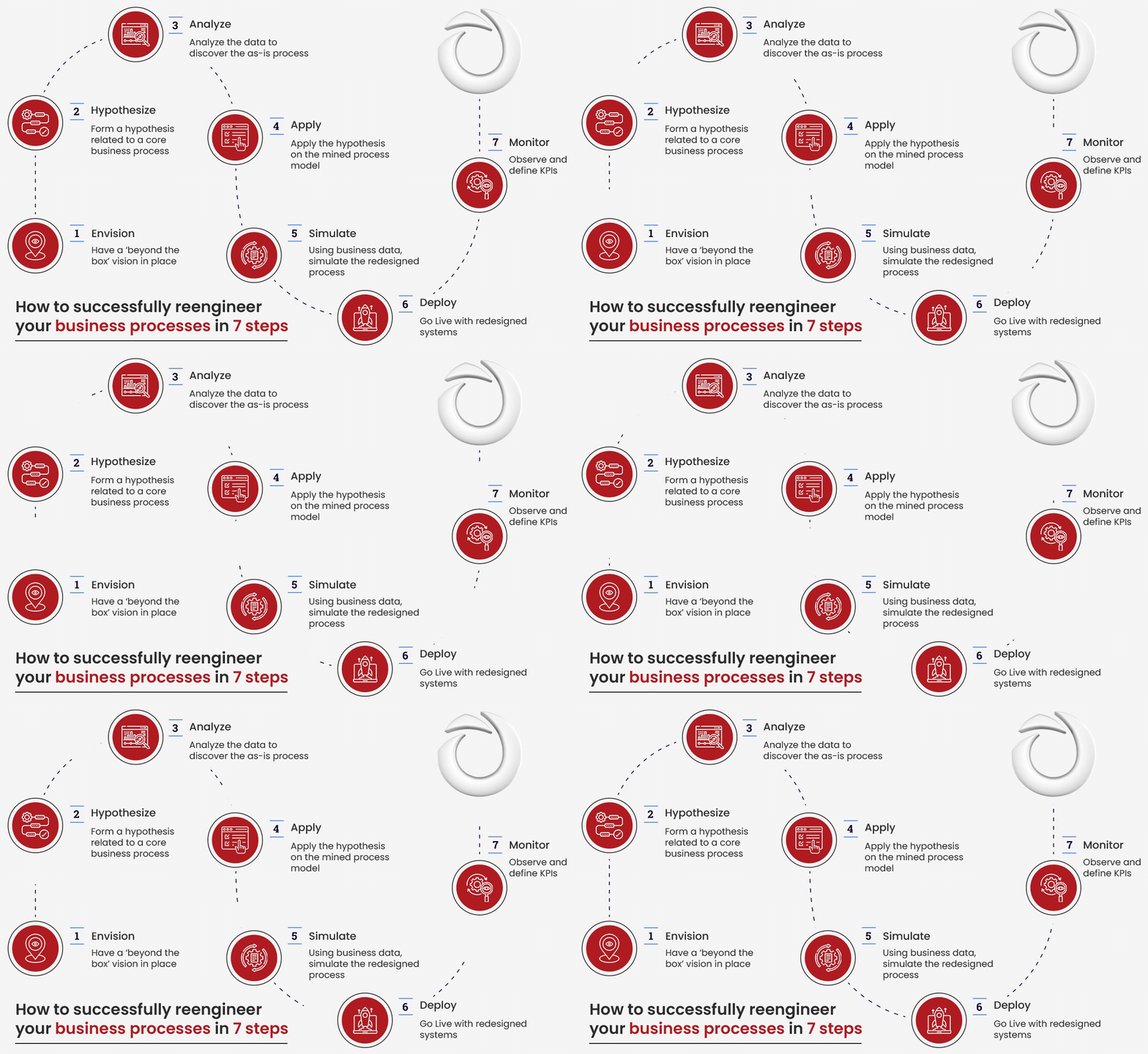
1. Have a ‘beyond the box’ vision in place
This should be one that challenges conventional wisdom.
Industry disruption tends to cause the creation of a vision and is frequently led by one visionary.
This visionary should be able to transmit the larger vision to the right people, and essentially, be able to convince them to step up in support of it.
Creating a vision is the first step of BPR implementation since it sets the tone for the whole project. It inspires people to think radically and hands out generous helpings of courage to transform the existing situation.
2. Form a hypothesis related to a core business process
A hypothesis based on excellent reasoning will fulfil two purposes:
- Put forth adequately drastic change
- Be realistic enough to garner people’s support
The hypothesis could be in the format of a statement or a question.
3. Mining: Analyze the data to discover the as-is process
The as-is process works as a solid foundation for process architects to rest their work on.
Mining process data helps to make a distinction between fundamental process events and superficial process events. The questions generally addressed are:
- Which process stages are carried out because they are required, and generate true value?
- Which process stages are carried out habitually, or because “a certain person said so”?
The as-is process data tends to explain all the ways wherein superficial process steps congest the pipeline.
4. Apply the hypothesis on the mined process model and design a new business process
It is time to put in place a fresh process that’s cross-functional in scope and arranged around outcomes.
The reengineered process ought to integrate elements of the vision, hypothesis, as well as findings from process mining. The fresh design should portray the principles of BPR as outlined in the Harvard Business Review by Michael Hammer.
5. Using business data, simulate the redesigned process
How is this essentially done? With process mining software.
The main purpose of process simulation is to preview suggested changes or ideas for refining the original (as-is) process.
This helps you to validate “what-if scenarios” in a simulated setting with actual data. It also lets you explore the viability of the suggested changes.
As it is a part of the BPR project, process simulation can measure and ratify the probable benefits (cost, time perspective, and decreased variations). What’s more, it can show unplanned outcomes of the anticipated changes.
6. Deploy: Go Live with redesigned systems
The “Go Live” step in business process reengineering (BPR) marks the change from the redesigned processes to their actual execution in the organization. It is a vital phase where the reengineered processes are put into action. The organization starts work afresh, based on the new workflows and systems.
During this phase, the reengineered processes are launched across the organization. The employees find their ways through the redesigned systems and follow the new procedures.
This step involves thorough planning and coordination to ensure a smooth transition. This is also to curtail disruptions to daily operations.
To execute the Go Live phase, organizations conduct thorough testing and simulations. This allows them to identify and resolve any potential glitches in the reengineered processes before they are fully implemented.
It is essential to involve employees who will be directly affected by the changes. This is by offering them good training and support to get used to the new ways of working.
The Go Live phase also involves helpful change management practices. Communication plays a vital role in ensuring that employees understand the reasons behind the process changes. They must also know the benefits they will bring, and adjustments to their roles and responsibilities.
By actively engaging employees and concentrating on their concerns, organizations can create a sense of ownership and commitment to the reengineered processes. This boosts the chances of successful implementation.
7. Monitor, Observe and Define KPIs
Monitoring is the next vital step in the BPR journey. It involves tracking and evaluating the performance of the reengineered processes post implementation.
It allows organizations to see whether intended improvements are being realized. It also provides beneficial insights for additional refinement and optimization.
During the monitoring phase, organizations establish key performance indicators (KPIs). These measure the effectiveness and efficiency of the reengineered processes. These KPIs could include metrics such as:
- Cycle time
- Cost savings
- Customer satisfaction
- Error rates
- Productivity levels
By steadily monitoring these metrics, organizations can trace the progress. They can recognize areas that call for attention or supplementary improvements.
Monitoring also involves collecting feedback from employees, customers, and other stakeholders. These are directly or indirectly impacted by the reengineered processes. Their input provides valuable insights into the practicality and effectiveness of the implemented changes.
Organizations can conduct surveys, interviews, or focus groups to gather this feedback. They can use it to refine and optimize the processes.
The data accumulated during the monitoring phase serves for continuous improvement. Organizations can analyze the results and identify bottlenecks or areas of underperformance. They can then initiate corrective actions or further process enhancements.
This iterative approach helps organizations to fine-tune the reengineered processes over time.
Additionally, monitoring helps organizations to identify any unforeseen consequences. It also helps them to recognize unplanned outcomes of the reengineering efforts. It allows them to address these issues speedily. This is to ensure that the desired improvements are realized sans creating more problems or disruptions.
Through these steps, organizations can achieve viable improvements in their operations. They can maintain a proactive approach to process enhancement!
Now, let’s walk through some well-known examples of BPR.
Business Process Reengineering: Examples
In this section, we will explore real-life examples of productive BPR initiatives. You will also see the positive outcomes they have generated.
IBM’s Supply Chain Transformation
IBM, a global technology company, embarked on a major supply chain transformation in the early 2000s. The company recognized the need to streamline its complex and fragmented supply chain to improve responsiveness and reduce costs. IBM’s supply chain consisted of multiple systems, processes, and teams operating independently. This was leading to inefficiencies and delays.
To address these challenges, IBM reengineered its supply chain by implementing a single, integrated system that provided real-time visibility into inventory, orders, and logistics. IBM consolidated its various supply chain processes and used advanced analytics. Thus, it gained better control over its inventory management. It also saw reduced order cycle times, and enhanced demand forecasting accuracy.
As a result, the company achieved substantial cost savings, enhanced customer satisfaction, and increased operational agility.
Amazon’s Fulfillment Center Optimization
Amazon, the e-commerce giant, has been at the forefront of business process reengineering to enhance its fulfilment operations. It had millions of products and an extensive network of fulfillment centers worldwide. Optimizing order processing, inventory management, and delivery logistics is crucial for Amazon’s success.
Amazon revolutionized its fulfillment process by leveraging advanced sophisticated technologies such as robotics, automation, and data analytics. The company implemented robotic systems for efficient product picking and packing. This lessened human error and increasing speed. By using sophisticated algorithms and predictive analytics, Amazon optimized its inventory management. This helped them to ensure the availability of popular items while minimizing excess stock.
The implementation of wonderful innovations and process redesigns allowed Amazon to improve its order accuracy and lower delivery times. This enhanced the overall customer experience.
American Express’ Credit Card Approval Process
American Express, a global financial services company, needed to streamline its credit card approval process. This was to deliver faster decisions to customers. The company’s existing process involved multiple manual steps. This was resulting in lengthy approval cycles and customer dissatisfaction.
To address these challenges, American Express reengineered its credit card approval process by implementing an automated system. The new system integrated various data sources, credit risk models, and decision-making algorithms. This enabled real-time evaluation and approval of credit card applications.
So, American Express cut the approval cycle time from weeks to minutes. This helped customers to receive rapid decisions. The reengineered process augmented customer satisfaction and escalated operational efficiency. It also cut costs for the company.
These examples of successful BPR initiatives show the impact it can have on organizations.
The next section sheds some light on the role of AI in BPR, so read on!
Business Process Reengineering and AI
Process Mining with GenAI
When organizations talk about fixing or redesigning their processes, the biggest challenge is usually this: we might not always know how work truly happens on the ground.
This is where AI – especially Generative AI – can change the game.
Today, GenAI doesn’t just analyze event logs or dashboards. It can pull insights from everyday interactions across the business – emails, documents, workflows, systems – and piece together a realistic picture of how processes flow. Think of it as getting a “behind-the-scenes” view of your operations, not just what’s documented.
Imagine:
- It can simulate “what if” scenarios so leaders can predict outcomes before making any changes.
- It can spot anomalies in real time, whether it’s a compliance risk, an inefficiency, or a sudden bottleneck.
- It can provide clear, dynamic dashboards that explain not just what is going wrong, but why – and what you can do about it.
The result? BPR no longer feels like a one-time cleanup project. With GenAI-driven process mining, it becomes a continuous, intelligent improvement cycle. It is one that stays aligned with evolving business goals and customer expectations.
Agentic AI in BPR
Unlike traditional AI, which waits for instructions, agentic AI can take initiative, explore strategies, and recommend improvements on its own – within safe, human‑approved boundaries.
Here’s what that can mean for BPR:
- Strategy doesn’t have to start from scratch.
AI agents can scan market trends, customer signals, competitor activity, and internal data to suggest new process opportunities you may not have noticed. - Cross-functional alignment can become easier.
Different AI agents can collaborate. This way, they can ensure that any proposed process change makes sense across the entire organization, not just in one department. - Leaders could get more time for big-picture decisions.
Leaders could get distilled insights, scenario recommendations, and clear next steps.
Most importantly, agentic AI has great potential to amplify human judgment. Humans bring context and creativity; AI brings speed. Together, they help organizations evolve faster, smarter, and with more confidence.

Dive into the benefits and use cases of 15 key Agentic AI frameworks.

Embracing BPR isn’t just about improving processes. It’s about building the resilience and agility required to thrive in a constantly shifting landscape. With the right approach, organizations can stay aligned with customer expectations, adopt new technologies with confidence, and stay ahead of market change. Ultimately, this sets the foundation for sustained, long-term success.
Send us an email with your thoughts about BPR. Contact us at Nitor Infotech to see how the technology we craft can heighten your business processes.