

LLMOps (Large Language Model Operations) is the strategic framework for managing AI models across their entire lifecycle. Unlike traditional methods, it ensures your AI systems stay reliable, secure, and cost-efficient.
Key Benefits at a Glance:
- 40–60% faster AI model deployment
- 25–35% improvement in reliability
- 20–30% cost savings on operations
- Enhanced security & compliance
- Rapid scaling across teams & models
Don’t just build AI—manage it strategically with LLMOps.
Artificial intelligence is advancing at a rapid pace, driving widespread adoption across various industries. From startups to Fortune 500 companies, organizations are racing to integrate AI technology into their core business processes. But here’s the thing – deploying a large language model or any AI model isn’t just about getting it up and running. It’s about managing its entire lifecycle effectively, and that’s where LLMOps comes into play.
Suppose you’ve been wondering how successful AI companies maintain their competitive edge while ensuring their AI models perform consistently. In that case, you’re about to discover the strategic framework that makes it all possible. Let’s dive into the world of LLMOps and explore how it’s revolutionizing AI lifecycle management.
Understanding LLMOps: The Foundation of Modern AI Operations
LLMOps, or Large Language Model Operations, represents a specialized approach to managing artificial intelligence systems throughout their entire lifecycle. Think of it as the evolved cousin of MLOps. It is specifically designed to handle the unique challenges that come with large language models and other sophisticated AI technologies.
Unlike traditional software deployment, AI for business requires continuous monitoring, frequent updates, and constant performance optimization. This is where LLMOps shines – it provides a comprehensive framework that addresses everything from initial model deployment to ongoing maintenance and improvement.
The beauty of LLMOps lies in its holistic approach. It doesn’t just focus on getting your AI language model into production. It ensures that your artificial intelligence answer remains accurate, relevant, and aligned with your business objectives over time. For organizations investing heavily in AI automation, this operational framework becomes critical.
Key components of LLMOps include:
- Automated model deployment pipelines
- Continuous performance monitoring
- Data quality management
- Security and compliance protocols
- Version control and rollback mechanisms
- Cost optimization strategies
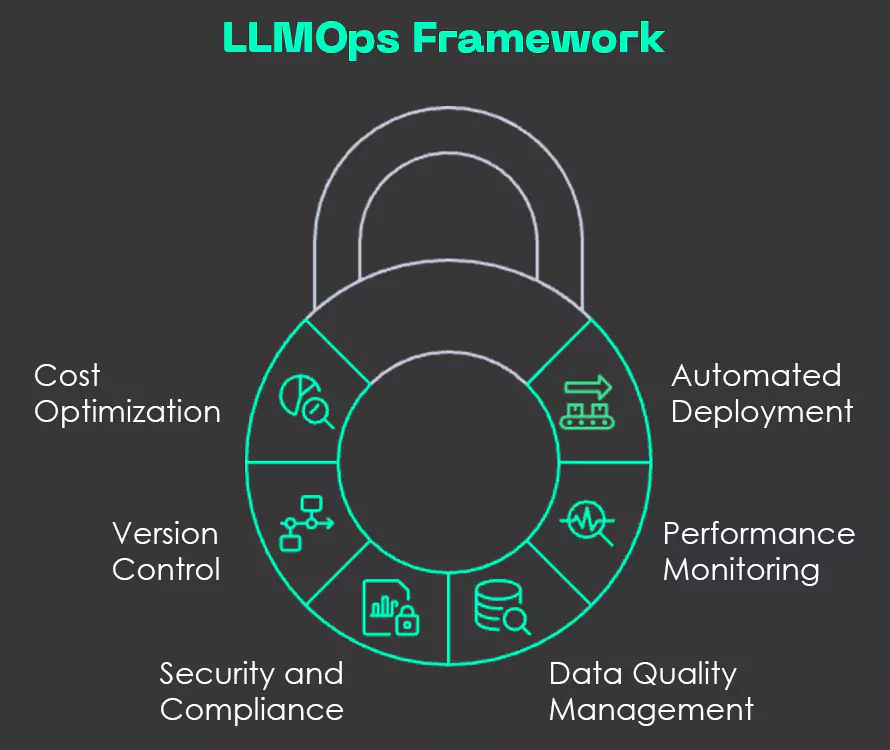
Fig: LLMOps Framework
Now that we understand what LLMOps is, let’s explore why traditional approaches to AI management fall short in today’s dynamic business environment.
Why Traditional AI Management Approaches Fall Short
Many organizations still approach AI model lifecycle management with outdated methodologies borrowed from traditional software development. However, artificial intelligence technologies present unique challenges that require specialized solutions.
Consider this scenario: you’ve deployed an AI app for customer service automation. Initially, it performs exceptionally well. It provides accurate responses and improves customer satisfaction. But over time, you notice the AI model’s performance starting to decline. Customer queries are evolving, new products are being launched, and the language patterns in your industry are shifting. This is where model drift becomes a serious concern.
Traditional software rarely faces such dynamic challenges. Once deployed, a conventional application typically maintains consistent behavior unless explicitly updated. AI models, particularly large language models, are different. They’re sensitive to changes in input patterns, data distributions, and even subtle shifts in user behavior.
Common pitfalls of traditional AI management:
- Reactive rather than proactive monitoring
- Limited visibility into model performance degradation
- Inadequate security measures for AI-specific threats
- Lack of automated rollback mechanisms
- Insufficient data lineage tracking
- Poor integration between development and operations teams

Fig: AI Management Challenges
The financial implications of these shortcomings can be substantial. When AI model performance degrades without proper monitoring, businesses may experience decreased customer satisfaction, increased operational costs, and missed revenue opportunities.
Understanding these limitations brings us to the strategic advantages that LLMOps offers for modern AI lifecycle management.
The Strategic Advantages of LLMOps
Implementing LLMOps isn’t just about following best practices. It’s about gaining strategic advantages that can transform how your organization leverages artificial intelligence. Let’s explore the key benefits that make LLMOps essential for AI-driven businesses.
Enhanced Model Performance and Reliability
One of the most significant advantages of LLMOps is its ability to maintain consistent AI model performance over time. Through continuous monitoring and automated model drift mitigation strategies, organizations can ensure their AI systems deliver reliable results even as conditions change.
This reliability becomes particularly crucial for agentic AI systems that operate autonomously. When your AI agents are making decisions without human intervention, you need robust systems that can detect and correct performance issues before they impact business operations.
Accelerated Time-to-Market
LLMOps streamlines the AI model deployment pipeline, enabling organizations to move from development to production faster than ever before. Automated testing, validation, and deployment processes reduce the time required to launch new AI capabilities.
For AI companies competing in fast-moving markets, this acceleration can mean the difference between leading innovation and playing catch-up. The framework enables rapid experimentation while maintaining production stability.
Cost Optimization and Resource Efficiency
Managing large language models can be expensive, particularly when dealing with cloud-based AI services. LLMOps provides visibility into resource utilization and enables automated scaling based on demand. This optimization ensures you’re not overpaying for unused capacity while maintaining performance during peak usage periods.
Improved Security and Compliance
AI for automation introduces unique security challenges, from data privacy concerns to potential adversarial attacks. LLMOps incorporates security measures specifically designed for AI systems, including secure model deployment, encrypted data handling, and comprehensive audit trails.
Strategic benefits summary:
- 40-60% reduction in model deployment time
- 25-35% improvement in model reliability
- 20-30% decrease in operational costs
- Enhanced regulatory compliance
- Better risk management
With these strategic advantages in mind, let’s examine the core components that make LLMOps effective.

Want to see how leading frameworks stack up?Explore the infographic and discover the tools shaping the future of Agentic AI.

Core Components of Effective LLMOps
Building a successful LLMOps framework requires careful attention to several interconnected components. Each element plays a crucial role in ensuring your AI lifecycle management strategy delivers maximum value.
Model Deployment and Pipeline Management
The foundation of any LLMOps strategy is a robust AI model deployment pipeline. This isn’t just about moving code from development to production – it’s about creating automated workflows that handle the complexities of AI model deployment.
Modern deployment pipelines include automated testing phases that validate model accuracy, performance benchmarks, and integration compatibility. They also incorporate blue-green deployment strategies that allow for zero-downtime updates and quick rollbacks if issues arise.
Continuous Monitoring and Observability
AI model monitoring goes far beyond traditional application monitoring. You need visibility into model accuracy, prediction confidence, input data quality, and performance metrics. This comprehensive monitoring enables early detection of model drift and performance degradation.
Advanced AI model monitoring tools provide real-time dashboards that track key performance indicators, alert teams to anomalies, and provide detailed analytics for troubleshooting. These tools become especially important when managing multiple models across different business functions.
Data Management and Quality Assurance
The quality of your AI model performance is directly tied to the quality of your data. LLMOps includes robust data management practices that ensure consistent, high-quality inputs for your AI systems.
This involves implementing data validation pipelines, monitoring data drift, and maintaining data lineage tracking. When your large language model starts producing unexpected results, you need to quickly trace the issue back to its source – whether it’s a data quality problem, model drift, or infrastructure issue.
Version Control and Model Registry
Managing different versions of AI models requires specialized tools that go beyond traditional version control systems. A comprehensive model registry tracks model versions, their performance metrics, deployment history, and associated metadata.
This version control system enables teams to compare model performance across different versions, roll back to previous versions when necessary, and maintain clear documentation of model evolution.
Now that we understand the components, let’s explore the practical implementation strategies that organizations can use.
Implementing LLMOps: A Step-by-Step Approach
Successfully implementing LLMOps requires a structured approach that considers your organization’s current AI maturity, technical capabilities, and business objectives. Here’s a practical roadmap for getting started.

Fig: Implementing LLMOps: A Step-by-Step Approach
Phase 1: Assessment and Planning
Begin by evaluating your current AI infrastructure and identifying gaps in your AI lifecycle management. This assessment should cover your existing AI models, deployment processes, monitoring capabilities, and team skills.
Here are some key questions to consider during this phase:
- What AI models are currently in production?
- How do you currently monitor AI model performance?
- What are your biggest challenges with model deployment?
- Do you have adequate security measures for AI systems?
- What tools and platforms are you currently using?
Phase 2: Tool Selection and Infrastructure Setup
Choose AI model monitoring tools and platforms that align with your technical requirements and budget constraints. Consider factors like integration capabilities, scalability, and ease of use when making these decisions.
Popular LLMOps platforms include cloud-based solutions that offer comprehensive model management capabilities, as well as open-source tools that provide flexibility for customization. The key is selecting tools that can grow with your organization’s AI ambitions.
Phase 3: Process Development and Team Training
Develop standardized processes for model deployment, monitoring, and incident response. These processes should be well-documented and include clear responsibilities for different team members.
Training is crucial for successful implementation. Your teams need to understand not just how to use the new tools, but also the principles behind effective AI lifecycle management. This includes understanding model drift, prompt engineering best practices, and AI-specific security considerations.
Phase 4: Gradual Rollout and Optimization
Start with a pilot project that allows you to test your LLMOps implementation in a controlled environment. This approach enables you to identify and address issues before rolling out the framework across your entire AI portfolio.
Monitor the pilot closely, gathering feedback from users and measuring key performance indicators. Use these insights to refine your processes and make necessary adjustments before expanding the implementation.
Here is an implementation checklist you might like to refer to:
- Current state assessment completed
- LLMOps tools selected and configured
- Team training programs delivered
- Standard operating procedures documented
- Pilot project successfully completed
- Performance metrics baseline established
With implementation strategies covered, let’s examine the specific challenges organizations face and how to overcome them.
Overcoming Common LLMOps Challenges
Even with the best planning, organizations often encounter obstacles when implementing LLMOps. Understanding these challenges and their solutions can help you navigate potential pitfalls more effectively.
Model Drift Detection and Mitigation
Model drift represents one of the most significant challenges in AI lifecycle management. As real-world conditions change, your AI models may gradually lose accuracy. This could lead to degraded business outcomes.
Effective model drift mitigation requires establishing clear baselines for model performance and implementing automated systems that can detect deviations. When drift is detected, you need processes for investigating the root cause and implementing corrective actions.
Advanced AI model drift mitigation strategies include:
- Continuous retraining pipelines
- Ensemble modeling approaches
- Dynamic threshold adjustment
- Automated model replacement protocols
Security and Compliance Considerations
AI systems introduce unique security vulnerabilities that traditional cybersecurity measures may not address. From adversarial attacks that attempt to manipulate model outputs to data poisoning attacks that corrupt training data, the threat landscape for AI is constantly evolving.
LLMOps must incorporate security measures at every stage of the AI lifecycle. This includes secure model development environments, encrypted data transmission, access controls for model deployment, and comprehensive audit logging.
Scaling Across Multiple Models and Teams
As organizations expand their AI initiatives, managing multiple models across different teams becomes increasingly complex. Each team may have different requirements, skill levels, and business objectives.
Successful scaling requires standardized processes that provide consistency while allowing for team-specific customization. This balance ensures that best practices are maintained across the organization while enabling teams to adapt the framework to their unique needs.
Resource Management and Cost Control
Large language models can consume significant computational resources, leading to unexpected costs if not managed properly. LLMOps should include cost monitoring and optimization features that help organizations maintain control over their AI spending.
This involves implementing automated scaling policies, optimizing model inference processes, and providing visibility into resource utilization patterns. Regular cost reviews and optimization initiatives should be built into your LLMOps processes.
As we look toward the future, several emerging trends are shaping the evolution of LLMOps and AI lifecycle management.
Future Trends in LLMOps and AI Lifecycle Management
The field of LLMOps is rapidly evolving, driven by advances in AI technologies and changing business requirements. Understanding these trends can help organizations prepare for the future of AI operations.
Automated AI Lifecycle Management
We’re moving toward increasingly automated AI lifecycle management systems that can handle routine tasks with minimal human intervention. These systems will automatically detect model drift, trigger retraining processes, and deploy updated models based on predefined criteria.
This automation extends to prompt engineering. This is where AI tools are beginning to optimize prompts automatically based on performance data. This capability reduces the manual effort required to maintain optimal model performance.
Enhanced AI Model Monitoring and Explainability
Future AI model monitoring tools will provide deeper insights into model behavior and decision-making processes. This enhanced explainability becomes crucial as organizations deploy AI systems in high-stakes applications where understanding model reasoning is essential.
Advanced monitoring capabilities will include real-time visualization of model attention patterns, confidence scoring for individual predictions, and automated identification of potential bias issues.
Integration with Business Intelligence Systems
LLMOps platforms are increasingly integrating with business intelligence and analytics systems. They are providing executives with clear visibility into AI performance metrics and business impact. This integration enables data-driven decisions about AI investments and strategy.
Edge AI and Distributed Model Management
As edge computing becomes more prevalent, LLMOps must evolve to handle distributed AI deployments. This includes managing models deployed across multiple edge locations, handling intermittent connectivity, and coordinating updates across distributed systems.
Emerging trends to keep an eye on:
- Federated learning integration
- AutoML for continuous optimization
- Quantum-resistant AI security
- Sustainability-focused AI operations
- Cross-cloud model portability
Looking ahead, let’s explore what organizations can expect from the future of AI operations.
Building a Sustainable AI Future with LLMOps
The journey toward effective AI lifecycle management isn’t just about implementing tools and processes – it’s about building a foundation for sustainable AI innovation. LLMOps provides the framework that enables organizations to harness the full potential of AI while managing risks and maintaining operational excellence.
As AI technologies continue to advance at breakneck speed, organizations that invest in robust LLMOps practices will find themselves better positioned to capitalize on new opportunities. Whether you’re developing customer-facing AI applications, implementing internal AI automation, or exploring agentic AI systems, the principles of effective lifecycle management remain constant.
The key to success lies in viewing LLMOps not as a one-time implementation project, but as an ongoing capability that evolves with your organization’s AI maturity. Start with the fundamentals:
- Establish clear processes for model deployment,
- Implement comprehensive monitoring, and
- Build security into every aspect of your AI operations.
Remember that LLMOps is ultimately about enabling innovation while maintaining control. It’s the difference between AI initiatives that deliver lasting business value and those that create more problems than they solve. By implementing a strategic approach to AI lifecycle management, you’re not just optimizing your current AI systems. You’re building the foundation for future AI innovations that can transform your business.
The organizations that master LLMOps today will be the ones leading the AI-powered economy of tomorrow. The question isn’t whether you need LLMOps – it’s how quickly you can implement it to gain a competitive advantage in an increasingly AI-driven world.
Don’t just deploy AI—manage it strategically. Contact us Nitor Infotech to explore how LLMOps can transform your business operations.