

Our latest blog explores how Generative AI is revolutionizing Mobile Device Management, transforming organizations from reactive problem-solvers to proactive orchestrators. Traditional Mobile Device Management acted like security guards, while AI-powered systems function as digital fortune tellers, predicting device failures and threats weeks in advance. Key capabilities include predictive analytics, behavioral analysis, automated threat response, and intelligent policy creation.
The technology provides measurable benefits like reduced response times, preventive maintenance, and cost optimization. Industries from healthcare to manufacturing benefit from specialized applications. Successful implementation requires strategic planning, proper partner selection, and phased deployment. Organizations must choose between leading this transformation or being transformed by it.
The Dawn of Intelligent Device Management
Picture this: Your company’s devices are having a secret conversation behind your back. Traditional Mobile Device Management (MDM) solutions play security guard at the front door. In the meantime, your smartphones, tablets, and IoT sensors are already three steps ahead. They are predicting threats, optimizing performance, and making decisions with superhuman precision.
Advanced MDM solutions powered by Generative AI are revolutionizing how organizations approach device management tools.
High-tech organizations are transforming from digital chaos coordinators into AI-powered orchestrators. Here, Generative AI and machine learning capabilities don’t just manage devices. They create seamless productivity experiences through intelligent MDM fusion. It’s like upgrading from a manual typewriter to a telepathic assistant who knows what you need before you do.
Today’s device management tools aren’t just software anymore. They’re digital fortune tellers, behavioral psychologists, and security ninjas rolled into one intelligent data management system. Organizations still debating whether to embrace this transformation are like people wondering if the internet will catch on. Meanwhile, their competitors are already living in the future.
To truly understand the magnitude of this transformation, we need to examine how device management has evolved from its humble beginnings to today’s sophisticated AI-powered systems.
From Digital Babysitting to AI Wizardry
Remember when mobile device management meant manually installing software on each device and hoping employees wouldn’t break anything? Those days feel as ancient as using paper maps for navigation. Today’s mobile management tools have evolved from simple babysitters into sophisticated AI applications that can predict device failure three weeks before it happens.
Traditional Mobile Device Management device management worked like a reactive emergency room. It would deal with problems after they exploded into full-blown crises. IT teams were digital firefighters, constantly running from one burning device to another with only basic troubleshooting scripts and endless coffee.
The transformation to AI-powered data management systems represents a shift from reactive firefighting to proactive fortune-telling. Imagine having a crystal ball that shows you exactly which devices will fail, which users will click phishing links, and which applications will consume excessive bandwidth. This is all before these events occur.
GenAI applications in device management now function like digital detectives with the following capabilities:

Fig: Capabilities of GenAI applications in device management
- Predictive analytics powered by deep learning that anticipates problems weeks in advance.
- Behavioral analysis through machine learning that understands user patterns and irregularities
- Automated threat response that can detect AI-powered attacks and neutralize them in milliseconds.
- Intelligent policy creation that adapts to changing requirements through continuous learning
This isn’t just evolution. It’s a complete metamorphosis. It’s where every management device mobile gains superpowers simultaneously.
But understanding this technological evolution is only part of the picture. The real question organizations face today is why AI-powered defense has become critical for survival in the Cutting-edge digital landscape.

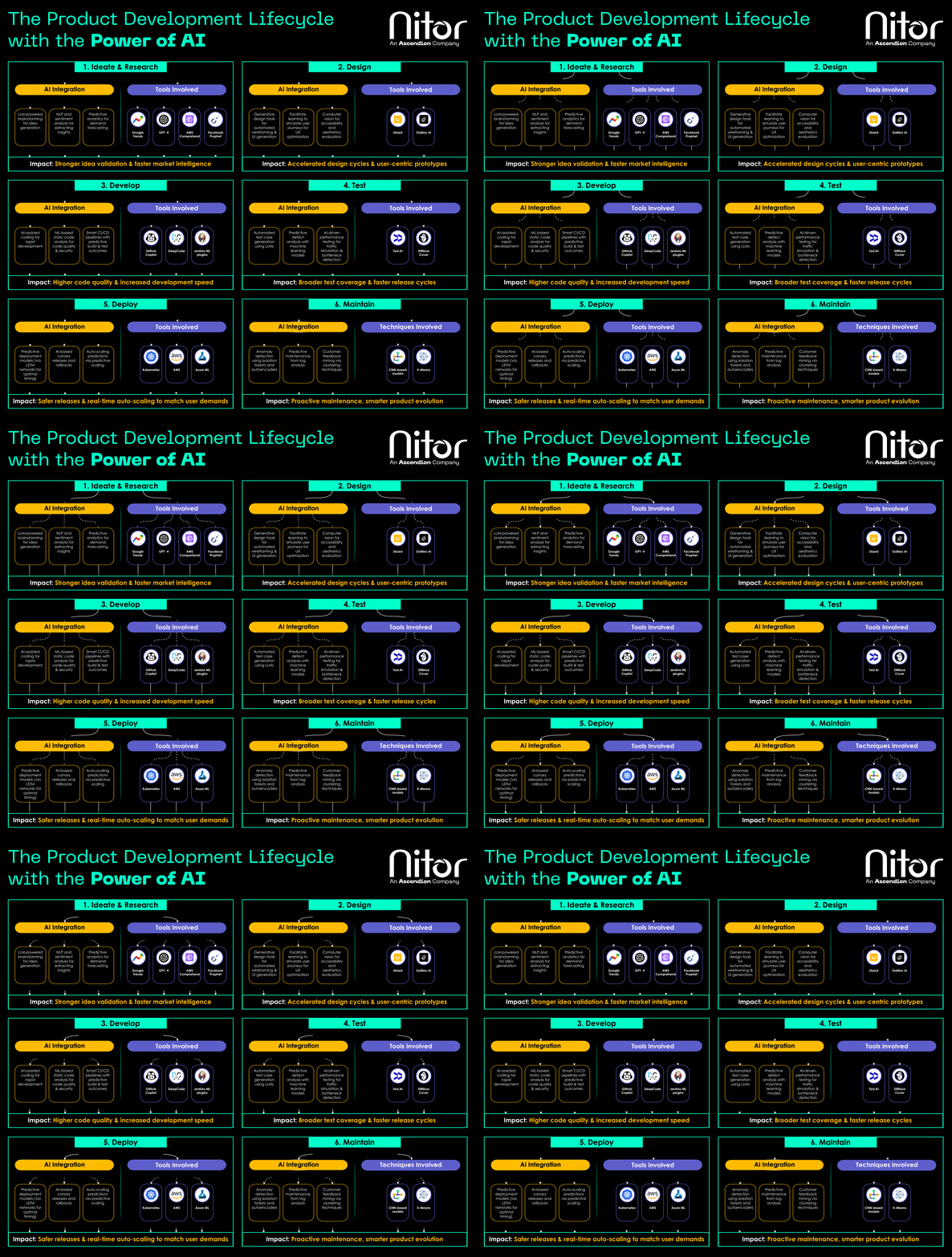
Speaking of the strengths of AI, experience the compelling impact of AI on the product development lifecycle, visualized in our GIF-ographic.
Why Your Organization Needs AI-Powered Defense
The Futuristic enterprise resembles a medieval kingdom under siege, except the attackers are invisible, the walls are made of code, and the defending knights are algorithms. Without AI-powered MDM solutions, organizations are essentially sending foot soldiers with wooden swords to fight laser-wielding aliens.
Consider this shocking reality: Every 39 seconds, a cyber-attack occurs somewhere in the world. Traditional security measures are like trying to stop a tsunami with an umbrella. It’s brave but ultimately futile. Cybercriminals have weaponized AI to create attacks that morph faster than shapeshifters. They are making static security policies as effective as chocolate teapots.
Systems management software powered by artificial intelligence completely changes this battlefield dynamic. Instead of waiting for attacks to breach defenses, AI-driven systems actively hunt threats like digital bloodhounds with supernatural senses. They detect AI anomalies that slip past human observation like master thieves in crowded marketplaces.
Machine learning algorithms within these data management software solutions analyze patterns with Swiss watchmaker precision and Formula One speed. They identify sophisticated threats that traditional signature-based systems miss entirely. When an employee suddenly accesses sensitive files at 3 AM from a coffee shop in another country, AI systems don’t just flag the anomaly. They instantly assess threat levels, implement protective measures, and notify security teams faster than you can say “cybersecurity breach.”
Understanding these security benefits is crucial. But the real power of AI-powered MDM becomes clear when we examine its measurable impact on business operations and competitive positioning.
Read on to learn exactly what that is!
The Business Impact: From Cost Center to Competitive Advantage
The implementation of AI-powered mobile management tools transforms IT departments from necessary expenses into strategic weapons of competitive advantage. Organizations experience a transformation comparable to a caterpillar becoming a butterfly. The exception is this butterfly can predict market trends and defend against cyber-attacks.
You might ask, “What are the measurable financial benefits?” Well, continue reading for the answer.
Measurable Financial Benefits: Mobile Device Mangement
Consider the quantifiable impact:
- Response time reduction: From hours to milliseconds
- Preventive maintenance: Stops 80% of potential failures before they occur
- Automated compliance: Eliminates manual audit preparations
- Resource optimization: Maximizes ROI on device investments

Fig: Financial Benefits of AI-powered MDM
Cost optimization through AI automation works like having efficiency experts operating 24/7 without breaks.
These systems eliminate waste with surgical precision. They do this while optimizing resource allocation like master strategists managing complex campaigns.
Enhanced Security and Productivity
Security enhancement through AI-driven capabilities provides protection equivalent to having a personal bodyguard for every device. The exception is that these bodyguards have superpowers and predict attacks before they happen. The system creates a security posture that evolves like a living organism. It adapts to new threats with martial arts master agility.
Productivity improvements result from seamless device management that feels like magic to end users. Employees experience technology that:
- anticipates their needs,
- solves problems before they notice them, and
- provides exactly the right level of security without creating friction.
These broad benefits apply across all organizations, but different industries face unique challenges that require specialized approaches.
Next up, let’s explore how AI-powered MDM adapts to meet specific industry requirements.
Industry-Specific Applications of MDM
The versatility of AI-powered data management systems enables customized solutions that address unique industry challenges like a Swiss Army knife designed by specialists.
1. Healthcare organizations operate like digital emergency rooms where patient data flows through AI-protected channels. Machine learning algorithms ensure HIPAA compliance while enabling healthcare professionals to access critical information at ambulance-like speed. The system predicts potential compliance violations, like medical scanners detecting problems before symptoms appear.
2. Financial services institutions function as digital Fort Knox, where AI-powered systems guard assets with elite security force vigilance. Deep learning algorithms analyze transaction patterns with jeweler-like precision, identifying fraudulent activities that would slip past human detection.
3. Manufacturing environments transform into intelligent factories where AI systems monitor both traditional devices and industrial IoT sensors. Predictive maintenance capabilities prevent equipment failures that could shut down production lines. Meanwhile, security monitoring protects against cyber-attacks that could compromise manufacturing processes.
4. Educational institutions become digital learning sanctuaries where AI systems manage thousands of devices. They do this while ensuring appropriate content access and protecting student privacy with wise librarian-like precision.
Understanding these industry-specific benefits is valuable. But knowing how to implement AI-powered MDM in your organization is where theory meets practice.
Let’s examine a proven roadmap for successful transformation.
Assessment: Preparing for AI-Driven Mobile Device Management
Before launching AI into your mobile device management (MDM) ecosystem, a detailed assessment is key to ensure compatibility, performance, and alignment with business goals. Here are the essential checkpoints:
1. Device Compatibility
- Platform Support: Confirm whether the solution supports both iOS and Android platforms.
- Version Requirements: Identify if all OS versions are supported or if there’s a minimum OS requirement (e.g., Android 10+, iOS 13+).
2.Offline Functionality
- AI Offline Support: Does the AI component provide offline capabilities, such as basic threat detection or usage pattern monitoring, when the device is not connected to the internet?
3.Integration & Deployment Readiness
- AI Chatbot Integration: Evaluate whether an AI chatbot is available for end-user support and troubleshooting.
- Policy Automation: Can the AI trigger critical actions like policy updates, real-time user alerts, or data wipe in case of security threats?
4.Feedback & Optimization
- User Feedback Collection: Is there a mechanism to collect real-time user feedback on AI-driven experiences for continuous improvement?
Implementation Strategy: Your Roadmap to Success
Successfully integrating AI-powered mobile device management is not a one-click affair. It demands strategic planning, phased execution, and adaptive learning-much like launching a mission into space.
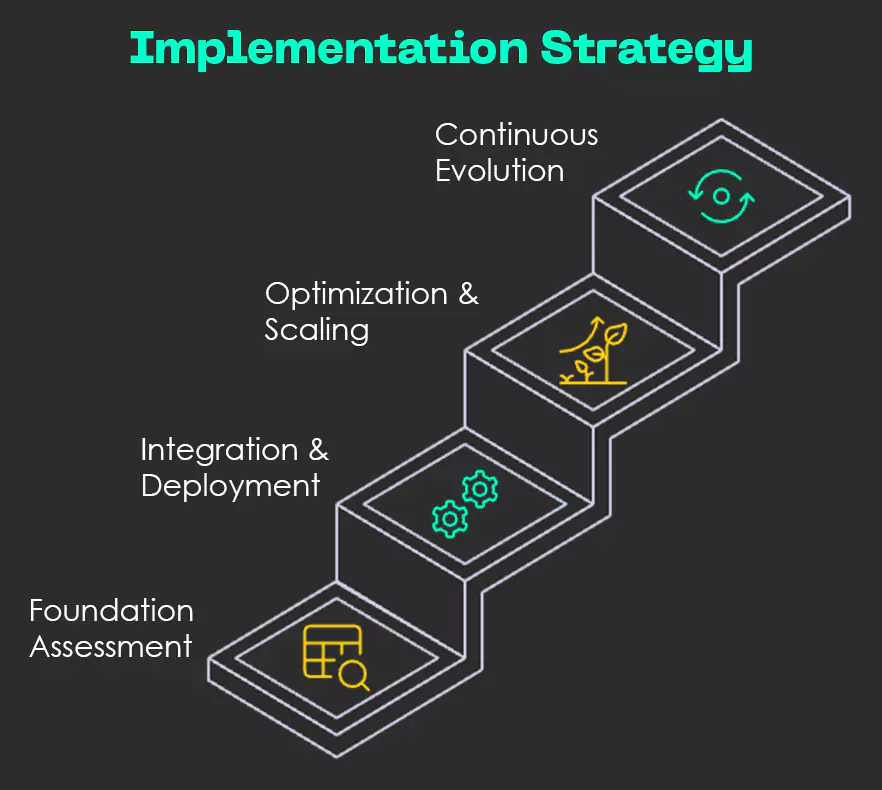
Fig: Integration Roadmap of AI-powered MDM
Phase 1: Foundation Assessment
Begin by evaluating where you stand today. This phase builds the groundwork:
- Infrastructure Audit – Map current systems and identify integration gaps.
- AI Readiness Check – Assess your organization’s preparedness for AI deployment.
- Security Analysis – Define compliance and protection benchmarks.
- Strategic Roadmap – Align AI implementation with business goals and user needs.
Phase 2: Integration & Deployment
Now that the foundation is laid, roll out AI capabilities in a structured, agile way:
- Machine Learning Integration – For predictive analytics and behavioral insights.
- Generative AI – To dynamically create or update policies.
- Deep Learning Models – For advanced threat detection and anomaly spotting.
- Data Management Connection – Ensure smooth data flow between systems.
Phase 3: Optimization & Scaling
Maximize the potential of AI by continuously refining and expanding capabilities:
- Predictive Management – Enable proactive responses to device or user trends.
- Automated Decision-Making – Reduce manual overhead with AI-driven logic.
- Intelligent UX – Improve productivity with adaptive user interfaces.
- Advanced System Integration – Connect seamlessly with existing enterprise platforms.
Phase 4: Continuous Evolution
AI isn’t static—it thrives on iteration. This phase ensures the system grows with your needs:
- Model Refinement – Use operational data to fine-tune AI algorithms.
- Performance Monitoring – Continuously track and enhance system efficiency.
- Capability Expansion – Stay ahead of emerging threats and tech trends.
- Organizational Scaling – Adapt as your team, devices, or security landscape evolves.
The partner you choose will determine not just immediate success, but long-term competitive advantage.
Choosing Your AI-Powered Technology Partner
Selecting the right MDM solutions provider requires evaluation resembling choosing a life partner- the decision impacts not just immediate needs but long-term success and happiness.
Critical Evaluation Criteria
When assessing potential partners, examine:
- AI expertise depth and proven implementation track record
- Innovation commitment demonstrated through R&D investments
- Integration capabilities with existing infrastructure
- Scalability potential for future growth requirements
- Security standards that exceed industry benchmarks
Essential AI Capabilities
Modern systems management software must provide:
- Predictive analytics that anticipate problems before they occur
- Automated threat response that neutralizes attacks in real-time
- Intelligent policy generation that adapts to changing requirements
- Behavioral analysis that understands user patterns and needs
- Continuous learning capabilities that improve over time
Choosing the right partner is crucial, but even the best technology can fail without proper implementation practices.
Success depends on the following proven strategies that minimize risk while maximizing transformational benefits.
Best Practices for Successful Mobile Device Management
Successful deployment requires the following practices:
1. Implementation Success Strategies:
- Execute pilot programs to validate capabilities in controlled environments
- Provide comprehensive staff training that builds confidence and competence
- Roll out capabilities gradually to allow adaptation and learning
- Monitor continuously and optimize based on real-world feedback
- Manage change by addressing human factors and organizational culture
2. Common Pitfalls to Avoid:
- Rushing implementation without proper preparation and testing
- Neglecting human factors in favor of pure technology focus
- Underestimating training requirements for successful adoption
- Ignoring governance frameworks for AI decision-making
- Overlooking security implications of AI-powered automation
Following these best practices is important. But understanding the broader strategic context helps organizations recognize why timing has become such a critical factor in this transformation. Read on!
The Strategic Imperative: Why Timing Matters
The competitive landscape increasingly favors organizations demonstrating superior cybersecurity capabilities, operational efficiency, and user experience.
AI-powered MDM provides all three advantages while positioning organizations to adapt to future challenges that haven’t yet emerged.
Market dynamics resemble high-stakes poker games where stakes keep increasing, and rules keep changing. Organizations with AI-powered capabilities hold better cards and adapt to rule changes faster than competitors using traditional tools.
Regulatory trends toward stricter data protection requirements make AI-powered compliance capabilities increasingly valuable. Organizations implementing comprehensive solutions now position themselves to meet current requirements. They achieve this while adapting to future changes without major infrastructure overhauls.
The window for competitive advantage continues narrowing as awareness of AI capabilities spreads throughout the market. Early adopters gain significant advantages, while late adopters face the challenge of catching up to competitors who have already established AI-powered operational superiority.
This strategic context brings us to the crucial decision point every organization faces: whether to lead the digital transformation or be transformed by it.
Embracing Your Digital Destiny
The transformation from traditional device management to AI-powered orchestration represents more than a technological upgrade. It’s a fundamental shift in how organizations approach digital security, operational efficiency, and competitive positioning. We’ve moved from reactive problem-solving to proactive future-shaping, where Mobile Device Management systems don’t just respond to events but actively create better outcomes.
At Nitor Infotech, we understand this transformation requires more than implementing sophisticated technology. It demands a comprehensive approach combining cutting-edge Generative AI capabilities with deep industry expertise, proven implementation methodologies, and unwavering commitment to client success. Our AI-first philosophy towards MDM solutions helps organizations build resilient, adaptive, and intelligent device management ecosystems. These don’t just meet today’s challenges but anticipate tomorrow’s opportunities.
The evidence clearly shows that organizations embracing AI-powered mobile management tools gain measurable advantages across every critical business metric. They reduce operational costs through intelligent automation, enhance security through predictive threat detection, improve productivity through seamless device management, and achieve compliance through automated monitoring. This is while they position themselves for future technological advances.
Organizations face a simple choice: to lead the transformation or be transformed by it. Those who choose to lead will shape the future of device management. Those who hesitate will find themselves playing catch-up in an increasingly competitive landscape.
The future of intelligent device management isn’t just within reach. It’s waiting for you to grasp it.
Ready to transform your device management strategy with AI superpowers? Contact Nitor Infotech to discover how our AI-powered solutions can revolutionize your enterprise device ecosystem and secure your organization’s digital destiny.