

Folks, I doubt this term is new to you, especially if you are in the world of healthcare.
Social determinants of health are the conditions in which people are born, grow, live, work, and age. These non-medical factors and forces shape the conditions of daily life and influence health inequalities.
SDOH can be grouped into five domains:
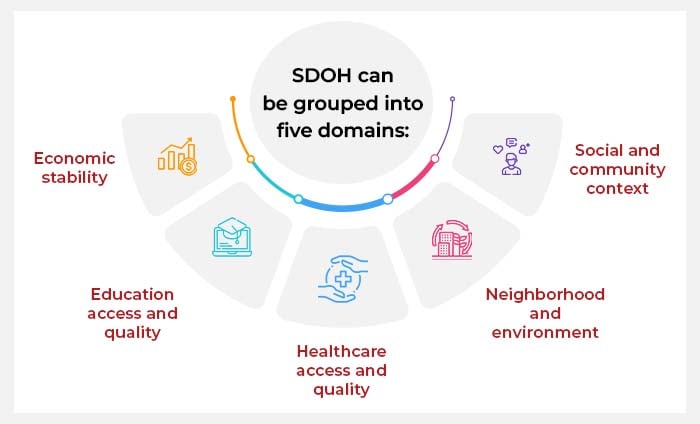
Fig 1: Five domains of SDOH
In this blog, let’s explore the above domains. Let’s get started!
Economic stability
Many people in almost all countries live in poverty. Economically unstable people may not be able to afford things like healthy food, healthcare, and housing.
The main factor of economic stability is steady employment which eventually affects health.
People with no employment live in poverty. They cannot afford the necessities to stay healthy.
Education access and quality
The second domain of SDOH is education access and quality. Higher education is again a crucial factor in health. Children with better education will be more likely to earn better incomes in life. This also gets them good health.
Health care access and quality
This includes:
- Access to primary care
- Access to specialty care
- Health insurance coverage
- Health literacy
People do have health insurance, but they are often unable to afford health care and medication they require. Some people face issues in identifying a primary care physician (PCP) and access to preventive care.
Neighborhood and environment
People in certain places may have to live with high rates of violence, unsafe air or water, and other health and safety risks. People with low income are likely to live in places with these risks.
Some neighborhoods do not have safe areas for communities to exercise, such as parks or bike lanes. Few workplaces might suffer from higher exposure to air pollution, second-hand smoke, or loud sounds that can affect members’ health.
Social and community context
Racism, discrimination, and violence are usually included in this domain. It includes relationships and interaction with family, friends, co-workers, and community members as well.
Positive relationships at home, at work, and in the community can help reduce these negative impacts. This works most of the times.
Connecting members with social and community support can help reduce the risks for many health issues as well.
Social support within the community, civic participation, workplace condition, discrimination and rates of incarceration are the factors of good health.
Social determinants of health matter a whole lot, but why?
The Importance of Social Determinants of Health
Health is not only about how frequently people get ill and any disease they might have. It is not only about physical fitness but also mental fitness. The social determinants of health have a major impact on mental fitness.
If a person has steady employment with good income, they can afford a superior quality of education. They can also access healthcare and are aware about the healthcare access they have. What’s more, the neighborhood and environment also have a major impact on people’s health.
This is why social determinants of health are important!
Now, let’s take a look at how SDOH is used in risk scoring.
How SDOH is used in risk scoring
In general, risk factors can be categorised into groups such as: Behavioural, Physiological, Demographic, Environment and Genetic.
SDOH can be used in risk scoring to assess an individual’s health risks and predict health outcomes.
Here are a few points that explain how SDOH can be used in risk scoring: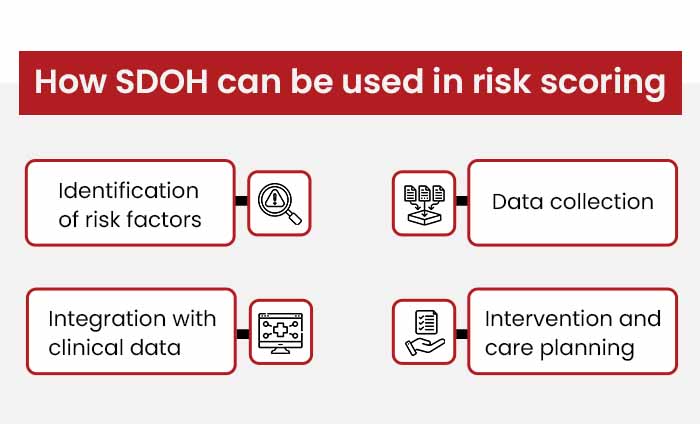
Fig 2: How SDOH can be used in risk scoring
Identification of risk factors: SDOH factors which impact the health outcomes are identified and incorporate into the risk scoring model. Lack of healthcare access and healthy food can be considered as risk factors.
Data collection: It includes information about a person’s social and economic conditions, such as income, level of children’s education, status of employment, housing conditions, healthy food, and social support network. This data can be collected through surveys, health records, other ways too. Health facility observations, and interviews.
Integration with clinical data: SDOH data can combined with clinical data such as medical history, vital signs, and lab results. As you can imagine, integration with this data can provide a more holistic view of an individual’s health risk.
Intervention and care planning: The risk score generated for individuals can help healthcare providers to identify who is at higher risk. This way, they can neatly allocate appropriate resources and interventions. Result = planning for better health.
Now, let’s understand how SDOH is important in public health and care management.
How SDOH is important in public health and care management
Addressing differences in SDOH helps us to makes progress towards health equity, wherein every person will enjoy their highest level of health. Here’s to more and more healthy people on the planet!
SDOH plays a crucial role in public health and care management by recognizing that health outcomes are influenced by factors beyond clinical care.
Let’s walk through how SDOH is important in public health and care management…
- SDOH helps identify and understand the underlying causes of health disparities among different populations. It highlights social, economic, and environmental factors that contribute to inequities in health outcomes.
- SDOH data helps shift the focus from reactive healthcare to the initiative-taking healthcare approach. It includes initiatives such as:
-
- Health education campaigns
- Community engagement program
- Policies that promote healthy behaviours and environment
- Incorporating SDOH into care management can improve the efficiency and effectiveness of healthcare delivery. By considering social factors, healthcare providers can better understand their patients’ needs and develop wonderful care plans that account for the social context.
This can lead to more appropriate resource allocation, reduced healthcare costs, and improve health outcomes.
That’s it for this blog, folks. I’m sure you are familiar with SDOH now!
Team Nitor Infotech is experienced in using SDOH for risk scoring and care management. Write to us with your thoughts about this blog.
Visit us at Nitor Infotech and click here to learn more about our healthcare offerings.
You might like this datasheet that delves into fostering healthcare with IT innovation!