

What do you think is the one thing that frustrates patients and healthcare providers the most till date? The answer is – long wait times. For patients, it’s a source of stress and dissatisfaction, leaving them anxious and questioning the efficiency of the practice. For doctors, it’s a constant battle between managing a packed schedule and providing the attentive, personalized care every patient deserves.
This strain can lead to:
- negative patient experience
- increased staff pressure
- loss in trust and loyalty
Fortunately, there are actionable strategies that healthcare practitioners can implement to reduce wait times and enhance the overall patient experience. In this blog, you’ll first explore the concept of doctor wait times and the various factors that contribute to them.
Additionally, you’ll get to know about all the effective strategies that can be implemented to reduce these wait times, highlighting the benefits that both patients and healthcare providers can gain from these improvements.
Let’s get started!
Doctor Wait Times and Their Influencing Factors
When a patient visits a healthcare provider, one of the key aspects of patient experience is the time the patient spends waiting to see the doctor. This “doctor waiting time” specifically refers to the period a patient waits for the doctor to arrive after being taken to an exam room.
Ever wondered how much time is spent on various activities during a patient’s appointment with a healthcare provider? Well, understanding this can help you appreciate the complexities of patient care and the demands placed on providers.
Here’s a breakdown of how time is typically distributed during patient visits:

Fig: Average Time Distribution by Healthcare Activity
While it may seem like a minor detail, understanding the factors that contribute to this waiting time is very crucial. Here are some of the most common factors:
| High Patient Volume: Busy clinics with many patients, especially during peak hours, often face delays as doctors struggle to attend to everyone promptly. | Scheduling Inefficiencies: Poor appointment management, like double-booking or misallocating time, leads to delays and longer wait times. |
| Complex Cases: Patients with complicated health issues may need more time, disrupting schedules for subsequent patients. | Staffing Shortages: Fewer doctors or support staff may slow down operations, increasing patient wait times. |
| Administrative Tasks: Time spent on paperwork or technical problems with equipment and software reduces available consultation time, leading to longer waits. | Technical Problems: Issues with equipment or software can disrupt operations and lead to longer wait times. |
Now, let’s get to know the ways that can help minimize doctor wait times and enhance patient satisfaction.
How to Reduce Doctor Wait Times?
There are several effective strategies to streamline the process and enhance patient experience. Here are some practical solutions to reduce wait times:
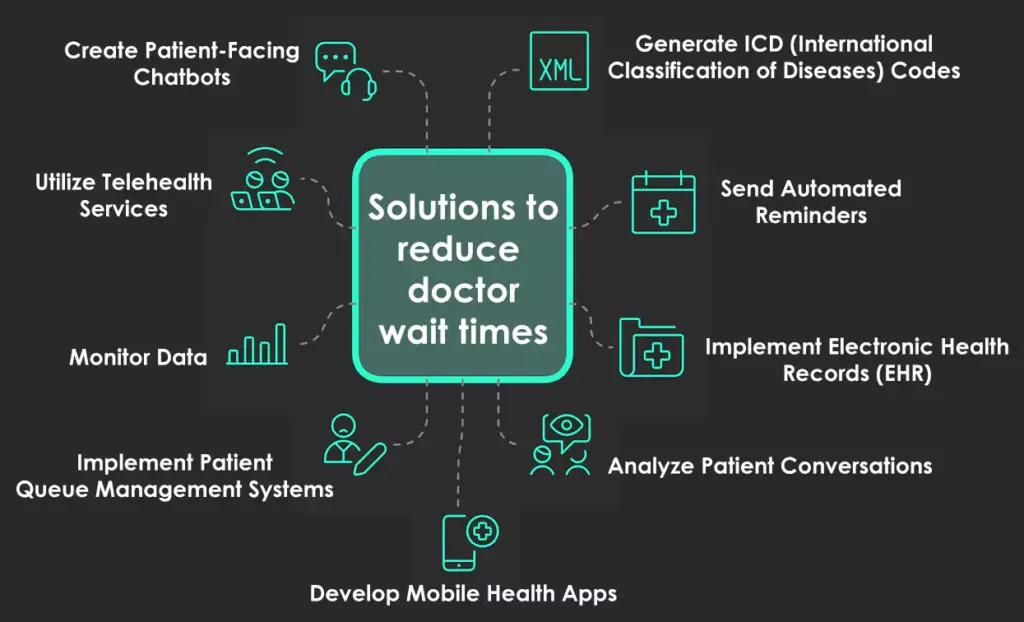
Fig: Solutions to reduce doctor wait times
One of the most crucial strategies for reducing doctor waiting times is effective collaboration between primary care physicians (PCPs) and various support entities, including – nursing staff, health coaches, medical assistants, and technology as shown in the above image.
As highlighted in recent studies, doctors often spend about 50-60% of their time on non-clinical administrative tasks. This significant portion of their work can be efficiently managed by these tech solutions and support roles, allowing physicians to focus more on patient care. Discover how Nitor Infotech’s expertise in integration and interoperability can enhance patient care and tackle healthcare challenges.
Here’s how each of the above tech solutions and roles helps reduce wait times, improve patient experience, and streamline healthcare delivery:
a. Utilize Telehealth Services: Telehealth options are invaluable for reducing in-office visits. Virtual platforms can facilitate initial assessments to determine the necessity of in-person consultations. Additionally, offering telehealth for follow-ups or minor issues frees up crucial appointment slots for patients who require immediate attention.
b. Send Automated Reminders: To minimize no-shows, sending automated appointment reminders via text or email is highly effective. This healthcare automation helps patients remember their appointments, leading to better scheduling and reduced waiting times.
c. Implement Electronic Health Records (EHR): Using EHR systems can significantly streamline documentation. These systems allow healthcare providers to access patient information quickly, ensuring that consultations are efficient and focused.
d. Monitor Data: Regularly tracking appointment durations and patient volumes helps identify patterns in patient flow. Analysing this data enables practices to adjust scheduling and staffing accordingly, further reducing wait times.
e. Implement Patient Queue Management Systems: Implementing a cloud-based queue management system can streamline patient flow by allowing patients to check in remotely. This system can provide real-time updates on wait times and notify patients when it’s their turn, reducing congestion in waiting areas.

Learn how we transformed patient care for a client with advanced risk management powered by GenAI.
f. Analyze Patient Conversations: Generative AI can analyze conversations between patients and nursing staff regarding symptoms and medical history. By creating concise summaries, this technology can automatically input relevant information into EHR systems by extracting summarization of medical text in FHIR format.
g. Create Patient-Facing Chatbots: Leveraging generative AI, healthcare practitioners can develop patient-facing chatbots. These bots can interact with patients, gather information about their symptoms and history, and even schedule appointments based on doctor availability.
h. Generate ICD (International Classification of Diseases) Codes: It can assist in generating possible ICD codes for diagnoses. This streamlines the coding process and ensures accurate record-keeping.
i. Develop Mobile Health Apps: Integrating self-service features within a mobile app can empower patients to manage their healthcare needs more proactively. It can not only allow patients to access important health information at their fingertips but also streamline interactions with healthcare providers.
In addition to the above tech-based solutions, enhancing staff efficiency is crucial in managing patient flow. Hiring additional nursing staff, medical assistants or health coaches can alleviate the burden on doctors. These professionals can handle:
- administrative tasks
- documentation
- patient history
- education
- basic diagnostic tests and vital readings
Such support allows doctors to focus more on patient care.
So, implementing such effective strategies in healthcare practices can lead to a significant reduction in doctor waiting times. These improvements not only enhance patient satisfaction but also alleviate the burden on doctors.
Fortunately, advancements in technology and the support of nursing staff can now take on many of these responsibilities. This allows doctors to focus more on what they do best: providing quality patient care. That is, physicians can see more patients within the same timeframe.
For instance, rather than accommodating just one patient per appointment, they can now see more, leading to greater efficiency.
Ultimately, these enhancements also contribute to increased revenue for healthcare practices. By prioritizing collaboration and smart resource allocation, we can create a more effective and satisfying healthcare environment for everyone involved.
To leverage such cutting-edge technologies and transform challenges into practical solutions, reach us at Nitor Infotech.
Also, write to us with your thoughts about minimizing wait times and learn more about our digital healthcare technologies.
What is doctor wait and how to reduce it?
Doctor wait time refers to the duration a patient spends waiting after being taken into the exam room until the doctor arrives.
To reduce this, healthcare providers can adopt several strategies, such as:
- Utilize telehealth services for minor cases and follow-ups to reduce in-office visits.
- Send automated appointment reminders to reduce no-shows and improve scheduling efficiency.
- Implement Electronic Health Records (EHR) for faster access to patient information and efficient consultations.
- Adopt patient queue management systems to provide real-time updates and reduce waiting room congestion.
- Leverage generative AI to summarize patient data, automating documentation and ICD code generation.
- Develop mobile health apps to empower patients in managing their healthcare needs and appointments.