

Highlights
A Business Analyst transitioning into the audit domain is essentially a step into a world that revolves around accuracy. This blog reveals how BAs can juggle performance and accuracy – delivering products the right way. It shares the journey of the characters and how attributes like curiosity, collaboration, and logical thinking helped them to convert the challenges into a better understanding. It is a walk through the maze for the newcomers by posing the right questions, grasping the actual audit situations, and so forth. Each BA, by
being committed to their craft and diligent in their work, has the potential to turn difficult situations into trustworthy, impactful results.
In the world of audits, accuracy isn’t a bonus — it’s the baseline. When I first stepped into this domain as a Business Analyst, I had a basic understanding of how audits actually worked. Like many others, I thought, “Okay, a few weeks of learning and I’ll get the hang of it.” However, here’s the truth — audit is a vast ocean. Just when you feel like you’ve understood 100%, something new pops up and humbles you back to 40%. It keeps you learning, thinking, and adapting.
If you’re a Business Analyst as well, your role must involve making sure the solutions your organization delivers not only solves the right problems, but solves them accurately. And to do that well, you need to bring two perspectives to the table:
- Driving clarity, communication, and delivery
- Ensuring correctness, consistency, and confidence in the output
In this blog, I’ll share how I learned to balance both — and how you can too, especially if you’re new to this audit domain.
So, sit back, enjoy the read, and let your journey as a Business Analyst in the audit domain unfold and thrive!
What Can Business Analysts Transition into the Audit Domain?
Business Analysts stepping into the audit domain quickly realize that this field isn’t just about technical know-how; it’s more about the mindset. Here, success depends as much on traits like accuracy, consistency, and trustworthiness as it does on analytical skills.
Working in the audit domain as a Business Analyst is not just about building a product; it’s about building trust, transparency, and accuracy. And as a BA, you often find yourself balancing two critical roles — the enabler and the gatekeeper.
Here are the two perspectives that I’m talking about:
Perspective 1: Making the Product Happen
Some of you might relate to this – you’re the glue between business needs and technical implementation. You take complex audit workflows and break them down into features, flows,
or processes that a delivery team can build and ship. You’re constantly gathering inputs, organizing feedback, writing clear and testable user stories, and ensuring nothing is lost in translation.
You also help the team stay aligned on priorities and create clarity where there’s ambiguity. You run walkthroughs, follow up on dependencies, and keep delivery moving forward. You know who to talk to when a decision is stuck, and you always keep one eye on timelines.
In this space, your strength lies in execution. You’re helping turn an idea into reality — not just any reality, but one that improves how audit professionals work, manage their time, or make better decisions. It’s about building things and binding them together to make it work.
Perspective 2: Making the Product Happen Right
To be honest, just building something that works isn’t enough in the world of audit. It has to work right.Audit professionals rely on accuracy, completeness, and traceability. A small miscalculation or oversight can have ripple effects — sometimes even legal or financial consequences (a situation organizations avoid being in). That’s why this second lens is all about ensuring that what we build is logically sound, compliant, and reliable.
This means understanding the reasoning behind every feature, the implications of every output, and the edge cases that could silently cause issues.
To ensure this, you must ask questions like:
- “What happens if the data changes after the review has started?”
- “Will this flow produce consistent and explainable results across scenarios?”
Moreover, this role involves close collaboration with quality teams, focusing on exceptions rather than just happy paths. The goal isn’t merely to support a product/feature release — but to safeguard the integrity of what’s being delivered.
Let me take you through a bit of my experience!
What Questions Should a Business Analyst Ask to Stand Out in the Audit Domain?
I’ve come to realize that the best way to understand this domain is through the people in it. By people, I mean — the reviewers, the engagement teams, and those working under pressure to make timely, accurate decisions.
At the beginning, I had to push myself out of my comfort zone. I approached the audit domain with a reader’s mindset.
A great source to learn everything was when I explored Investopedia – this helped brush up my basics. I simultaneously watched “n” number of YouTube videos that explained financial and audit terms, followed market news, and asked the most powerful question: “Why?”
- Why is this step needed?
- Why does it matter in a review?
- Why would someone flag or reject this?
That single question of curiosity has taken me further than any documentation ever could. It helped me connect the dots between what we build and how it’s used in the real world for greater impact.
From asking the right questions to aligning with project expectations, here’s a checklist that every BA needs to read to stand out in the audit domain:
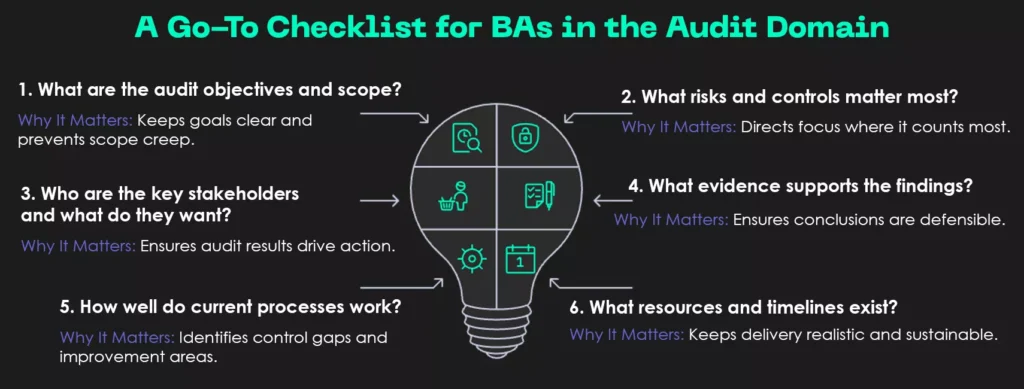
Having figured it out myself, I’d like to guide freshers entering this domain as analysts to navigate it with ease. So, let’s walk through the complete roadmap to make it happen.
What Are the 6 Actionable Steps For Business Analysts to Succeed in the Audit Domain?
Take these steps to build your expertise as a Business Analyst and stand out in the audit domain:
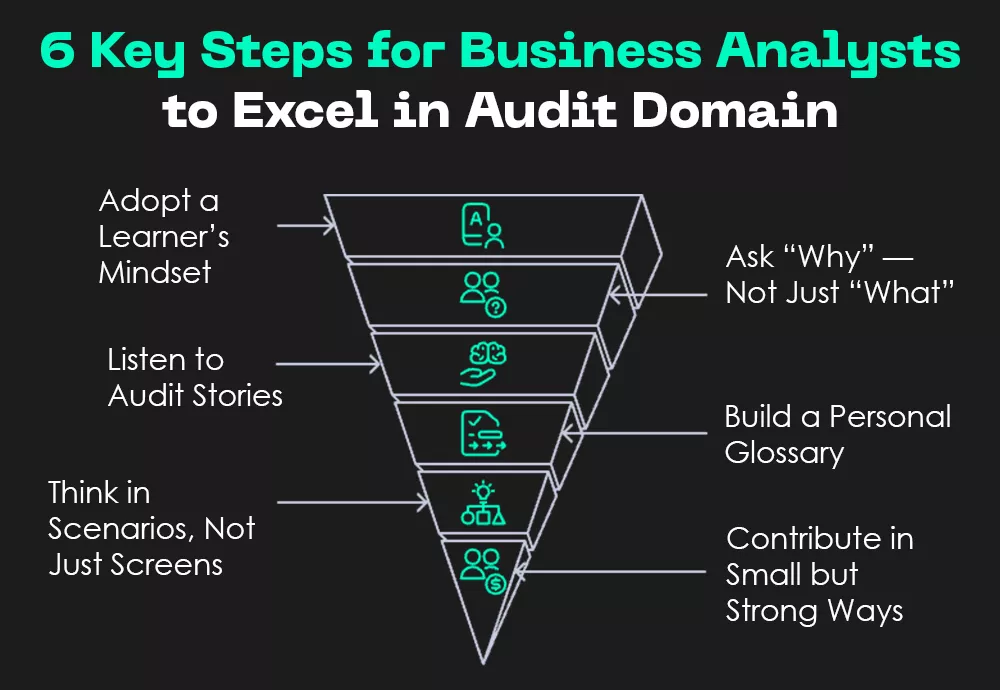
Fig: 6 Key Steps for Business Analysts to Excel in Auditing
1. Adopt a Learner’s Mindset
It’s not that I didn’t feel pressure — I absolutely did. In the beginning, I was constantly wondering – “when will I finally understand this domain? It’s all moving so fast — how will I catch up?” I mean, everything felt new — the workflows, the expectations, even the terminology.
At first, I tried to match that speed. I pushed myself to learn both domain knowledge and technical skills in parallel — and that quickly became overwhelming. Eventually, I gave myself permission to slow down and learn one step at a time.
I started by picking one flow or one topic and going deeper into that. I also made time for technical upskilling — including learning about AI (artificial intelligence) — but again, one course or concept at a time.
For BAs coming from a commerce background, that’s a definite advantage — many concepts in the audit space may already feel familiar. But even if you don’t come from that world (like me), you can still find your own strength. For me, it was my love for mathematics and logic — I’ve always enjoyed structured thinking, solving puzzles, and breaking down complex problems. That mindset helped me feel comfortable in a domain full of dependencies, checks, and validations.
I also leaned on my team. I started by learning from colleagues who had been in the space longer. Those informal conversations gave me clarity and confidence to ask questions. From there, I slowly expanded to videos, articles, and external resources to keep building.
Looking back, I’ve realized: you don’t have to know everything — you just need to keep learning consistently. There’s no perfect starting point, only progress.

Discover how our data-driven insights empowered a healthcare ISV to identify at-risk diabetic patients early and slash expenses.
2. Ask “Why” — Not Just “What”
In most cases, a BA is expected to know what a feature does and how it should behave. However, the real depth kicks in when you start asking — and answering — “why.”
At a surface level, you might find answers based on development feasibility or system design rules. But the real “why” often lives beyond the application — in the offline process that the system is trying to replicate or support.
And that’s where I had to dig deeper.
I realized that asking “why” wasn’t just about satisfying my own curiosity. It was necessary to ensure that the functional design was truly aligned with the business need — not just on paper, but in a practical context. Once I understood that offline process, it became much easier to validate such questions.
Here’s the other thing — it wasn’t enough for just me to know the “why.” I had to share it with the developers, testers, and other stakeholders, too. This is because once the whole team understood the reasoning behind a flow or rule, it became easier for everyone to visualize the impact, spot edge cases, and make better decisions.
Getting to the “why” wasn’t always instant. Sometimes I had to understand, then re-understand, and then understand again. I’d go back to SMEs, play out scenarios, and revisit requirements — until I was clear. Because if I wasn’t sure why we were doing something, how could I expect the team to build it, right?
3. Listen to Audit Stories
One of the most underrated sources of domain learning is simple: listen. I got into the habit of asking questions — not just about the product or features, but about the audit process itself.
My colleagues and I also attended various offline sessions — sometimes they were tool trainings, sometimes pure domain knowledge sharing, etc. And here’s a line I live by:
“If there’s knowledge coming your way, grab it — it’ll come in handy someday!”
Not everything will make sense immediately. But over time, these bits of information start to link together, helping you understand what’s behind the processes and user needs more clearly.
Also, my advice would be to be open to connecting with auditors themselves. Their feedback is full of real-life cases — many of which won’t be found in documentation. Every time they raise a question or point out a gap, it’s a chance to understand a real-world scenario that might be new to you. Often, these are the moments when you gain the kind of clarity that textbooks or specs can’t provide.
Extra read: Fund Audits Explained: Ensuring Trust and Compliance in Asset Management
4. Build a Personal Glossary
Here’s the truth: I didn’t maintain a formal glossary when I started. I relied on discussions, reading through documents, and yes — a lot of surfing on Google. Over time, the terms began to make sense simply through repeated exposure.
However, if I were starting fresh, I’d definitely suggest creating a basic, running list of terms. It doesn’t need to be anything fancy — just something to help you keep track of the new words, abbreviations, and domain-specific phrases that come up in meetings and conversations.
In my case, I found a different way that worked for me: I started dropping notes and references into my own emails. That way, whenever I needed to revisit something, a simple email search brought it up way faster than digging through folders or documents. It wasn’t a traditional glossary — but it worked for me.
So, whether it’s a Notion board, a Word doc, or even just your own inbox, find a method that helps you keep learning visible and searchable. There’s no shame in not knowing all the terms — but you do need to keep learning and evolving constantly.
5. Think in Scenarios, Not Just Screens
As a business analyst, it’s easy to get caught up in what a screen looks like — field placements, buttons, dropdowns. With time, I learned that user experience (UX) goes way deeper than the user interface (UI). It’s about how the flow of a product feels to the user:
- Is it intuitive?
- Is it guiding the user, or confusing them?
- Does it work just on the “happy path,” or does it support real-life scenarios?
That’s why I started thinking about scenarios, not just screens.
Instead of asking “What does this screen show?”, I’d ask:
- What happens if a user forgets to complete a step?
- What if the data arrives late, or changes at a later time?
- What if two users try to act on the same item?
These “what if” questions helped me go beyond surface-level flows and identify gaps early — whether it was missing validations, unclear error messages, or overly complex steps that could be simplified.
So, the goal was always to ease the user’s experience, not complicate it. It’s because even if the UI looks great, it won’t matter if the flow is frustrating or inconsistent in real-world use.
6. Contribute in Small but Strong Ways
Before you can ask the right questions, you need to know the product.
That means spending time exploring the system hands-on, not just reading documentation. In my case, a lot of my understanding came from trial and error — clicking through flows, testing different paths, and observing how the system responds in different situations. Every time I got stuck or saw something unexpected, it sparked a new question or discussion.
Creating my own specification notes or quick-reference documents also helped me. I didn’t rely only on formal documents — I made my own internal versions based on what I learned, what confused me, and what I needed to revisit later. This became my personal support system.
Once I got familiar with the product, it became easier to contribute — even as a fresher.
So, you must know that – strong requirements aren’t created in isolation. They’re shaped by:
- Asking thoughtful, sometimes repeated, questions
- Anticipating edge cases and “what if” situations
- Thinking with a QA lens — what can break, what needs validation
- Reviewing designs like a user, not just a stakeholder
- Connecting functional needs with technical feasibility
These may seem like small steps — but together, they strengthen the foundation of every solution.
Make the move and start your technical journey with seasoned professionals. Learn everything about business analysis, tools, and more advanced technologies.
Let’s wrap up!
Final Thoughts
This is what you must understand – you don’t need an accounting degree or years of domain experience to be a good BA in the audit space. What you need is curiosity to learn, humility to ask, and ownership to ensure the outcomes are right. The more you listen, ask “why,” and explore with intent — the faster you’ll find your footing.
And remember:
“Even 0.01% progress every day adds up. Don’t wait for the big leap — show up and build daily.”
So don’t wait for the perfect opportunity or the perfect time — just start. Show up, stay consistent, and trust that every small effort is shaping a stronger you.
If you’re a seasoned professional and have read this blog, we’d love to hear your thoughts. Reach out to us at Nitor Infotech, an Ascendion company.