
Every heartbeat, every step, and every breath you take can now be monitored and analyzed in real time, thanks to the Internet of Medical Things (IoMT) — a revolutionary software technology that’s redefining how we approach healthcare.
You must have heard about the Internet of Things, an ecosystem of devices where each device is equipped with a sensor and other technologies that enable communication or data transfer amongst themselves as well as the cloud. The Internet of Medical Things, however, refers to the group of medical devices that transfer healthcare information.
Each time you visit the hospital, healthcare professionals measure your glucose levels, blood pressure, and pulse. They do so via IoMT devices such as glucose monitors, heart rate monitors, and pulse oximeters that are integrated with sensors and can transfer data with the help of BLE.
Let’s look at the pulse oximeter, for example.
A pulse oximeter can become a crucial part of connected healthcare by transforming itself into an IoT-enabled device. For example, imagine a patient with a chronic respiratory condition who needs constant monitoring of their oxygen levels. With an IoT-enabled pulse oximeter, the device can continuously track oxygen saturation and heart rate in real time.
The data collected is transmitted securely to a cloud platform using Bluetooth, Wi-Fi, or cellular networks. Once stored in the cloud, this information is accessible to both the patient and their healthcare providers in a secure way through an integrated mobile application or web dashboard.
The connected app provides the patient with easy-to-understand visual trends of their oxygen levels over time, along with alerts if the levels drop below a safe threshold. Simultaneously, the healthcare provider can access the same data remotely, allowing them to monitor the patient’s condition and make informed decisions.
In case of an emergency such as hypoxia, the pulse oximeter can send real-time alerts to both the patient and their doctor, ensuring timely intervention especially for home health and hospice patients. This integration of healthcare technology enhances patient safety and facilitates proactive medical responses.

Fig: Working of a pulse oximeter.
The Key Technologies Driving IoMT:
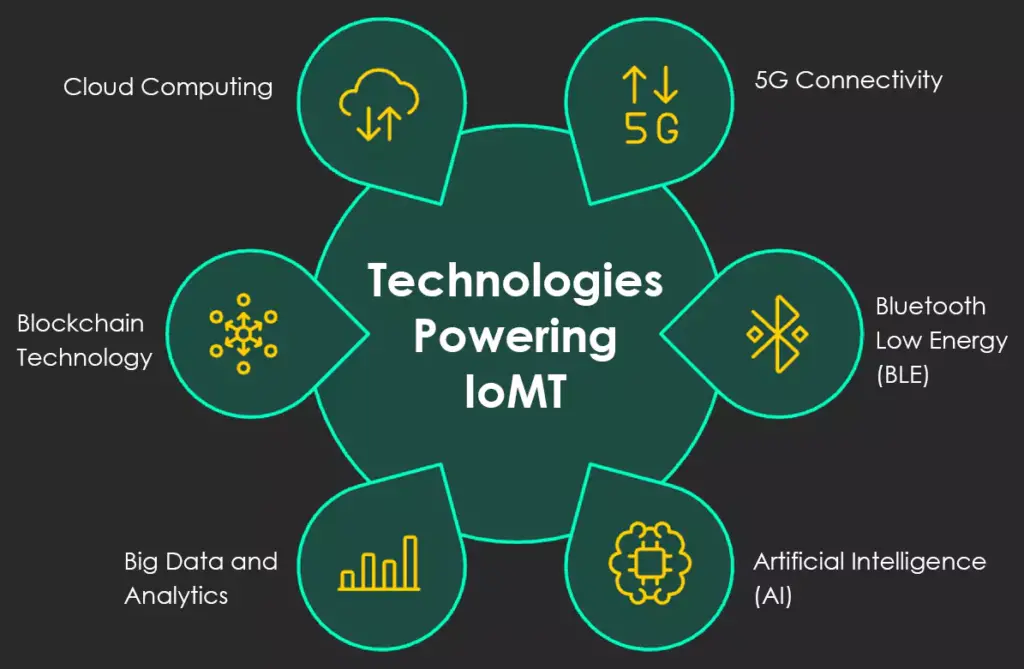
Fig: Technologies powering IoMT
- 5G Connectivity ensures IoMT devices can communicate quickly and reliably. It allows real-time data transfer. This is especially useful for remote patient monitoring and emergency responses.
- Bluetooth Low Energy (BLE) helps in transferring data through radio waves. It facilitates device communication over short distances.
- Artificial Intelligence (AI) plays a major role in IoMT by using predictive analytics. This helps healthcare providers understand patterns in patient data, predict potential health issues, and offer personalized treatments. AI also supports faster and smarter decision-making.
- Generative AI is useful for generating automated treatment plans, patient health reports, medical charts, and important documentation for healthcare managers to refer to for future use.
- Big Data and Analytics help process the huge amounts of information collected by IoMT devices. This data is analyzed to provide better insights. This helps doctors make more informed decisions about patients.
- Blockchain Technology ensures that sensitive patient data is handled securely and transparently. It protects information from being tampered with and gives patients confidence that their data is safe.
- Cloud Computing is essential for storing large amounts of data generated by IoMT devices. It allows healthcare providers to access this information anytime, from anywhere. This way, it ensures better collaboration and care delivery.

To learn more about each technology in depth and how they can elevate your business
Now that you know about the technologies that can power medical IoT devices, let’s look at how IoT is transforming the healthcare landscape and revolutionizing the way we approach patient care.
How is IoMT revolutionizing today’s Healthcare Landscape?
IoT is transforming healthcare by enabling smarter, faster, and more connected solutions. Here are the ways IoMT is revolutionizing healthcare:
- Remote Patient Monitoring (RPM): IoMT-powered devices like glucose monitors, ECG trackers, and smart wearables help track vital signs in real time. These devices allow healthcare providers to monitor patients continuously, through applications improving the accuracy of diagnoses. This also helps the healthcare provider to intervene whenever necessary to prevent life-threatening situations like a possible heart attack.
- Telemedicine: IoMT facilitates remote doctor-patient interactions, overcoming geographical barriers. This allows patients to receive healthcare consultations, follow-up appointments, and treatment plans without needing to visit a clinic or hospital. This is especially beneficial in rural areas.
- Smart Hospitals: IoT devices are embedded throughout hospitals to optimize workflows. For example, connected operating rooms allow for real-time monitoring of medical equipment, ensuring that everything functions smoothly during procedures. Automated medication tracking systems help prevent errors by ensuring medications are delivered correctly, at the right time, and to the right patient.
- Chronic Disease Management: IoMT devices continuously monitor patients with chronic conditions like diabetes, hypertension, and heart disease. These devices send real-time data to healthcare providers, allowing them to adjust treatment plans quickly and reduce complications.
The advantages of IoMT in healthcare are significant:
- IoMT improves patient care as continuous, real-time monitoring allows for early detection of health issues and illnesses. This leads to quicker interventions and faster results.
- Healthcare officials can check the patient’s data and respond quickly leading to improved diagnosis.
- Automating processes like patient monitoring frees up resources and reduces manual workload, helping the hospitals to streamline their processes.
- With remote real-time health monitoring and fewer in-person visits, IoT can significantly lower the costs of hospital re-admissions.
- Telemedicine and remote monitoring make healthcare more accessible to patients in remote or underserved areas, ensuring that everyone can receive the care they need.
- Lessons from Covid: IoMT devices can track patient symptoms, monitor vitals, and enable contactless consultations, ensuring timely care while reducing the burden on hospitals.
By enabling continuous monitoring, improving access to care, and streamlining hospital workflows, IoT is creating a more efficient, patient-centered healthcare environment.
IoMT has already become so advanced – let’s imagine what it will look like in the next five years.
The Future of IoMT in Healthcare
The future of connected healthcare, particularly through the Internet of Medical Things (IoMT), looks promising, especially as we move toward 2025-2030. IoMT will revolutionize how we monitor and manage health by creating a more efficient, and accessible healthcare ecosystem. We could see this happening in the following ways:
1. One significant change will be the rise of smart implants and next-generation devices capable of real-time monitoring. These devices will continuously track vital signs, manage chronic conditions, and even deliver medication or electrical impulses to help regulate health.
For example, heart devices could monitor arrhythmias and send alerts to doctors if a patient’s heart rate is irregular. This technology will also be crucial for managing aging populations, allowing for continuous monitoring without requiring frequent hospital visits.
2. Telemedicine and virtual healthcare, driven by IoMT, will become more widely used. Virtual consultations will be more common, with remote monitoring devices helping doctors track patients’ conditions and provide personalized advice without the need for physical appointments. This will make healthcare more accessible, especially for the elderly or those in rural areas.
3. IoMT could also be integrated with smart homes and personal assistants (like Alexa or Google Home), allowing elderly individuals to monitor their health seamlessly. These devices will send health data to healthcare providers or caregivers and even alert them if there are any concerns, ensuring timely interventions for aging populations.
This connectivity will help improve the quality of life for seniors. It will offer them independence while ensuring their health is closely monitored.
To conclude, I’d like to say that the future of connected healthcare powered by IoMT holds immense potential to transform the way we monitor, manage, and improve health outcomes.
For more insights on how IoMT and connected healthcare can transform your business, contact us at Nitor Infotech.
What is IoMT?
The Internet of Medical Things (IoMT) refers to the network of connected devices that collect, monitor, and share patient data in real time. These devices include wearables, sensors, and medical equipment that work together to enhance patient care and optimize healthcare processes.
How IoT is Used in Medical Devices?
IoT enables medical devices to communicate data seamlessly to healthcare providers, allowing for continuous monitoring. Devices like glucose monitors, ECG trackers, and wearable health sensors track vital signs and send this information to healthcare systems or mobile apps. This allows doctors to monitor patients remotely, making healthcare more accessible and efficient. IoT also powers telemedicine platforms, enabling real-time doctor-patient interactions, especially for those in remote areas.