
Highlights
As healthcare transforms, HL7 stands at the core of next-generation contact center innovation. By integrating electronic health records, scheduling tools, and clinical data systems, HL7 creates unified communication between patients, agents, and clinicians.
This interoperability simplifies complex workflows, improves decision-making, and fosters trust through accurate, up-to-date information access. Patients receive faster, more informed assistance, while healthcare teams gain data-driven insight for better outcomes. Contact centers powered by HL7 can redefine efficiency and empathy, offering a seamless balance between technology and patient care that drives healthcare excellence into the digital age.
HL7 (Health Level Seven), is at the heart of a new era in healthcare—one defined by seamless connectivity, smarter workflows, and an empowered patient journey.
In the evolving landscape of next-gen healthcare, next-generation contact centers are rapidly transforming, and HL7 standards are the foundation that enables this progress.
I wrote this blog to explore how HL7 is revolutionizing healthcare contact centers, making medical care more efficient, accessible, and patient-centric.
Let’s begin!
What Is HL7 and How Is It Used in Healthcare?
HL7 refers to a set of international standards that enable healthcare systems and applications to communicate and share data with each other securely and reliably. These standards primarily focus on the exchange, integration, sharing, and retrieval of electronic health information, ensuring that diverse healthcare IT environments can collaborate seamlessly.
HL7 includes several frameworks, the most notable being HL7 V2, V3, and FHIR (Fast Healthcare Interoperability Resources).
Its most widely used frameworks include:
- HL7 V2
- HL7 V3
- C-CDA
- FHIR (Fast Healthcare Interoperability Resources)
Interoperability—the ability for systems to “speak the same language”—is the ultimate goal of HL7 in modern healthcare. By enabling seamless data exchange among hospitals, clinics, labs, and patients, HL7 ensures timely access to critical health information, improves care coordination, reduces medical errors, and supports the shift toward more personalized, data-driven healthcare delivery.
The primary goal of HL7 is interoperability—the ability for healthcare systems to “speak the same language.” By standardizing data exchange, HL7 enables:
- Faster care coordination
- Reduced medical errors
- Efficient clinical workflows
- Improved patient safety
- Data-driven decision-making

Discover the Benefits of Healthcare Tech for Yourself!
Nitor Infotech’s experts can assist you in enhancing product time-to-market, delivering excellent healthcare applications, and skyrocketing the patient care experience.
The Central Role of Contact Centers in Modern Healthcare
Contact centers serve as the “front door” to healthcare institutions, handling everything from appointment scheduling and medication inquiries to billing and patient support. As healthcare becomes more digital and patient expectations rise, contact centers require reliable, real-time access to a wide variety of information systems.
Contact centers integrate with electronic health records (EHRs), scheduling software, billing systems, and more.
Efficient contact centers lead to enhanced patient experience, better care coordination, and streamlined clinical workflows.
Now for the pivotal question: the next section answers it.
Healthcare contact centers serve as the front line of patient interaction, handling:
- Appointment scheduling
- Medication inquiries
- Billing and insurance support
- Care coordination
- Telehealth routing
- Patient follow-ups
To perform efficiently, contact centers need real-time access to EHRs, scheduling tools, billing systems, and clinical data. This is where HL7 brings unmatched value.
How HL7 Powers Next-Gen Healthcare Contact Centers

Fig: How HL7 Powers Next-Gen Healthcare Contact Centers
1. Seamless Data Integration
The strength of HL7 lies in its ability to make healthcare data portable between different systems. Through standardized message formats, HL7 allows contact center staff to instantly retrieve medical records, recent lab results, appointment history, and medication lists—without switching between systems or re-entering data.
HL7 unifies touchpoints, turning fragmented experiences into a coherent patient journey.
Staff can respond to patient questions with a complete picture in hand, ensuring accuracy and saving time.
HL7 standardizes how information flows across systems. This allows contact center agents to access:
- Medical history
- Lab results
- Appointment records
- Prescriptions
- Care plans
This is all from a single interface without switching applications.
2. Real-Time Workflow Automation
With HL7, actions such as scheduling, referrals, and care management can happen in real time. For example, an HL7 message can automatically:
- Trigger a follow-up task when a lab result is in.
- Schedule a telemedicine session based on patient need.
- Open a nurse review or send a patient reminder, reducing manual communication and the risk of human error.
3. Enhanced Data Interoperability
Contact center transformation relies heavily on easy communication between often incompatible systems. By standardizing how information is exchanged, HL7 ensures that data can freely move between practice management, radiology, pharmacy, and finance systems.
For example, appointment details can be updated in practitioner schedules and communicated directly to the billing or insurance team for seamless claims processing.
4. Enabling Advanced Tools and Automation
HL7 sets the stage for integrating AI-driven virtual agents and “copilot” assistants in the contact center. These tools can:
- Handle routine patient queries using context delivered by HL7 feeds.
- Suggest “next best actions” or escalate complex scenarios to human clinicians.
- Identify patterns in historical data to prevent missed follow-ups and improve patient adherence.
Our healthcare IT experts showcased their expertise by leveraging GenAI to assist a client, deftly identify risk factors, customize care plans, and categorize patients. Take a few minutes to discover how this led to a reduction in operational costs.
The HL7 FHIR Revolution
Fast Healthcare Interoperability Resources (FHIR) is the latest evolution in the HL7 family and is designed to work seamlessly with modern, API-based, web-friendly applications.
FHIR brings several new capabilities to healthcare contact centers:
- Real-time connectivity and data sharing, vital for cloud-based and mobile environments.
- Lightweight, scalable integration for telehealth, remote monitoring, and multi-channel patient engagement.
FHIR’s standardized data format enables everything from mobile apps to wearables and connected devices to interface directly with the contact center. This closes gaps in care and offers a truly “always connected” experience.
Benefits of HL7 Integration for Healthcare Contact Centers
- Improved patient experience
- Faster and more informed responses
- Higher operational efficiency
- Scalability for growing healthcare needs
- Cost reduction
Read on to learn about the advantages:
- Improved Patient Experience
Patients want fast answers, minimal repetition, and accurate information, regardless of how they interact with healthcare providers (phone, chat, or app). HL7 delivers this by keeping context intact across channels, so a query started by phone can be resolved via chat or followed up through a telemedicine visit—without repeating information. - Faster and More Informed Responses
With HL7-enabled systems, contact center staff don’t have to chase data. They receive automatic updates for new lab results, can verify patient history instantly, and provide next-step advice on the spot. - Higher Operational Efficiency
HL7 dramatically reduces the need for manual data entry and rekeying, which decreases errors and administrative overhead. Automated exchanges free up staff to focus on complex or sensitive interactions that require critical thinking and empathy. - Scalability for Growing Healthcare Needs
As healthcare organizations expand, HL7 ensures new departments, clinics, or technologies easily “plug in” to their existing ecosystem, maintaining a consistent and secure flow of information. - Cost Reduction
Implementing HL7 means less custom coding and fewer ad-hoc integrations, lowering maintenance costs and development time for IT teams.
Now, let’s ponder a little bit about security, privacy, and HL7.
Security, Privacy, and HL7
Security is foundational to HL7. Its protocols support:
- Authentication
- Access control
- Encryption
- Audit logs
- Compliance with privacy laws
In contact centers, this is critical for safe patient verification and compliant communication.
HL7 continues to evolve in step with newer privacy regulations and cybersecurity requirements.
Contact centers leverage voice biometrics and multifactor authentication for seamless, secure patient verification.
Access logs and permission settings allow organizations to audit interactions and remain compliant with local laws and standards.
At this juncture, you might be curious to know the important use cases of HL7 when it comes to contact center transformation. Read on to get the scoop.
Key Use Cases of HL7 in Contact Center Transformation
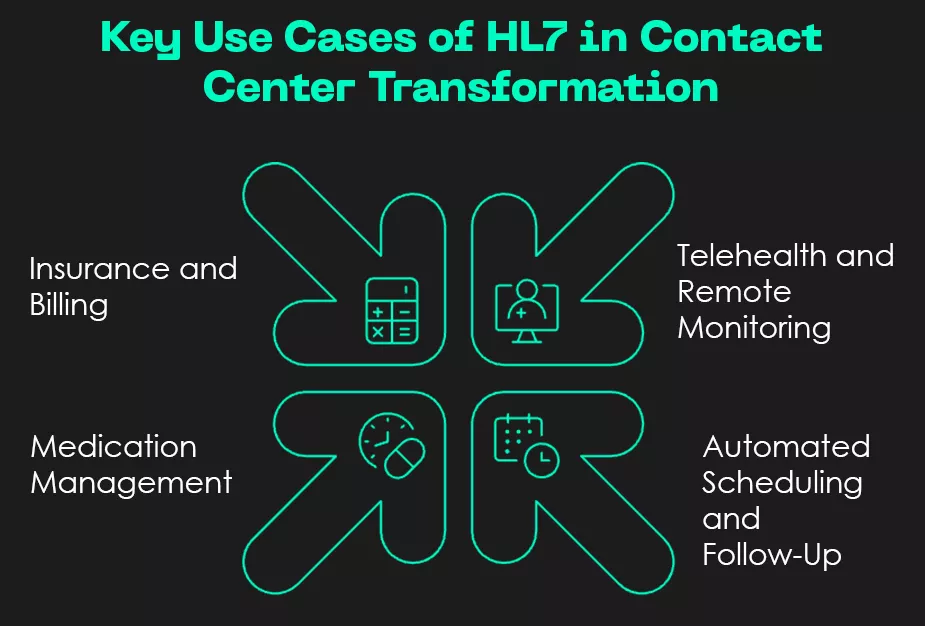
Fig: Key Use Cases of HL7 in Contact Center Transformation
- Telehealth and Remote Monitoring
HL7 powers real-time transmission of patient sensor and wearable device data to EHRs. This enables care teams to proactively reach out when readings suggest intervention is needed, significantly reducing risks for chronically ill or high-risk patients. - Automated Scheduling and Follow-Up
When lab results become available or a patient visit is due, HL7-triggered workflows can automatically generate tasks, send reminders, and book appointments—optimizing resource allocation and reducing missed visits. - Medication Management
Pharmacy and prescription data management is streamlined using HL7, enabling contact center staff to coordinate refills, verify medication histories, and answer patient queries quickly and safely. - Insurance and Billing
HL7 automates the handoff between front office scheduling and back office billing, allowing real-time insurance verification, claim status updates, and accelerated reimbursement cycles.
Let’s also consider the challenges.
Challenges and Considerations in HL7 Implementation
Although HL7 is a core enabler of interoperability, its implementation comes with these challenges:
- Different versions (V2, V3, FHIR) require planning for backward compatibility.
- Mapping legacy data formats to HL7 can be complex for older systems.
- Ensuring continued compliance with evolving security standards and local regulations.
Best practice involves using integration engines (middleware platforms) that translate, route, and validate HL7 messages between connected systems. This simplifies the technical complexity for healthcare organizations.
The Future: Next-Generation Contact Centers Powered by HL7
The future could hold the following:
- Artificial Intelligence and HL7
- Personalized, Proactive Patient Care
- Omnichannel Ecosystem
- Expanding Collaboration
Artificial Intelligence and HL7
With HL7 as a foundation, artificial intelligence and machine learning tools are set to revolutionize the contact center. By feeding live, standardized data into algorithms, healthcare providers can:
- Predict patient needs and adherence risks.
- Offer personalized engagement and recommendations in real-time.
- Route queries dynamically to the best resource, whether virtual or human.
Personalized, Proactive Patient Care
Next-generation contact centers can engage with patients before an issue arises—reminding about screenings, nudging medication adherence, or flagging risks based on health patterns. This proactive approach is only possible with the connectivity and real-time insight HL7 provides.
Omnichannel Ecosystem
The future is “channel agnostic.” Whether patients prefer phone calls, chat, web self-service, apps, or telehealth, HL7 ensures their data—and their story—travels with them, supporting a seamless, unified experience.
Expanding Collaboration
HL7 and FHIR are making it easier to extend interoperability beyond just care providers, bringing pharmacies, insurers, diagnostic labs, and public health bodies into shared workflows.
The digital contact center, empowered by HL7 and FHIR, stands at the core of next-generation healthcare. From unifying communications and automating routine workflows to powering AI-driven insights and proactive patient engagement, HL7 is not just a technical standard. It is the catalyst for better, safer, and more personalized care throughout the healthcare journey.
Healthcare organizations embracing HL7 are poised to set new benchmarks in efficiency, patient satisfaction, and operational resilience, ensuring their readiness for the dynamic, data-driven future of medicine.
Contact us at Nitor Infotech to learn about the progress we are making in healthcare IT.
Also visit the link to discover information about our healthcare software services.