

I think the most dangerous AI isn’t the one that becomes too intelligent – it’s the one whose intelligence we cannot understand. In the gap between capability and explainability lies the true frontier of AI risk. Imagine a healthcare AI recommending an unconventional treatment without explanation, or a financial algorithm denying your loan application with no justification. Would you trust them? This question lies at the heart of AI’s greatest challenge today: the need for explainable AI that can help us understand how and why machines make the decisions they make.
While increasingly sophisticated machine learning models drive efficiency and innovation across industries, their often-opaque nature—what researchers call the “black box problem” – has become AI’s Achilles heel. As Stanford’s 2023 AI Index Report revealed, over 65% of surveyed organizations cited “lack of explainability” as the primary barrier to AI adoption, ahead of both cost and technical complexity.
Explainable AI in 2025 represents a mature approach to artificial intelligence that prioritizes transparency and interpretability alongside performance. Unlike traditional “Black box” systems, modern XAI provides clear, understandable explanations for its decisions and actions in real-time. It encompasses autonomous agents that can justify their reasoning, predictive models that show their work, and decision-making systems that build trust through transparency.
XAI now includes interactive explanations tailored to different user expertise levels, from technical developers to end consumers. It’s become essential for regulatory compliance, ethical AI deployment, and maintaining human oversight in increasingly autonomous systems across industries like healthcare, finance, and autonomous vehicles.
Looking toward 2025, Explainable AI (XAI) has evolved from a desirable feature to a strategic imperative, closely linked with the emerging paradigm of agentic AI. In this blog, I volunteer to help you explore this critical intersection of transparency, trust, and autonomous capability that will define AI’s next chapter.
The Evolving Definition of Explainability
In AI’s early days, explainability meant simple post-hoc justifications—providing basic rationales after a decision was made. Techniques like feature importance scores and LIME (Local Interpretable Model-Agnostic Explanations) offered limited insight. But as Meta’s researchers demonstrated in their 2023 study “Beyond Post-hoc Explanations,” these techniques explained less than 40% of model behavior for complex decisions.
Today’s AI landscape demands a more sophisticated approach, especially for systems powering autonomous agents. Now in 2025, organizations are shifting toward inherently explainable AI – designing systems with transparency as a foundational AI characteristic rather than an afterthought. This evolution encompasses:
Evolution towards XAI
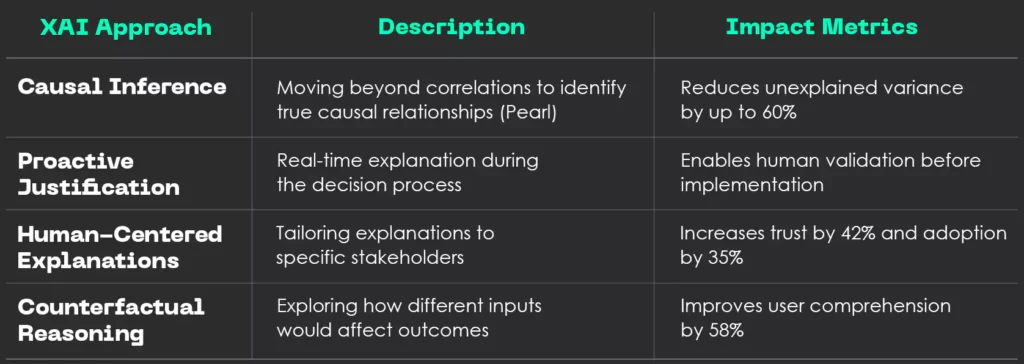
Fig: Evolution towards XAI
As our understanding of explainability continues to mature, a new paradigm is emerging. It promises to revolutionize how AI systems interact with humans and their environment.
Agentic AI: The New Frontier for XAI
Have you considered how much authority you’d delegate to an AI that can act autonomously but can’t explain its reasoning? This question has become increasingly relevant as agentic AI – systems capable of autonomous perception, reasoning, action, and learning – transitions from theory to widespread implementation.
The stakes are high: Gartner says that in 2025, organizations with transparent, explainable AI agents will achieve 30% higher ROI on AI investments than those deploying opaque systems. But the challenges are equally significant.

Make your AI journey more meaningful by harnessing the most promising capabilities of technology.
Key Challenges in Agentic XAI:

Fig: Key Challenges in Agentic XAI
- Chain of Reasoning: Tesla’s autonomous vehicle AI makes approximately 60 micro-decisions per second while driving. Explaining each step in this complex reasoning chain requires new approaches to “traceable intelligence” that goes beyond simple input-output explanations.
- Goal Alignment: Without clear explanations of an agent’s objectives, misalignment can occur. The infamous case of an investment algorithm at Knight Capital that lost $440 million in 45 minutes illustrates the catastrophic potential of misaligned AI goals.
- Dynamic Context: JP Morgan’s AI agents for fraud detection now include contextual awareness modules that explain how environmental factors influenced decisions, reducing false positives by 27%.
- Model Orchestration: When multiple models work together, the explanation becomes exponentially complex. IBM’s research on “ensemble explainability” provides frameworks for understanding these interactions that have been adopted by leading financial institutions.
To better understand how these challenges are being addressed in practice, let’s examine how one of AI’s leading research labs is tackling the explainability problem head-on.
Case Study: DeepMind’s Explainable Agents
Imagine you got a new video game, but the controller had no labels and randomly changed what each button did. Pretty frustrating, right? That’s kind of what using advanced AI systems can feel like when they don’t explain their decisions.
Leading organizations are embedding explainability from the design phase. Google DeepMind’s Agent57 uses knowledge graphs and symbolic reasoning alongside neural networks, creating hybrid architectures that balance high performance with interpretable decision paths.
Agent57 can play Atari games better than humans. It’s a big deal because it doesn’t just excel at one game (like chess) but can handle 57 different Atari games—from Pac-Man to Space Invaders, each requiring different strategies.
But what makes Agent57 special for our discussion is how it’s designed to be more understandable. Instead of being just one giant black box (like most AI), it uses what tech folks call a “hybrid architecture.”
Think of it like this: Most AI is like having a super-smart friend who’s terrible at explaining their thinking. They just say “Trust me” a lot. Agent57 differs because it combines two approaches:
- Neural networks (the typical “black box” part) that are amazing at pattern recognition. This is like how you instantly recognize your friend’s face without consciously thinking about it.
- Knowledge graphs and symbolic reasoning work more like logical thinking—step-by-step processes that can be traced and explained, similar to solving a math problem.
What does this mean in real-world terms? This is like the difference between the following kinds of AI:
- An AI that just tells your doctor, “This patient needs medication X” (traditional approach)
- An AI that says, “This patient needs medication X because they show patterns A, B, and C in their test results, which match previous cases where this treatment was successful” (explainable approach)
Companies are learning that making AI explainable isn’t just about being nice. It’s practical. When self-driving cars make decisions, when loan applications get approved or denied, or when medical treatments get recommended, people need to understand why.
By designing AI systems like Agent57 with explainability from the start, these companies are creating technology that’s not just powerful but trustworthy. After all, would you rather have a brilliant friend who can never explain their thinking, or one who’s just as smart but can walk you through their reasoning?
Building on these technological breakthroughs, forward-thinking organizations need practical approaches to incorporate explainable AI into their operations and strategic initiatives.
Business Strategies for Successful XAI Implementation
What separates organizations that successfully implement XAI from those that struggle? McKinsey’s 2024 State of AI report reveals that companies with mature XAI practices achieve 25% higher AI-driven revenue growth and 34% greater cost reductions than industry peers. The business benefits extend far beyond regulatory compliance:
- Enhanced Trust & Adoption: Bank of America found that explaining AI-driven investment recommendations increased customer acceptance by 41% and subsequently boosted portfolio adjustments by 28%.
- Improved Decision-Making: When Mayo Clinic introduced explainable diagnostics AI, physician override rates dropped from 31% to 12%, while diagnostic accuracy improved by 17%.
- Risk Mitigation: Analysis of 347 AI-related incidents between 2020-2023 showed organizations with robust XAI frameworks experienced 58% fewer costly AI failures.
- Innovation & Optimization: Understanding why models perform well unlocks iterative improvement. Spotify’s explainable recommendation engine has driven a 23% increase in user engagement since implementing transparent AI systems.
With these strategies in mind, organizations need a clear path forward to transform theoretical benefits into practical implementations.
XAI Implementation Roadmap
To capitalize on these benefits, forward-thinking organizations are following clear implementation roadmaps:
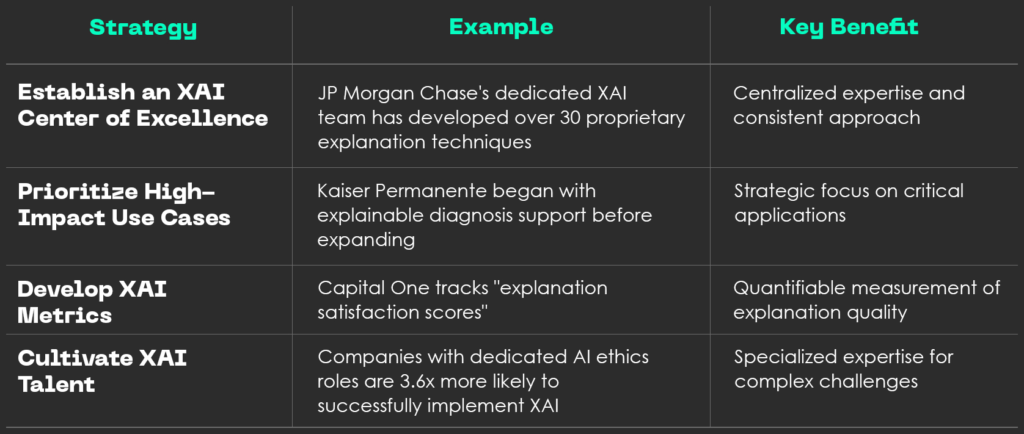
Fig: XAI Implementation Roadmap
As we navigate this implementation journey, it’s crucial to understand the rapidly evolving technical ecosystem that’s making explainable AI more accessible and powerful than ever before.
The Technical Landscape: Tools & Techniques Evolving in 2025
The XAI toolbox keeps growing as calls for transparency rise. While established techniques like SHAP (SHapley Additive exPlanations) remain relevant, innovative approaches are emerging:
Cutting-Edge XAI Technologies
- Neuro-Symbolic AI: By integrating Neural networks with symbolic reasoning, these hybrid systems achieve both high performance and interpretability. Researchers at MIT demonstrated that neuro-symbolic models can match deep learning accuracy while providing human-readable explanations for 94% of decisions.
- Causal Discovery Algorithms: Amazon’s recently open-sourced “CausalGraph” framework automatically uncovers cause-effect relationships within data, reducing explanation time from weeks to hours for complex supply chain models.
- Explainable Foundation Models: Antropic’s work on “interpreter heads” within large language models allows these systems to trace reasoning paths and explain how different components contributed to outputs. This is critical for sophisticated agentic systems.
- Federated Explainability: Techniques developed by Apple allow explanation of models trained on decentralized data without compromising privacy, solving a critical challenge for healthcare and financial applications.
As these tools mature and become more sophisticated, we’re witnessing a remarkable shift in who can leverage explainable AI capabilities and how widely these technologies can be deployed.
Democratization of XAI
Cloud platforms are democratizing these advanced capabilities. Google Cloud’s Explainable AI suite now integrates with over 200 model types. Meanwhile Microsoft’s Azure Cognitive Services includes explanation capabilities accessible through simple APIs, dramatically reducing implementation barriers.
While expanding access to XAI creates tremendous opportunities, it also amplifies the importance of establishing strong ethical foundations for these increasingly influential systems.
Looking Ahead: Ethical AI Considerations and the Future of Trust
As we navigate 2025, ethical implications of XAI become increasingly critical. The EU AI Act’s “right to explanation” provision signals a regulatory future where transparency isn’t optional. But beyond compliance, organizations are grappling with profound questions:
Key Ethical Challenges in XAI
- Algorithmic Bias: Goldman Sachs’ controversial credit card approval algorithm demonstrated how seemingly “black box” decisions can perpetuate bias. Their subsequent investment in XAI tools revealed and corrected unintended gender bias. This resulted in 23% more approvals for qualified female applicants.
- Explainability vs. Fidelity: Meta researchers documented the “accuracy-explainability tradeoff,” finding that each 10% increase in model interpretability typically reduced accuracy by 2-4%. However, emerging techniques from Stanford’s HAI lab have narrowed this gap to less than 1% for most applications.
- Explanation Manipulation: A concerning study from Cornell Tech demonstrated how explanations could be engineered to hide problematic decision factors while appearing transparent. This highlighted the need for explanation verification standards.
- Regulatory Landscape: The EU’s “Right to Explanation” is just the beginning. Twenty-seven countries now have some form of algorithmic transparency requirement, with penalties for non-compliance reaching up to 6% of global annual revenue under the most stringent frameworks.
The future of AI depends fundamentally on building systems worthy of trust. As Andreas Holzinger, pioneer in XAI research, notes:
“In high-stakes domains, an unexplainable AI system, no matter how accurate, will ultimately fail to gain adoption. Explainability isn’t just a technical challenge—it’s the bridge between powerful AI and human acceptance.”
How do Explainable AI and Responsible AI Work Together?
Have you ever had a friend make a decision but refuse to tell you why? Pretty frustrating, right? That’s basically what happens with many AI systems today – they make decisions without explaining their reasoning.
Explainable AI is like having an honest friend who not only makes decisions but tells you exactly why. Instead of just saying “you didn’t get the loan” or “take this medication,” explainable AI shows its work, kind of like when you were in school, your math teacher asks you to show how you solved a problem.
Responsible AI, on the other hand, is about making sure AI systems are fair, ethical, and safe. It is like making sure your friend isn’t making decisions that hurt people or discriminate against them.
Here’s how they connect: You can’t have truly responsible AI without explainability.
Imagine you’re applying for your first college loan. An AI is responsible for reviewing your application. It reviews your application and rejects it. If the AI can’t explain why (lack of explainability), how would you know if it rejected you for valid reasons or because it’s biased against people from your neighborhood (a responsible AI issue)?
Or think about social media. When AI recommends videos to you, explainable AI would help you understand why you’re seeing certain content. This transparency helps ensure the recommendations aren’t pushing harmful content or creating unhealthy echo chambers—key concerns of responsible AI.
Another example: self-driving cars. If a self-driving car makes a sudden decision to change lanes, explainable AI would help us understand why it made that choice. This explanation is crucial for determining if the AI is making safe, responsible decisions in different driving situations.
Explainable AI is like using a flashlight in a dark room of algorithms. Once we can see what’s happening, we can better ensure the AI is behaving responsibly, treating everyone fairly, protecting privacy, and making decisions that help rather than harm people.
Without explainability, responsible AI is just a promise without proof. When AI systems can explain themselves, we can hold them (and the companies that create them) accountable, making sure they’re working for everyone’s benefit, not just a select few.
The continued expansion of artificial intelligence is reshaping industries and operations worldwide. While increasingly sophisticated models drive efficiency and innovation, the challenge of opacity threatens adoption, limits confidence, and raises regulatory concerns.
In 2025, Explainable AI has become not just a technical consideration, but a strategic imperative intimately connected with the rise of agentic systems.
Organizations that invest in explainability now will establish competitive advantages in AI trustworthiness, regulatory compliance, and user adoption. The focus has shifted decidedly from simple justifications to demonstrating the reasoning behind decisions – building confidence and enabling proactive governance.
As AI systems gain greater autonomy, the ability to explain their actions becomes not just beneficial but essential for responsible deployment and human-AI collaboration.
“In high-stakes domains, an unexplainable AI system, no matter how accurate, will ultimately fail to gain adoption.” – Andreas Holzinger, Pioneer in XAI Research
The AI revolution isn’t coming – it’s already here. While this blog has shown you the transformative potential of explainable AI, many organizations struggle with the practical implementation and integration of these technologies into their existing business processes.
Visit us at Nitor Infotech, an Ascendion company to explore our generative AI services and discover how we can help you build responsible, explainable AI systems that transform your business while maintaining transparency and trust. Contact us today!