
Highlights
The Transforming Episode Accountability Model (TEAM) from the Centers for Medicare & Medicaid Services (CMS), will be launched in January 2026. This model will upgrade surgical reimbursement by replacing multiple payments with a single bundled payment. This will include everything from consultation to recovery.
Participating hospitals must ensure accountability for costs and quality across five major surgical episodes. These would be supported by detailed reporting and equity requirements. With an emphasis on excellent care coordination and superior analytics, providers who prepare now can streamline operations, manage risk, and succeed in value-based, patient-centered surgical care.
The way healthcare pays for surgery is on the verge of a seismic shift. For decades, hospitals and physician groups have had to navigate a complex web of individual bills, inconsistent reimbursements, and administrative back-and-forth that often left patients confused, and healthcare providers overburdened. Each procedure, follow-up, and specialist visit came with its own invoice, turning what should be a smooth care journey into a paper-heavy obstacle course. However, the Centers for Medicare & Medicaid Services (CMS) is ready to rewrite that playbook. Their upcoming TEAM (Transforming Episode Accountability Model) is designed to bring order to chaos.
Instead of multiple payments for each step of surgical care, TEAM introduces a single bundled payment that covers the entire process, from the initial consultation through recovery.
In this blog, we’ll break down what the TEAM model entails, why it matters, and what it could mean for hospitals, doctors, and patients. We’ll also focus on answering what changes to expect, and what steps your organization can take now to ensure you’re ready when the model goes live.
So, let’s begin by taking a closer look at the TEAM model.
What Is the CMS TEAM Model?
The TEAM Model is a mandatory, value-based care initiative that will hold participating hospitals financially accountable for the costs and quality of certain surgical care episodes.
It builds on the lessons from previous bundled payment models, like BPCI Advanced (Bundled Payments for Care Improvement Advanced) and CJR (Comprehensive Care for Joint Replacement). Plus, it takes it a step further by focusing more directly on equity, care coordination, and multi-provider collaboration.
Note: Starting January 2026, this model will ask hospitals and physician groups to coordinate like never before, aligning financial incentives with patient outcomes. It’s a challenge, yes—but also a powerful opportunity.
Healthcare providers who will start strategizing today can streamline operations, improve collaboration across care teams, and stand out as innovators when the new rules take effect.
Next, let’s explore the key features of the TEAM model.
What Are the Key Features of TEAM?
Here are some of the key features of the TEAM model:
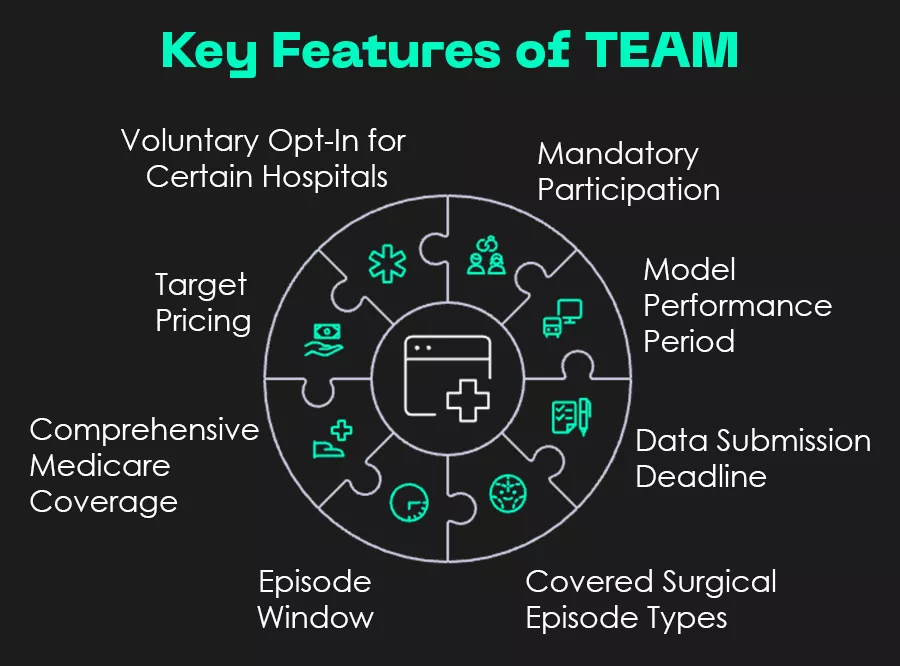
Fig: Key Features of the TEAM Model
1. Mandatory Participation: Acute care hospitals located within the Core-Based Statistical Areas (CBSAs) are required to participate. This ensures consistent implementation across large population centers, helping CMS test the model’s impact on a wide scale.
2. Model Performance Period: TEAM will run for five full 12-month performance years (PY) starting from 1st January 2026 and ending 31st December 2030. This five-year span will provide hospitals and physician groups enough time to adapt, measure results, and refine their care practices.
3. Data Submission Deadline: The deadline for submission of clinical data and quality data is in CY 2031. This extra time allows providers to finalize reporting after the performance period while maintaining accountability.
4. Covered Surgical Episode Types: It focuses on five surgical procedures, each treated as a single ”episode of care”.It includes:
- Major bowel procedures – surgeries involving the large intestine or rectum.
- Surgical treatment of hip or femur fracture – from initial repair to post-operative recovery.
- Coronary artery bypass graft (CABG) – heart bypass operations and related follow-up care.
- Lower extremity joint replacement – such as hip or knee replacements.
- Spinal fusion – surgeries to stabilize the spine.
These episodes represent high-volume, high-cost surgeries where coordinated care can significantly improve outcomes and control expenses.
5. Episode Window: Every episode starts on the day of the inpatient admission/outpatient procedure and lasts 30 days after discharge/outpatient procedure. This full-journey approach encourages hospitals and physicians to coordinate not just during surgery, but through recovery and follow-up.
6. Comprehensive Medicare Coverage: The bundled payment covers Medicare Part A (hospital services) and Part B (outpatient and physician services) across the entire episode. Patients receive continuous care under one payment, while providers are incentivized to manage resources efficiently.
7. Target Pricing: CMS provides preliminary and final target pricess to participants for each episode. These prices set a clear benchmark, enabling hospitals to plan budgets and identify opportunities for cost savings while maintaining quality.
8. Voluntary Opt-In for Certain Hospitals: Hospitals participating in BPCI and CJR models have the opportunity to opt in voluntarily. This flexibility lets experienced healthcare providers build on existing bundled-payment strategies rather than start from scratch.
Extra info: Here are two examples of how TEAM addresses health equity and finances:
1. TEAM’s Approach to Health Equity
TEAM enables hospitals to share Health Equity plans, report patient demographics, and adjust target prices based on social risk factors.
2. Financial Model of TEAM
CMS sets a target price for each care episode using historical data, regional trends, and episode complexity. Hospitals’ actual spending is compared to this target, along with quality performance, to determine payouts or penalties. Discount and normalization factors ensure medicare savings and fair comparisons across hospitals.
Let’s move onwards to understand the participation tracks and financial risks of TEAM—who’s involved and what’s at stake for each performance year.
What are the CMS Track Options, Eligibility Rules, and Risks for Participants?
Participants are required to notify CMS of their chosen track before the start of each performance year.
Here’s a table outlining the CMS tracks, participant eligibility, and financial risk levels when it comes to the TEAM model:
| Track 1 | Track 2 | Track 3 | |
|---|---|---|---|
| Eligibility | a) All TEAM participants are eligible for Track 1 for PY 1 Safety. b) Net Hospitals are eligible for Track 1 for PY 1, PY2, and PY 3. |
Medicare dependent hospitals, rural hospitals, safety net hospitals, sole community hospitals, and essential access community hospitals are eligible for Track 2 for PY 2, PY 3, and PY 5. | All TEAM participants are eligible for Track 1 for PY 1, PY 2, PY3, PY4, and PY 5. |
| Financial Risk | Upside Risk: The Stop Gain limit is 10%, while there is no Stop Loss limit. |
Limited Upside and Downside Risk: Both the Stop Gain and Stop Loss limits are set at 5%. |
Full Upside and Downside Risk: Both the Stop Gain and Stop Lost limits are set at 20%. |
| Reconciliation Amounts | The maximum Positive Reconciliation Amount is up to 10%. | The maximum Positive Reconciliation Amount is up to 10%. And, the maximum Negative Reconciliation Amount is up to 15%. |
The maximum Positive and Negative Reconciliation Amount is up to 10%. |
| Overall Risk | No Risk | Medium | High |
Next, you’ll know how TEAM links hospital performance to quality measures and the impact on rewards and penalties.
How Does TEAM Measure Care Coordination, Safety, and Patient Outcomes?
In TEAM, quality isn’t just a buzzword—it decides whether hospitals keep their bonus or pay a penalty. The program tracks care coordination, patient safety, and what patients say about their own results (PROs).
Here’s a breakdown of the measures applicable to each episode for every performance year:
| Measure | Episode | Performance Year |
|---|---|---|
| Hybrid Hospital-Wide Readmission | All | PY 1-5 |
| Inpatient THA/TKA PRO-PM | LEJR (Lower Extremity Joint Replacement) | PY 1-5 |
| PSI 90 | All | PY 1 |
| HH-Falls with Injury eCQM | All | PY 2-5 |
| HH-Post-Respiratory Failure eCQM | All | PY 2-5 |
| Thirty-day Risk – Standardized Death Rate among Surgical Inpatients with Complications | All | PY 2-5 |
Now, I’ll guide you through how TEAM hospitals access and use data.
Which Data Will TEAM Use and Share?
CMS will provide access to two kinds of data to TEAM hospitals to conduct quality assessment, quality improvement, and evaluate their performance, namely:
- Beneficiary-identifiable claims data (i.e., data that includes personal identifiers about medicare fee-for-service patients)
- Regional aggregate data (i.e., summary-level data about how care is delivered in the region)
A few more things for you to remember:
The baseline period refers to the three years preceding the performance year.
The beneficiary’s identifiable data will be provided for patients who have started an episode at the hospital or outpatient department.
The data will include only the services and items covered in the episode.
Hospitals can request data by executing a Data Sharing Agreement and submitting a Data Request and Attestation form.

Experience a 50-60% increase in code conversion accuracy. Embrace the power of GitHub Copilot and Visual Studio Code.
With all the updates in mind, the key question is: Is your organization prepared to adopt the TEAM model?
Is Your Organization Prepared for TEAM?
To succeed under the TEAM model, proactive preparation is essential. Here’s a checklist to assess your organization’s readiness:
1. Clinical Pathway Standardization
- Are care teams following evidence-based protocols for surgical episodes?
- Is there alignment across inpatient, outpatient, and post-acute providers?
2. Data Infrastructure
- Do you have tools to track cost and quality performance across the full episode?
- Can your systems report demographic and social determinants data accurately?
3. Care Coordination
- Are case managers involved early and often?
- Is there a structured process to communicate with post-acute and community-based partners?
4. Health Equity Strategy
- Have you identified high-risk populations?
- Do you have a plan for collecting and analyzing HRSN and demographic data?
5. Financial Modeling
- Have you modeled the potential impact of TEAM on your bottom line?
- Are you prepared to take on risk in later years of the model?
These sets of questions will help you identify gaps, prioritize improvements, and ensure your organization is fully prepared to succeed under the TEAM model.
For starters, there are a few key steps you need to follow to implement the model seamlessly. Keep reading to learn those.
What Actions Are Needed to Implement TEAM Successfully?
Here are the necessary steps one can take to implement the TEAM model seamlessly:
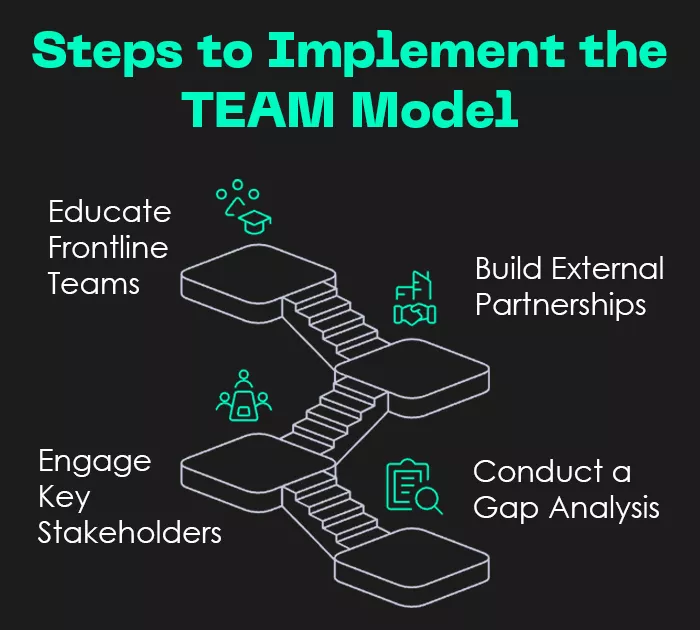
Fig: Steps to Implement the TEAM Model
1. Conduct a Gap Analysis
Benchmark current performance against TEAM requirements to identify weak spots.
2. Engage Key Stakeholders
Bring together clinical, financial, and compliance leaders to align on priorities.
3. Build External Partnerships
Collaborate with home health, SNFs, rehab, and community organizations to strengthen transitions of care.
4. Educate Frontline Teams
Ensure clinicians, nurses, and administrators understand the impact of TEAM on their daily workflows.
So, the CMS TEAM Model represents a pivotal move toward value-based surgical care—and it’s coming fast.
While the model officially begins in 2026, hospitals that start preparing in 2025 will have a strategic advantage. By investing in care coordination, data infrastructure, and equity initiatives today, your organization can avoid penalties. It can also emerge as a leader in delivering efficient, patient-centered care.
However, you don’t have to think on this strategic path alone – we, Nitor Infotech, an Ascendion company, are here to help.
Our seasoned experts can support your success in achieving TEAM goals by guiding you through every aspect of the model. We can help you with advanced tools such as:
- Gen AI to embed AI into financial, clinical, and quality workflows like predictive episode risk, continuous target monitoring, automated quality coaching, etc.
- Claims analytics and episode tracking to monitor performance and manage costs
- Clinical quality measurement tools to streamline quality reporting
- Data integration and interoperability platforms for smooth patient care transitions
- Custom dashboards and reporting engines for track selection impacts, reconciliation forecasting, equity performance, baseline vs. performance year comparison
- HIE integration to enable seamless care coordination
- Care management tools that help cut readmissions and make patient transitions smoother
- Patient engagement and PRO collection tools to capture outcomes and enhance patient-centered care
These solutions will empower you to navigate the TEAM model effectively while driving measurable improvements in care quality and operational efficiency.
To express your views about this blog, write to us. To learn more about us, contact us at Nitor Infotech.