

In the world of modern healthcare, professionals often find themselves overwhelmed by administrative tasks, detracting from patient care. One critical issue is the growing burden of documentation, which can lead to frequent burnout and decreased efficiency. Enter medical scribes—a solution that is revolutionizing healthcare documentation.
In this blog, you will delve into the multifaceted world of medical scribes, examining traditional in-person support, virtual assistance, and the cutting-edge integration of artificial intelligence. By navigating through the nuances of each approach, I aim to highlight the benefits, challenges, and essential considerations for healthcare practitioners.
So, let’s get started!
What is a Medical Scribe?
A medical scribe is a professional who helps doctors by recording patient information, such as medical history and treatments, during or after patient visits. This support enhances the doctor-patient interaction and ensures accurate record-keeping.
They also assist physicians by finding information, managing medical forms, generating referral letters, booking appointments, and organizing medical documents within the Electronic Health Record (EHR) system.
The demand for medical scribes has grown significantly due to several reasons:
- Implementing electronic health records (EHRs) and other health information systems requires more time and effort for documentation and regulatory compliance.
- The increasing complexity and volume of medical information demand greater attention to detail for accurate capture and recording.
- Patients now seek more personalized and engaging care from their providers.
- Growing pressure and workload from administrative tasks lead to healthcare provider shortages and burnout, increasing the need for medical scribes.
Clear with the basics? Great!

Learn how we helped a healthcare provider streamline patient care with a GenAI-powered app, automating history reviews and enhancing doctor-patient communication.
Now, let’s delve deeper into understanding how medical scribes have evolved over the years.
History of Medical Scribing
These 5 stages will help you understand the origins and evolution of medical scribes with ease:
- The concept of medical scribes dates back to ancient civilizations like Egypt, Greece, and Mesopotamia. Physicians in these societies relied on assistants to transcribe medical texts, record observations, and document treatments.
- During the Middle Ages and Renaissance, medical scribes continued to be important. They copied medical knowledge into manuscripts, including detailed diagrams and remedies, shaping the foundations of medical education.
- The Industrial Revolution brought technological advancements, changing healthcare practices. Medical scribes adapted by helping with documentation, correspondence, and medical records, integrating more closely with new technologies.
- In the 21st century, technologies like Electronic Health Records (EHRs) revolutionized healthcare. Medical scribes transitioned to digital platforms, assisting with telemedicine consultations and ensuring accurate patient information in databases. This shift reduced manual paperwork, allowing scribes to focus more on patient care.
- Today’s medical scribes blend tradition, technology, and innovation. They use tools like voice recognition software, mobile apps, and EHR systems to document patient encounters accurately and efficiently, supporting physicians and enhancing patient care.
So, the medical scribes have evolved over centuries, adapting to technological advancements and changing healthcare practices. From ancient civilizations to the digital age, these have shaped the medical field and supported patient care.
Head over to the various types of scribing next!
Types of Medical Scribing
The following table provides a clear explanation of the three types of medical scribing:
| Type | Description |
|---|---|
| In-person medical scribes | During patient encounters providers are accompanied by individuals who document the medical information in real-time. |
| Virtual medical scribes | Individuals document the relevant information in real time by remotely accessing the provider’s audio and video feed during patient encounters |
| AI-powered medical scribes | Artificial intelligence (AI) technologies like natural language processing (NLP), speech recognition, machine learning (ML), and computer vision allow healthcare applications to automatically create clinical documentation from provider-patient conversations. |
You might be wondering about AI-powered medical scribes, right?
Well, the next section is ready to fuel your curious mind; keep reading!
What is AI Medical Scribing and how does it work?
Definition
AI medical scribing is the use of artificial intelligence and natural language processing to automatically generate clinical documentation and notes during patient-provider interactions. It is designed to reduce the administrative burden on healthcare providers, allowing them to focus more on patient care.
The AI scribe utilizes a microphone on a secure smartphone to transcribe patient encounters. It then employs machine learning and natural language processing to summarize the clinical content of the conversation and generate a note documenting the visit.
Advantages of using an AI scribe in different areas of healthcare
Here are the top 4 advantages of using an AI scribe:
- AI scribes in emergency departments reduce documentation time, after-hours work, and burnout for physicians, improving efficiency and quality of care in fast-paced, high-stress environments.
- In primary care, they can enhance documentation accuracy, consistency, and completeness. Thus, they improve workflow efficiency, work-life balance, patient communication, and satisfaction.
- They help radiologists to speed up reporting time, reduce transcription costs, improve report quality, enhance communication with referring physicians, and increase compliance with billing codes, ensuring care coordination.
- By using AI medical scribes, oncologists can save time on documentation, reduce errors, enhance decision-making, improve quality measures, and increase referrals, resulting in increased revenue.
Now let’s understand what gives AI medical scribing an advantage over traditional methods.
Difference between Traditional and AI Medical Scribing
| Feature | Traditional Medical Scribes | AI Medical Scribes |
|---|---|---|
| Cost | High, with expenses related to hiring and training of human scribes. | Cost-effective, with minimal training requirements and no ongoing benefits. |
| Efficiency | Real-time documentation can be time-consuming, making it less efficient. | Real-time note generation reduces the administrative time significantly, making it more efficient. |
| Customization | Customization is very limited. | Easily customizable to meet specific provider needs. The demand for customization is more. |
| Human Interaction | Direct human interaction with patients fosters trust. | Direct human interaction is missing. |
| Accuracy | Human-dependent and prone to transcription errors. | Uses advanced technologies for precise transcription. |
| Privacy and security | If not properly screened or supervised, they could pose privacy and security risks. | Maintains robust data security and privacy protocols. Ex. HIPAA compliance |
Note:
AI medical scribing may face a few challenges including:
- lack of human interaction
- customization requirements to meet specific provider needs
Other potential errors may include misinterpretations further leading to hallucinations, where the AI records incorrect information.
If you want to implement an AI medical scribe for your own organization, I’d recommend you read the next part of this blog.
Implementing AI Medical Scribe for your Healthcare Organization
Here are the 10 steps to implement AI medical scribes effectively for superior healthcare management:

- Evaluate the current documentation workflow and identify problem areas and goals.
- Research and compare different AI medical scribe solutions in terms of features, benefits, and costs.
- Choose an AI medical scribe solution that meets your needs and budget.
- Test the solution in a pilot project with a small group of physicians and patients.
- Collect feedback from the pilot participants and measure the solution’s impact on documentation quality, efficiency, and satisfaction.
- Adjust your workflow and settings to optimize your use of the solution.
- Scale up implementation to include more physicians and patients.
- Monitor performance and outcomes and continue to improve processes.
- Look for AI solutions that are reviewed by real, trained scribes before hitting your EHR.
- Ensure AI improves workflows by making them user-friendly, customizable, and non-disruptive.
Note: Explore these popular AI Scribes and choose the one that suits your business forte:
- Nuance DAX
- Deep Scribe
- Nabla
- Ambience
- Tali
Keep reading for the bonus!
Insights from Research Studies and Early Adopters on AI Scribes
Walk through these 7 pointers to get the insights:
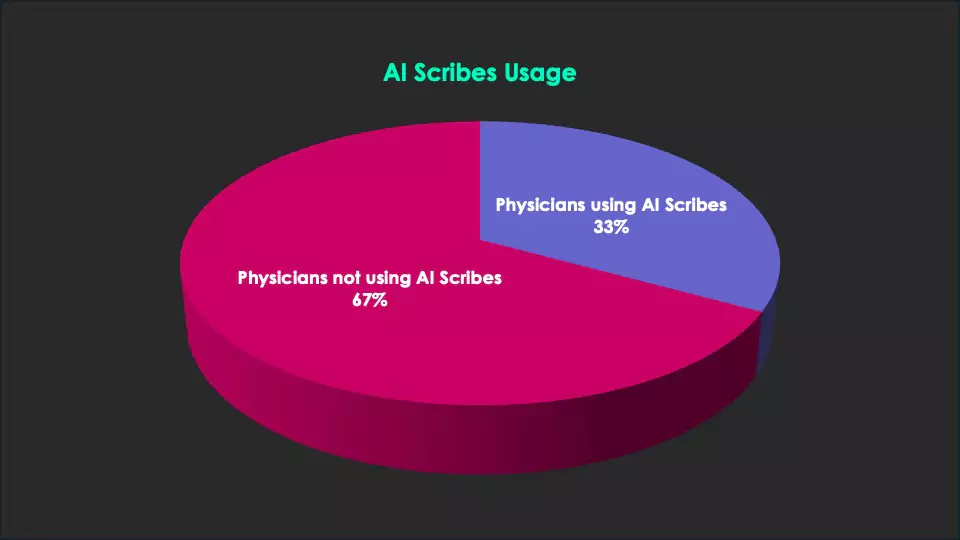
1. A San Francisco-based tech company surveyed 229 primary care physicians (PCPs) about using AI scribes. The results revealed that 67% of PCPs have not tried an AI scribe, while 33% have.
Here’s what the two groups had to say:
a. Feedback from Physicians not using AI scribe (67%):
- They relied on EHR vendors for the best integration options.
- There was a significant lack of confidence in accuracy of AI scribes.
- They experienced poor integration with their existing tools.
- They didn’t have the time to research.
b. Feedback from Early Adopters (33%):
- There was a noticeable dissatisfaction with current solutions.
- They expressed a need for advanced features like template personalization, patient education materials, and automation of repetitive tasks (lab, imaging, and referral orders).
2. Medscape conducted a survey that highlights the impact of AI Medical Scribes on a physician’s professional life, comparing the before and after scenarios. The findings suggest that with the help of AI scribes, doctors can now use the extra time in their schedules to see an additional 5-6 patients. Here are the results:
a. Before AI Medical Scribes:
- Documentation time was at least 15–20 minutes.
- Non-clinical charting time was 3+ hours.
b. After AI Medical Scribes:
- Documentation time was reduced to 3 minutes.
- Non-clinical charting time reduced to 1 hour.
3. During a pilot study, 3,442 physicians from 21 locations in Northern California adopted a new scribe technology tool. Over 10 weeks, they utilized the tool in 303,266 patient encounters. Notably, 968 physicians used the tool more than 100 times.
At the beginning of the study, weekly usage was around 20,000 instances. Over the next ten weeks, this number surged, reaching over 30,000 instances in seven of those weeks.
Here, both physician adoption and AI scribe usage increased significantly.
4. Rothman’s research focused on reducing burnout among physicians’ clerical teams. Researchers carried out 118 clinical encounters, employing 30 AI scribes, 28 transcription services, 30 VRMs, and 30 medical scribes.
This study showed that AI scribes struggled to form medical plans and needed verification and correction. However, AI notes were faster than VRMs and transcription services.
5. An obstetrician and gynecologist in Enid, Oklahoma, said that she now spends just 3 minutes on documentation per patient visit, down from 15 to 20 minutes. Also, her charting time outside clinic hours has been cut from 2-3 hours to just 1 hour.
6. One provider said he might need to edit transcripts lightly. He said, “When someone tells me how long their knee hurts, slight variability in their transcribed words is tolerable”. However, for things like physical exam notes and x-ray readings, he speaks directly into the device, clearly and precisely.
7. A study on AI-generated visit summaries showed high performance across various specialties in a subsample of 35 notes. While the AI scribes produced high-quality notes, they weren’t flawless. Here’s what it looks like:

Quick info: Should you inform patients about being recorded?
HIPAA (Health Insurance Portability and Accountability Act) doesn’t mandate providers to inform patients about recording face-to-face conversations. However, state laws and healthcare policies may require providers to inform patients and obtain their consent before recording.
So, physician burnout is a pressing issue, with US clinicians spending twice as much time on documentation as they do on patient care. This has led to about half of doctors, especially in primary care, feeling burned out, and some 42% considering leaving clinical practice.
AI-powered medical scribes offer a solution by automating notetaking, but their adoption is limited due to cost, integration, and trust concerns. Hence, the “human in the loop” approach, where physicians review AI-generated notes, is key to overcoming these barriers. As AI technology improves, it has the potential to transform burnout into rest for healthcare professionals, allowing them to focus on patient care.
Want to know more about the impact of AI and GenAI? Feel free to reach out to Nitor Infotech.